CastleBaden

Rauheneck Castle

Rauheneck Castle

The remains of the Castle can be visited

Rauheneck Castle is a castle ruin located 2.5 km west of the city center of Baden bei Wien in Lower Austria. The ruin is situated on a foothill of the Lindkogel on the right bank of the Schwechat river. In the Middle Ages, together with the opposing Rauhenstein Castle and Scharfeneck Castle, it secured the trade route from Baden through the Helenental valley via Heiligenkreuz to the Triestingtal valley.

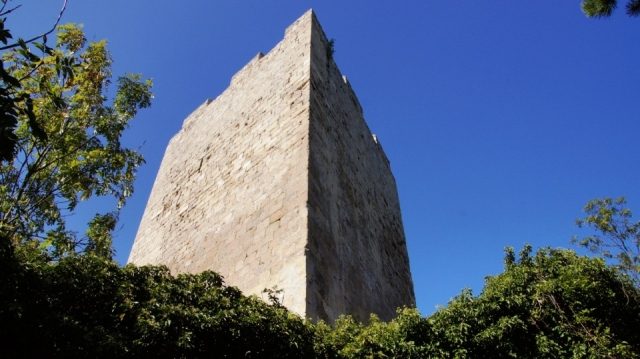
Then as now, a wooden bridge leads over a deep neck ditch to a semi-circular outer bailey with a 25-meter-high, triangular keep. In the inner courtyard, protected by eight-meter-high walls with an attached kitchen and pantry, was formerly the palas, from which the keep was reached. In another annex, which was only built in the 14th or 15th century, there were residential buildings and a chapel.

Hartung von Ruhenekke is first mentioned as the initial owner of Rauheneck in an undated document (around 1130). The Rauhenecker family (who called themselves "Tursen" after 1200) colonized the forest at the foot of the castle in the 12th and 13th centuries, where a ring of small villages was established. The lords of the castle demanded only very low (money) taxes and forestry services from their subjects in the villages.

In 1384, the Tursen lineage died out, and the possessions passed to the Walseer family. In its eventful history, the castle was destroyed several times but always rebuilt, sometimes even expanded.

In 1477, the Serbian troops of Hungarian King Matthias Corvinus stormed the castle and destroyed it; a reconstruction is unlikely to have taken place afterwards. The final destruction of Rauheneck Castle occurred in 1529 by the Turks.

The ruin was later acquired by the Doblhoff family and made accessible to visitors in 1810. In 1961, the city of Baden acquired the castle hill with the ruin and had it renovated.

Legend+

According to legend, the builder of the tower wanders as a ghost in the castle. He will not be redeemed until a cradle is fashioned from the wood of an oak tree that has grown from the masonry of the keep, and a Sunday child is rocked in it, who later enters the priesthood. However, a storm destroyed the tree more than a hundred years ago, so the old spirit must continue to wander lamenting.

Nearby+

Near the castle is the Königshöhle (King's Cave), where significant finds from the Baden culture were made during archaeological excavations.

Take Mobile History with you

You are reading this text for free. Premium adds what matters on the road: descriptions read aloud, sites found through your camera, whole regions taken offline.

  • Every description, including the ~17,700 Premium sites
  • Audio guide: have descriptions read to you on location
  • AR finder: see sites through your camera, with distance and bearing
  • Unlimited saved sites

14 days free, then from €2.99 a month. Cancel anytime.

Source: Wikipedia · Licence: CC BY-SA 4.0 · Image: http://www.wehrbauten.at/noe/niederoesterreich.html

This description draws on the facts documented in the linked Wikipedia article; Wikipedia content is licensed under CC BY-SA 4.0. Wording and editing: Mobile History.

Location: 48.0064, 16.2049