The castle ruins can be visited
CastleThüngersheim
Ravensburg Castle
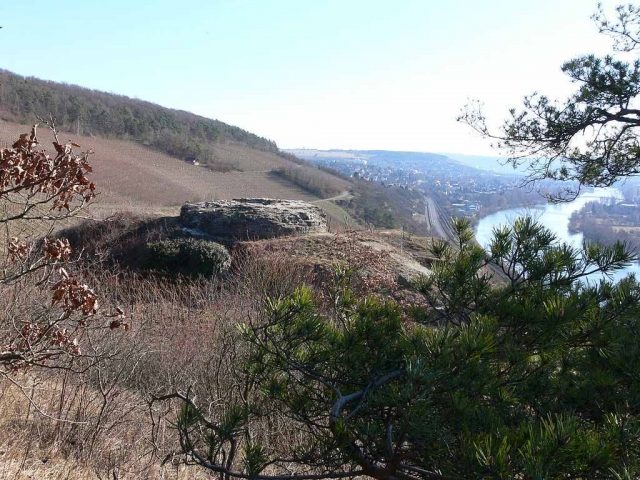
The Ravensburg ruin, also called Rabensburg in the oldest records, is a castle ruin from the Staufer period south of Thüngersheim in Franconia.
Around 1170, the Lords of Würzburg, vassals of the Bishop of Würzburg and the Empire, built a hilltop castle on the Ravensberg between Veitshöchheim and Thüngersheim. They named themselves after their seat, the Lords of Ravensburg. In 1178, a Heinrich von Ravensburg is first documented with this name. Together with the feudal lords of Falkenberg Castle, located high above Erlabrunn on the opposite side of the Main, the Ravensburgers dominated the Main valley north of Würzburg. They held a powerful position in the Prince-Bishopric of Würzburg until, on December 3, 1202, Bodo von Ravensburg and Heinrich von Falkenberg were found guilty of the murder of Bishop Konrad von Querfurt of Würzburg. As a punitive measure, the castles Ravensburg on the Ravensberg and Falkenberg on the Volkenberg were razed, and the castle lords and their helpers were excommunicated by Pope Innocent III. Although the Ravensburgers and Falkenbergers were able to free themselves from the ban under strict conditions and partially regain their old property rights, a reconstruction of the castles was no longer possible. The legendary history of Ravensburg and Falkenberg Castle was depicted in the open-air play "Gebrochene Schwingen" (Broken Wings), which was performed in Erlabrunn from 1995 to 2005. The performance was revived in 2009 on the occasion of Erlabrunn's 800th anniversary. In 2023, a digital reconstruction of the castle complex was presented to the public as part of the local courtyard festival.
Description+
The Ravensburg originally occupied the entire rock spur in a trapezoidal extension. The length of the enclosing walls on the north, west, and east sides was about 40 meters, and on the south side about 30 meters. A deep neck ditch secured access to the castle, which was only possible via a drawbridge. Beyond this ditch lay the outer bailey, consisting of outbuildings that served to supply the castle inhabitants.
Source: Wikipedia · Licence: CC BY-SA 4.0 · Image: http://de.wikipedia.org/wiki/Datei:Ravensburg_Thuengersheim_Blick_nach_Sueden.jpg
This description is a machine translation of an excerpt from the linked Wikipedia article. The source text was written by its authors, the translation is by Mobile History; like the original it is licensed under CC BY-SA 4.0.
Location: 49.8515, 9.8652