The castle ruins can be visited.
CastleAub - Baldersheim
Reichelsburg Castle
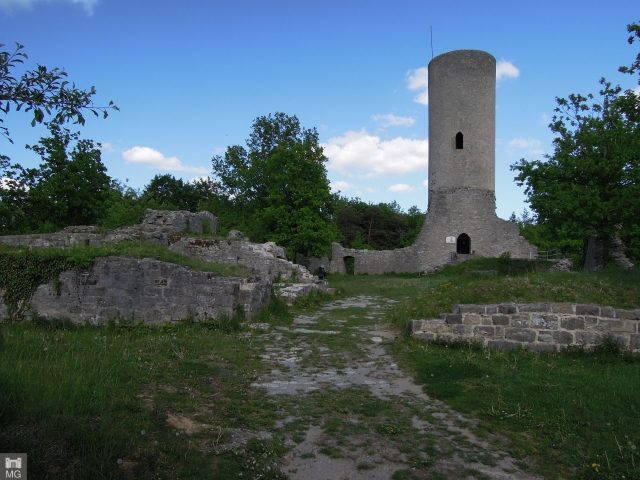
The Reichelsburg, also known as Reichelsberg Castle, is the ruin of a late medieval hilltop castle of the Prince-Bishopric of Würzburg. It is located near the village of Baldersheim, now part of the town of Aub, in the district of Würzburg in Bavaria.
Reichelsberg Castle was first mentioned as "Reigirberc" around 1230 as property of the brothers Gottfried and Konrad von Hohenlohe-Brauneck, whose ancestral seat, Brauneck Castle, was located six kilometers south of Aub and is partly still preserved. The castle mentioned in 1230 was probably a predecessor building to the current castle ruin. The feudal lord of the Reichelsberg dominion, which included the fortress and the villages of Baldersheim, Burgerroth (both now part of Aub), Bieberehren, and Buch (now part of Bieberehren), was the Prince-Bishopric of Bamberg. In 1338, Gottfried III von Hohenlohe-Brauneck and his wife Margareta founded a chapel at Reygerberch. In 1390, with the death of Konrad IV, the Hohenlohe-Brauneck line, which owned, among others, Creglingen and the "six Main villages" around Obernbreit/Marktsteft, died out. The Prince-Bishopric of Bamberg confiscated the fief and exchanged it for other properties with the Prince-Bishopric of Würzburg. In 1401, the Imperial Arch-Chamberlain Konrad von Weinsberg, who had married Anna von Hohenlohe-Brauneck, the widow of Konrad IV, in 1396, received Reichelsberg as a fief from the Würzburg Bishop Johann von Egloffstein. In 1425, four cannons ("Klotzbüchsen") were located at Reichelsburg. After Konrad von Weinsberg's death in 1448, he was succeeded by his sons Philipp the Elder (also an Imperial Arch-Chamberlain) and Philipp the Younger (a clergyman), both of whom lived together at Reichelsburg. Under the rule of Philipp the Elder, Reinhardt Truchsess von Baldersheim became bailiff at Reichelsburg in 1477. In the 15th century, the Weinsbergs also controlled the small town of Aub together with the Truchsesses and, at times, the Rosenbergs. After the male line of the Lords of Weinsberg died out, the castle passed to Philipp the Elder's daughter, Countess Katharina von Königstein, who sold the Weinsberg share of Reichelsburg to Prince-Bishop Konrad von Thüngen for 49,000 guilders in 1521. From 1521, the castle thus belonged entirely to the Prince-Bishopric of Würzburg; it was no longer enfeoffed but inhabited by Georg von Rosenberg as bailiff of the Prince-Bishopric. On April 22, 1525 (Saturday after Easter), Reichelsburg, like Brauneck Castle, was plundered and partially destroyed by rebellious peasants during the Peasants' War, so that Georg von Rosenberg moved to Aub Castle. The castle was later partially restored and continued to be inhabited, but had lost its significance. In 1669, the Reichelsberg office was dissolved, and in the early 18th century, it fell as a fief to the Barons von Schönborn. However, this was only the granting of a title. The Schönborns never owned property in the Reichelsburg/Aub area. From about 1750, Reichelsburg was no longer inhabited and fell into disrepair. In the first half of the 19th century, the still reasonably well-preserved castle was gradually demolished by the inhabitants of the surrounding villages, who used the stones for building their own houses. Protests against this remained ineffective. Only in 1900 did the Aub Beautification Association, founded 15 years earlier, set about securing and restoring the ruin.
Source: Wikipedia · Licence: CC BY-SA 4.0 · Image: Mobile Geschichte
This description is a machine translation of an excerpt from the linked Wikipedia article. The source text was written by its authors, the translation is by Mobile History; like the original it is licensed under CC BY-SA 4.0.
Location: 49.5465, 10.0509