CastleReichenau im Mühlkreis

Reichenau Castle
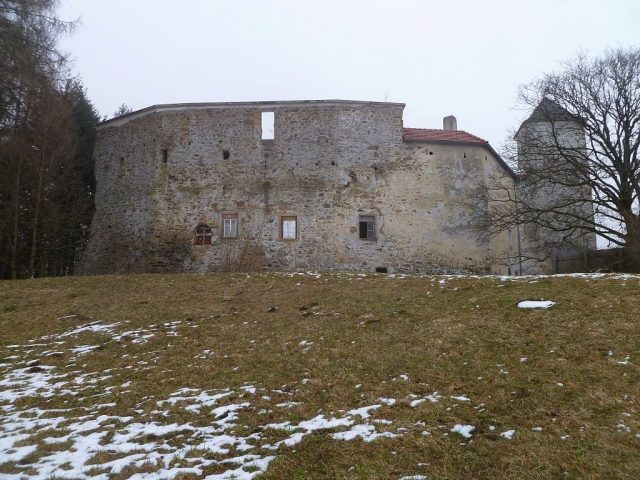
Reichenau Castle

Cultural Events

The castle ruin Reichenau (also: Reichenau Castle Ruin) is a castle ruin in Upper Austria and is located in the municipality of Reichenau in the Mühlviertel. The castle was built around 1315 and has been owned by the Starhembergs since 1630. In 1750, the castle was converted into a palace, from 1930 it became a ruin, which was only superficially renovated in the 1960s. The inner courtyard now serves as a venue for the "Reichenau Castle Festival".

Name+

The name, rather untypical for a hilltop castle with the ending -au, is probably to be seen in connection with the predecessor castle in the valley, to which the first documented mentions also refer: Middle High German ouwe means a piece of land surrounded by water. Reichenau lies in a narrow valley on the Große Gusen, which is formed in the village by the confluence of the Rohrbach and Grasbach. Rîch or rîche (= rich, powerful, precious) in connection with -au probably indicates the scenic or economic wealth of the area. It is worth mentioning in this context that the rows of fruit in the fields visible on the Vischer engraving can be seen as grapevines. Wine could be cultivated in the Mühlviertel due to the climatic conditions in the Middle Ages - this is also indicated by the place name of Schloss Weinberg. From the name parts, the composite name Reichenau arose through the dative place name designation (zur) reichen Au, customary in the Middle Ages.

Older documented mentions suggest a predecessor complex in the valley near the village of Reichenau. As early as 1209, a Salmannus de Richenowe is mentioned as owner. Even in the 16th century, an old masonry below the church is mentioned.

In 1315, Waither von Marschalich (also: Marschalk), a ministerialis of the Passau bishops, had the present castle built on the Pirchberg. In 1359, Eberhard von Wallsee bought the castle from Hans von Reichenstein. In 1379, it returned to the Lords of Marschalich. Georg von Marschalich got into a dispute with the population over his tithe demands; the then governor decided in favor of the lord of the castle. In 1575, the Marschalich family died out in Reichenau. The Freistadt citizen Jakob Röttl bought the castle from the heirs. Since 1569, he had been enfeoffed with it by the Bishop of Passau. In 1590, Joachim Stangl zu Waldenfels bought the castle from Veit Röttl. During the time of the Turkish threat around 1594, the castle served as a refuge for the population.

Around 1630, Heinrich Wilhelm von Starhemberg bought the castle from Stangl's heirs. The castle has belonged to the Starhemberg family to this day. Heinrich and his successors used the castle as a hunting lodge. After a fire in 1750, the castle was converted into a palace. In this year (1750), the dominion of Reichenau included 467 subject houses. The palace was neglected in the 19th century, and when the forestry personnel left the palace in 1930, it developed into a ruin. The local heritage association Urfahr-Umgebung leased the complex in 1955 and began with the renovation of individual parts. Only in 1966 could the ruin be made accessible to the public again. The entire complex has not yet been renovated. Since 1955, the castle has been used in summer as the backdrop for the "Reichenau Castle Festival".

Construction+

The castle, built in 1315, is located on a hill southwest of Reichenau. The ring wall was built around 1521 and is still largely preserved. The main residential wing no longer has intermediate floors. The keep, attached to the west wing, is hollow inside. Of the Gothic chapel, only the inner walls remain; a part collapsed into the moat in 1964. The best-preserved part before the renovation was the tower and gate wing, where the Starhemberg employees lived until 1930. The complex was surrounded by a moat with a drawbridge.

Inside, one can see an inner courtyard with an oriel and a stair tower from the 16th century. This inner courtyard is now used as a theater stage. From the village, the ruin can be reached via hiking trail 60.

Take Mobile History with you

You are reading this text for free. Premium adds what matters on the road: descriptions read aloud, sites found through your camera, whole regions taken offline.

  • Every description, including the ~17,700 Premium sites
  • Audio guide: have descriptions read to you on location
  • AR finder: see sites through your camera, with distance and bearing
  • Unlimited saved sites

14 days free, then from €2.99 a month. Cancel anytime.

Source: Wikipedia · Licence: CC BY-SA 4.0 · Image: http://commons.wikimedia.org/wiki/File:Reichenau_im_M%C3%BChlkreis_%28Burgruine_Reichenau-7%29.jpg

This description draws on the facts documented in the linked Wikipedia article; Wikipedia content is licensed under CC BY-SA 4.0. Wording and editing: Mobile History.

Location: 48.4531, 14.3472