CastleNeckargemünd

Reichenstein Castel

Reichenstein Castel

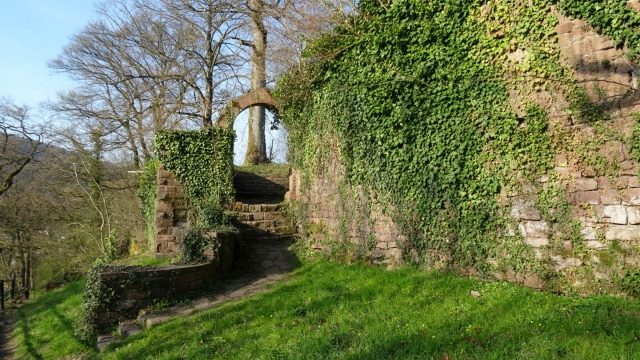
The remains of the Castle can be visited

Reichenstein Castle in Neckargemünd was an Imperial Castle probably built at the beginning of the 13th century. Together with other Imperial Castles in the lower Neckar region, it served to protect the Imperial territory against the Wittelsbach territory around Heidelberg. The castle is only mentioned in documents from 1292 to 1355. From 1329 onwards, it was owned by the Electors of the Palatinate and probably quickly lost importance compared to the nearby Dilsberg fortress. The castle fell into ruin from the 15th century at the latest and was almost completely demolished. The castle site underwent numerous changes in the 19th and 20th centuries, so that very few of the remaining wall fragments there today can actually be identified as remnants of the castle.

The ruins of the hilltop castle Reichenstein are located south above the old town of Neckargemünd in a small, park-like grove in the Sommerwiese and Mühlrain districts on the Hollmuth mountain east of the Elsenz. This is an extremely favorable strategic location (which, however, is hardly discernible today due to the nearby modern development), as from this position the Neckar Valley, the Elsenz Valley, and the Wiesenbach Valley with the old long-distance road from Heidelberg to Mosbach could be controlled.

Layout+

Stone removals in the early modern period, the subsequent long-term agricultural use of the area, and construction and restoration measures in the 19th and 20th centuries, most recently the terracing of the site in the 1930s and the blasting of part of the castle plateau for the construction of a water reservoir in 1989, led to a lasting alteration of the castle grounds. Many parts of the masonry visible today were only erected in the 19th century as retaining walls for gardens located there or freely reconstructed without scientific basis. Only in the south of the complex has original masonry been preserved, which is interpreted as a shield wall towards the ridge, analogous to other castles in the Neckar Valley. In that piece of masonry, three different layers from different epochs can be recognized, with the uppermost layer also being of modern date.

The few preserved structural elements allow almost no conclusions about the former appearance of the complex. Due to the topographical conditions on the slope of the Hollmuth, it is concluded that Reichenstein Castle was an elongated, almost rectangular defensive castle, protected to the south by a neck ditch and a shield wall against the mountain ridge. Access to the castle was probably through a gate in the western long wall, although the gate located there today was only built in 1934 from found pieces of masonry. Nothing remains of the interior buildings of the castle.

The castle was probably built in the early 13th century. Older literature still considers a predecessor building possible. Younger literature, however, assumes that Reichenstein Castle could not have been built before the end of the Counts of Lauffen, who had their seat at the nearby Dilsberg fortress, in 1219.

Like the nearby Imperial Castle Stolzeneck, the equipment of Reichenstein Castle essentially included only small forest holdings, so that it is not to be regarded as the seat of a manorial lordship, but as part of a security system for the Imperial territory against the Wittelsbach territory around Heidelberg. The fact that Reichenstein Castle was already built as an Imperial Castle is generally accepted due to its name.

Only limited documentary evidence allows speculation about the early history of the castle. The Lords of Mauer, also known as Nessel, could be considered as the original owners. Although there is no documentary proof that they resided in a castle in Neckargemünd, Diether Nessel of Neckargemünd lost all his possessions, imperial and other fiefs, to King Rudolf I due to crimes committed. Rudolf I granted them to Count Palatine Ludwig II in 1286; later, the Nessel properties in Neckargemünd were held as Palatine fiefs by the Lords Landschad von Steinach. In the chronicle of Hans Ulrich I Landschad von Steinach around 1605, a "Landschaden Burgkh" near Neckargemünd is mentioned, which could refer to Reichenstein, near which the Landschad also owned a manorial estate. At the first documentary mention of Reichenstein Castle in 1292, King Rudolf's son, Albrecht I, promised Ludwig II of the Palatinate the rights to Reichenstein Castle, which he had held as a fief of the Empire from ancient times, in the event of his election as Rudolf's successor. However, Ludwig II could not obtain these rights, as Adolf of Nassau was elected German King in May 1292 instead of Albrecht.

Adolf of Nassau pledged Reichenstein Castle, along with other possessions in Neckargemünd and Eberbach, to Eberhard I of Katzenelnbogen in 1297. The Counts of Katzenelnbogen sought a contiguous territory between Kraichgau, Odenwald, and the Middle Rhine, for which Reichenstein Castle was strategically located. However, King Adolf's successor, Albrecht, who had already been a candidate in 1292, did not confirm the Katzenelnbogen's possession of Neckargemünd and Eberbach. Instead, from the early 14th century, the Lords of Weinsberg, who were related to the Katzenelnbogen, held the imperial pledges on the lower Neckar. Upon the division of the Weinsberg possessions after the death of Konrad IV of Weinsberg in 1325, Reichenstein Castle and Neckargemünd passed to Engelhard VI of Weinsberg.

Emperor Ludwig the Bavarian finally allowed the Counts Palatine Rudolf II and Ruprecht I to redeem the pledges in Neckargemünd in 1329. In the following year, 1330, the Counts Palatine were enfeoffed with numerous other imperial estates in the lower Neckar region and were able to establish a new territorial focus of their power there. Although the court of the Meckesheim Zent was moved to a place below Reichenstein Castle in 1346, the castle quickly lost importance compared to the nearby Dilsberg fortress, which also came into the possession of the Electoral Palatinate from 1338 and where the Electoral Palatinate's cellarage was located. Reichenstein Castle appears in documents in 1353 and for the last time in 1355. The castle was probably quickly abandoned thereafter and fell into disrepair.

The cellar on Dilsberg leased the garden land around Reichenstein Castle to citizens of Neckargemünd. In the oldest Dilsberg rent book from 1494, only income from the garden land is mentioned. The castle itself was not assigned, but based on bone finds, a use of parts of the complex for animal husbandry seems plausible. As elsewhere, stones and other building materials from the castle were probably removed over time and used for the construction of other buildings. In the records of Hans Ulrich I Landschad von Steinach around 1605, a "Burckstall abwendig Neckergemünden, der Landschaden Burckh genandt" is mentioned. If this refers to Reichenstein Castle, then only a castle site existed there at that time. On an engraving by Merian from the first half of the 17th century, a box-like structure can still be seen on the right edge of the picture above the city fortifications of Neckargemünd, in which some researchers believe they recognize the ruins of Reichenstein Castle. In 1712, the Neckargemünd city mayor Edmund Münster reported on old walls, fallen into disrepair for several hundred years, on a mountain, which had been a castle and was called Reichenstein. The place was overgrown with grass. Johann Goswin Widder wrote in his description of the Electoral Palatinate in the late 18th century of still visible ruins. In 1822, Albert Ludwig Grimm wrote that the ruins of Reichenstein had almost disappeared without a trace.

Until the 16th century, the Hollmuth formed its own district. The city of Neckargemünd showed early interest in acquiring the mountain with its forest and castle area, but initially could only acquire a small part, while in 1803 the forest on the ridge came to the municipality of Bammental. Although the city of Neckargemünd succeeded in acquiring further small parts of the Hollmuth in the early 20th century, the largest part with the castle area remained in the possession of the Schönau care facility and some citizens and only came into municipal ownership in 1984.

In the 19th century, the grounds of Reichenstein Castle were a popular viewpoint, but then became overgrown until the early 20th century. Especially the neglected Borchard's Garden at the ruins was used by young people as a meeting place. The city reacted in 1926 by no longer leasing the garden and instead designing the Burg-Reichenstein-Garten as a public green space, park-like, below the ruins. In 1932, a shelter and sales hut was built there according to plans by architect Ludwig Neuer. According to plans by architect Hans Kayser, the Burg-Reichenstein-Garten was extended to parts of the castle area in 1934, creating the terraced areas still present today. Until 1937, various excavations and restoration measures followed throughout the ruins, including in parts that were still privately owned as gardens at the time. Unfortunately, neither excavation reports were written nor were the restoration measures documented, so that the measures of the 1930s still raise more questions than they provide answers. Only a few finds from 1934, which went to the Institute for Prehistory at the University of Heidelberg, could later be scientifically evaluated and dated to the 13th and 14th centuries, while the wall parts found on the site were haphazardly re-mortared during the terracing of the complex and even later.

After the Second World War, the castle area with the Burg-Reichenstein-Garten became overgrown again. It was not until 1967 that the green area was restored. It subsequently enjoyed great popularity as a festival venue, but damage and noise disturbances from 1975 led to a gradual ban on all festivities at that location. In 1978, the complex was restored again. After the city of Neckargemünd acquired the castle site in 1984, further repair measures were carried out on the historical and more recent masonry there. The city also harbored plans for further excavations or the creation of a historical garden on the castle area, but ultimately abandoned them. From 1987 to 1989, part of the mountain plateau with the northwestern wall of the castle was blasted away for the construction of a water reservoir. During the construction work, numerous finds came to light, which, like the objects excavated in the 1930s, can be dated to the 13th and 14th centuries. In 1995, the Reichenstein working group of the Neckargemünd cultural association was founded, whose objective is the monument preservation and documentation of the castle.

Today, Reichenstein Castle is freely accessible as a public green space and is used for sporadic summer concert events.

Take Mobile History with you

You are reading this text for free. Premium adds what matters on the road: descriptions read aloud, sites found through your camera, whole regions taken offline.

  • Every description, including the ~17,700 Premium sites
  • Audio guide: have descriptions read to you on location
  • AR finder: see sites through your camera, with distance and bearing
  • Unlimited saved sites

14 days free, then from €2.99 a month. Cancel anytime.

Source: Wikipedia · Licence: CC BY-SA 4.0 · Image: Jörg Heldt

This description draws on the facts documented in the linked Wikipedia article; Wikipedia content is licensed under CC BY-SA 4.0. Wording and editing: Mobile History.

Location: 49.3900, 8.8006