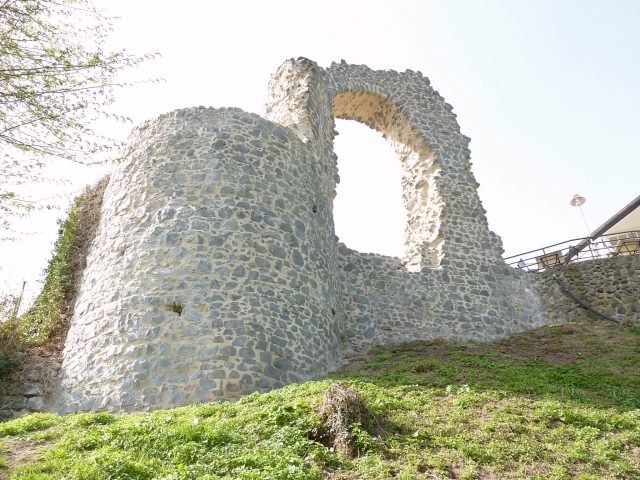
The remains of the castle can be visited
Rolandseck Castle

Rolandseck Castle in the Rolandswerth district of Remagen was a hilltop castle on the Rhine, whose preserved ruin is called Rolandsbogen. In 1040, it was first mentioned as Rulcheseck (Ruolechereck). The castle was built in 1122 by Archbishop Friedrich I of Cologne together with the Nonnenwerth convent. A predecessor building may have existed since 1040.
The ruin of Rolandseck Castle (Rulcheseck Castle) is located on the steep slope of the Rodderberg at about 105 m above sea level, above the Rhine Valley, and served, together with the almost directly opposite castles of Drachenfels and Wolkenburg, to secure the southern border of the closed territory of the Archdiocese of Cologne in the 12th century. In the 14th century, the old name changed to the present one.
Destroyed in 1475 during the Burgundian War, it was rebuilt and severely damaged by the Swedes around 1632 during the Thirty Years' War, falling into ruin. On February 19, 1673, during an earthquake, it collapsed, except for a last castle window, the so-called Rolandsbogen.
The Roland legend, in a Middle High German variant, revolves around the castle, according to which Knight Roland came from here and left a grieving Hildegunde from Drachenfels behind, who then entered the Nonnenwerth convent − despite the fact that the figure of Roland, as a vassal of Charlemagne, is to be placed in the 8th century, thus a good 300 years before the construction of the castle and convent.
Rolandsbogen+
The Rolandsbogen, the remaining castle window of Rolandseck Castle, became a landmark of Rhine Romanticism in the 18th/19th century in the Bonn area. When it collapsed on December 28, 1839, the poet Ferdinand Freiligrath, who lived in Unkel from 1839 to 1841, initiated its reconstruction with his appeal for donations in the Kölnische Zeitung. He was honored for this in 1914 with the Freiligrath Monument on the footpath from the Rhine Valley to the Rolandsbogen. Thanks to the donations, the arch could be rebuilt as early as 1840. The plans for the reconstruction were contributed by the Cologne Cathedral Master Builder Ernst Friedrich Zwirner.
As early as 1893, a refreshment kiosk is documented on the high plateau at the Rolandsbogen. Sophie, one of the daughters of the first operator, is said, according to family tradition, to have inspired the local poet Jörg Ritzel to a poem that became famous in its musical setting by Paul Mania:
I came from afar to the Rhine, to the Rhine.
At the inn at Rolandsbogen I stopped.
I drank with his cousin on a first-name basis.
The moon with a red nose watched, watched.
From the outdoor terrace, there is a good view of the Rhine Valley, especially of the Siebengebirge with Drachenfels and Petersberg to the north, with Bad Honnef and the islands of Grafenwerth and Nonnenwerth to the east, and upstream towards Unkel and Oberwinter to the south.
In 1929, the Lenz/Böhm family replaced the kiosk, which was in family ownership, with the Rolandsbogen restaurant, which is still in operation today; in 1965, a small vineyard was laid out around the building.
The place had prominent visitors several times. According to family tradition, the engagement between Konrad Adenauer and his first wife Emma Weyer is said to have taken place at the Rolandsbogen in 1902. In June 1999 (G8 summit in Cologne), Chancellor Gerhard Schröder received US President Bill Clinton here for a dinner.
At the end of 2007, the Rolandsbogen restaurant faced closure. The costs for the maintenance and preservation of the castle ruin could not be covered by the operation of the restaurant. At the beginning of 2008, the Bonn entrepreneur Jörg Haas, with his company BonnVisio, which operates at the Bonner Bogen, acquired the mountain with the castle ruin, with Frank L. Böhm initially continuing to act as managing director. With his departure on June 30, 2009, the tradition of the Lenz/Böhm family at the Arch, which began in 1893, ended. The Rolandsbogen restaurant was renovated in 2009 and has since been operated with a local gourmet cuisine. In July 2012, the Berlin catering company Lutter & Wegner took over the operation of the restaurant.
A long-term renovation plan was developed for the castle ruin and its surroundings. Planning and implementation are carried out in coordination with the city of Remagen, the district of Ahrweiler, the monument authorities, and the support associations. The renovation of the Freiligrath Monument on the historic ascent (historic post road), the endangered and ivy-covered Rolandsbogen, the up to 12-meter-high castle walls in the south, and the staircase to the castle began in 2010. The external appearance of the Rolandsbogen has changed after the completed renovation by its liberation from ivy.
In September 2012, another renovation phase was initiated, which will take several years and will include, among other things, the staircase to the viewing terrace and the southern walls of Rolandseck Castle. The redesign of the outdoor terrace is expected to be completed in spring 2013. In July 2013, the Rolandsbogen was included in the nationwide funding program for nationally valuable cultural monuments.
Take Mobile History with you
You are reading this text for free. Premium adds what matters on the road: descriptions read aloud, sites found through your camera, whole regions taken offline.
- Every description, including the ~17,700 Premium sites
- Audio guide: have descriptions read to you on location
- AR finder: see sites through your camera, with distance and bearing
- Unlimited saved sites
14 days free, then from €2.99 a month. Cancel anytime.
Source: Wikipedia · Licence: CC BY-SA 4.0 · Image: Joachim Schneeleopard
This description draws on the facts documented in the linked Wikipedia article; Wikipedia content is licensed under CC BY-SA 4.0. Wording and editing: Mobile History.
Location: 50.6402, 7.2044