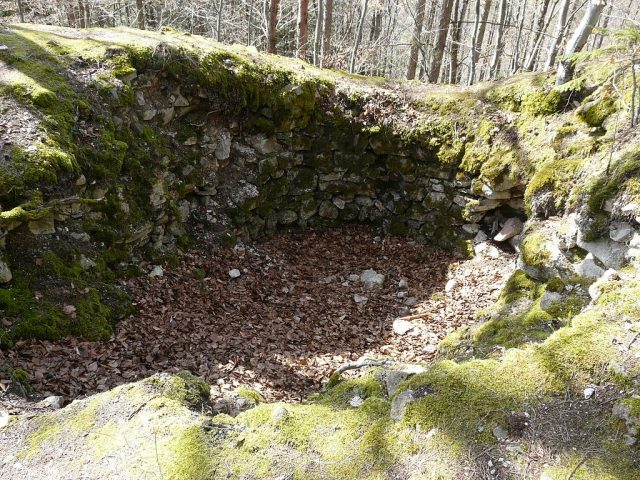
The remains of the Castle can be visited
Rotenburg Castle
The Rotenburg castle ruin is the ruin of a hilltop castle on a steep, 620.2 m above sea level high hill in the valley of the Kleine Wiese between Niedertegernau and Wieslet in the municipality of Kleines Wiesental in the district of Lörrach in Baden-Württemberg.
Only a few historical facts are known about the castle; only minor remains of masonry, as well as ramparts and ditches to secure the complex, have been preserved. Nearby is the small castle Bürgle.
The early history of this small castle complex is still unknown; it was probably built only after the year 1200, as can be seen from the type of masonry of the core castle. It is possible that the ramparts surrounding the castle hill could also originate from an older predecessor building. The builders were probably the Lords of Rotenberg, a collateral line of the noble family of Rötteln. They were first mentioned in documents in the middle of the 13th century. After two traceable generations of the family, they died out with Dietrich V von Rötteln-Rotenburg around 1280. Before his death, Dietrich bequeathed all his possessions in his will to the Prince-Bishopric of Basel and the St. Blasien Monastery. However, the Rotenburg and its associated possessions, in contrast, fell to the Lordship of Rötteln and thus came into the possession of the main line of the Lords of Rötteln, and after their extinction in 1316, to the Margraves of Hachberg-Sausenberg.
Nothing is known about the end of the castle either; it may also have been damaged by the Basel earthquake on October 18, 1356. In any case, it was referred to as a ruin in the 16th century.
Description+
The castle ruin is located on a rocky conical mountain, which slopes steeply on all sides. The complex consisted of a core castle at the summit and possibly an outer bailey, which adjoined to the southwest.
The entire hill of the core castle is surrounded by an irregularly oval ring ditch, which was carved out of the bedrock (Image 1). An additional ring wall was placed in front of this ditch. The castle hill rises several meters from the ring ditch and was built on an area of about 50 by 25 meters with an oval ring wall, which was leaned against the rock face of the castle hill and has been particularly preserved on the east side. In addition, approximately in the middle of the west side of the castle complex, there was a round keep. This tower had a diameter of nine meters with a wall thickness of about three meters. Its masonry consisted of larger blocks on the outside, while the inner casing was irregularly layered with smaller, only slightly worked ashlar stones (Title image and Image 2). Another larger building was located in the southern part of the complex (Image 3); a 15-meter long piece of masonry made of regularly laid ashlar stones has been preserved from it (Image 4), next to which there is a flat relieving arch.
Southwest of the ring wall, there was possibly an outer bailey. There, a wide, curved ditch with an outer wall was placed in front of this wall.
Take Mobile History with you
You are reading this text for free. Premium adds what matters on the road: descriptions read aloud, sites found through your camera, whole regions taken offline.
- Every description, including the ~17,700 Premium sites
- Audio guide: have descriptions read to you on location
- AR finder: see sites through your camera, with distance and bearing
- Unlimited saved sites
14 days free, then from €2.99 a month. Cancel anytime.
Source: Wikipedia · Licence: CC BY-SA 4.0 · Image: http://de.wikipedia.org/wiki/Datei:Rotenburg_3.JPG
This description draws on the facts documented in the linked Wikipedia article; Wikipedia content is licensed under CC BY-SA 4.0. Wording and editing: Mobile History.
Location: 47.6973, 7.8076