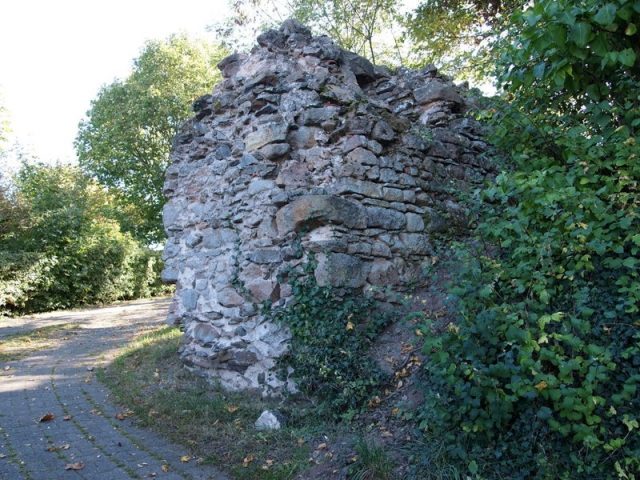
The remains of the Castle can be visited
Ruppertsecken Castle

Ruppertsecken Castle is the ruin of a hilltop castle at 498 m above sea level on the Schlossberg in the municipality of Ruppertsecken in the Donnersbergkreis of the Verbandsgemeinde Rockenhausen in Rhineland-Pfalz.
The castle is first mentioned in a document dated July 17, 1344, in the possession of Palatine Counts Ruprecht I and his nephew Ruprecht II, when the nearby Frauenstein Castle was transferred to Knight Hermann von Hohenfels as a hereditary fief. In a document dated June 1, 1401, the castle was pledged to Dieter Landschad von Steinach and his wife Irmgard for 4600 gold guilders. On March 30, 1406, the castle was sold to the Worms chamberlain Johann von Worms for 3000 guilders. Through inheritance, the castle came into the possession of Duke Stephan of Palatinate-Simmern-Zweibrücken on October 3, 1410. On September 16, 1444, the castle was transferred to Ludwig of Palatinate-Zweibrücken-Veldenz.
On October 2, 1470, Palatine Count Friedrich I began a 14-day siege of the castle; it was plundered and demolished. Reconstruction was forbidden.
In 1794, the castle remains and the village came to the Electorate of Palatinate. As late as 1825, there was talk of "aspiring masonry". Over time, the villagers removed the stones for house building. Among other things, these were used to build the bell tower erected in the village in 1869. In 1889, a water tower in the form of a medieval keep was built on the castle grounds; it was rebuilt and renovated again in 1963.
Legend+
According to legend, the Palatine Count was very angry because, despite his stately army, the siege lasted so long. The Palatine Count thought he could quickly take the rocky nest, but the Count in the castle with his men was excellent at defense. The Palatine Count wanted to deceive the Count and, while the weapons rested, sent a message to his wife, the Countess, that she was allowed to leave the castle unharmed and that she, as well as everything she could carry, would be spared. Shortly thereafter, the castle gate opened and the Countess came out, carrying her husband, the Count, on her back. The Palatine Count kept his word and, moreover, spared the lives of all other defenders because he rewarded such loyalty to a lord.
Take Mobile History with you
You are reading this text for free. Premium adds what matters on the road: descriptions read aloud, sites found through your camera, whole regions taken offline.
- Every description, including the ~17,700 Premium sites
- Audio guide: have descriptions read to you on location
- AR finder: see sites through your camera, with distance and bearing
- Unlimited saved sites
14 days free, then from €2.99 a month. Cancel anytime.
Source: Wikipedia · Licence: CC BY-SA 4.0 · Image: http://www.wehrbauten.de/thread.php?threadid=1343
This description draws on the facts documented in the linked Wikipedia article; Wikipedia content is licensed under CC BY-SA 4.0. Wording and editing: Mobile History.
Location: 49.6454, 7.8791