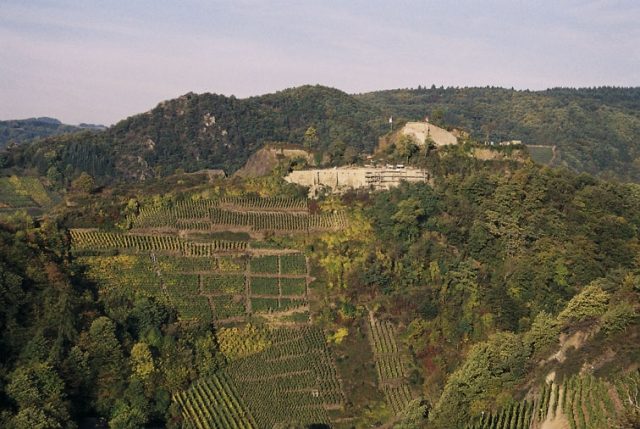
The remains of the Castle can be visited
Saffenburg Castle

The Saffenburg, also called Saffenberg, is the ruin of a high medieval hilltop castle in the municipality of Mayschoß in the Rhineland-Palatinate district of Ahrweiler. It is the oldest castle ruin in the Ahr valley and stands above the Ahr valley.
Genealogy
Built in the 11th century by Count Adolf von Nörvenich and Adalbert von Saffenburg, also called von Saffenberg, (Adelbertus de Saffenberch), it was first mentioned in a document in 1074. Here, Adelbertus de Saffenberch appears as a witness to a document in which Archbishop Anno II distributes the goods donated by Count Eberhard von Cleve to St. Quirinus and his church in Neuss to the said church and the cathedral in Cologne, on September 27, 1074. Adalbert was the founder of the Klosterrath Abbey near Rode in 1104, later the famous Augustinian Abbey of Rolduc near Maastricht, to which he simultaneously transferred goods in Ahrweiler and Lantershoven with his wife Mechtildis and his son Adolf. Adalbert died according to the chronicle of his monastery on December 16, 1110, and was buried in front of the high altar of the church there.
Adalbert was succeeded by his son Adolf I von Saffenberg. Through his marriage to Margarete von Schwarzenburg, a niece of the Cologne Archbishop Friedrich I von Schwarzenburg, he received the title of Count from him. Around 1147, he was appointed hereditary Vogt of the Cologne church, for which he probably ceded Saffenburg to Cologne and received it back as a fief, because from this point on, the lordship appears as a Cologne fief. Adolf's son Herman II succeeded him, and with his death in 1172, this family died out.
Around 1173, Saffenburg came into the possession of the Counts of Sayn through the marriage of Hermann II's daughter Agnes to Count Heinrich II von Sayn, but this lineage also died out with the son Heinrich III, who remained childless, in 1246. His widow Countess Mathilde bequeathed Saffenburg in 1247 to her husband's sister's sons, the Counts of Sponheim. Count Heinrich von Sponheim agreed with his brothers and became the sole owner of Saffenburg, which he, however, ceded in 1255 to his son-in-law Diedrich VII von Cleve. Since Diedrich VII's only son became a priest, Saffenburg was an open fief. In 1184, the Cologne Archbishop Philipp I von Heinsberg bought half of the castle. In addition to the Counts of Saffenberg, another noble family was now enfeoffed, who called themselves Edelherren von Saffenburg, and did not belong to the high nobility without the title of count.
The first to be mentioned was Albert von Saffenburg in 1197, probably a vassal of the Sayns, followed by Wilhelm around 1220 and Hermann around 1225. Wilhelm's son, Gerlach, is mentioned around 1253, and his son Konrad with his wife Mechthild still appear in contracts in 1284. He was succeeded by Wilhelm with his wife Isbergis around 1299. Then followed Johann I to Johann IV. Johann I with his wife Sophie are mentioned in documents around 1325. Johann II with his wife Gertrudis von Braunshorn followed, whereby in 1353 the successor Johann III was already married as a boy to the 14-year-old Katharina von Neuenahr, with the support of his father Johann II, who was still alive in 1382. The inheritance and the taking possession of the County of Neuenahr, however, could only take place with the support of the Cologne Archbishop Friedrich III von Saarwerden. His military intervention led to the siege and destruction of Neuenahr Castle in 1383. The children of Johann III were Johann IV, Wilhelm, Kraft, Katharina, Gertrud, Ponzetta, Johannetta and Elisabeth. Since Johann IV remained childless, the siblings continued the dynasty through Katharina, the daughter of brother Wilhelm.
In 1424, the lordship passed to the Counts of Virneburg, through the marriage of the heiress Countess Katharina, granddaughter of Johann III von Saffenburg, to Count Philipp I von Virneburg and remained in their possession until the death of the last Count Kuno von Virneburg in 1545. Count Diedrich IV (the elder) von Manderscheid and Johann IV, Count of Wied, now disputed the inheritance of the lordship of Saffenburg. By paying 3190 thalers to Count Friedrich IV von Wied, the legal successor of Johann IV, Count Diedrich II became the sole owner and was enfeoffed with the lordship of Saffenburg by Archbishop Salentin von Isenburg in 1572, thus the property came to the Counts of Manderscheid-Schleiden. Dietrich, however, was the last in the male line, and so the husband of his sister Katharina, Philipp von der Mark, a descendant of Count Wilhelm I von der Mark "the Boar of the Ardennes", came into possession of Saffenburg, Schleiden and Gelsdorf in 1593. On October 5, 1773, the last Count von der Mark died. The daughter from the House of Mark-Schleiden, Louise Margaretha, married Duke Karl Maria Raimund von Arenberg on June 10, 1748. He died on August 17, 1778, after which Saffenburg and Schleiden were inherited by his descendants.
Wars and Sieges
At the end of 1632, the Swedes under their General Baudissin undertook a raid and foray into the Ahr valley from their headquarters in Linz. After the attack and capture of the Imperial Castle Landskron, the plundering of Ahrweiler, the siege of Saffenburg took place in December 1632. The commander von Burckersdorf had reinforced his garrison with able-bodied men from the surrounding area. Many wealthy citizens from Ahrweiler had fled from the Swedes to the supposedly protective castle. After a fierce cannonade with three, eight, and sixteen-pound cannonballs, the castle was shelled until it was ready for storming. On December 14, the castle was stormed and captured, and the brave defenders had to pay for their courage with their lives. Many civilians managed to escape beforehand over the outer walls down the steep mountainside. Among them was the bailiff of the lordship, who broke a leg in the process, dragged himself to the village of Reimerzhoven, but was captured there by the Swedes through betrayal. The Swedes took him to Remagen on December 17, later he bought his freedom by paying a ransom of 600 Reichstalers. After the Swedes had stationed a company under Captain Bodinger in the castle, they withdrew towards the Rhine on December 15.
The sovereign Elector Ferdinand of Cologne, militarily overwhelmed in the fight against the Swedes, asked for assistance from the Infanta Isabella, who sent Spanish troops under Count Ernst von Isenburg-Grenzau to the Middle Rhine in January 1633. The siege of Saffenburg was entrusted to Count de Maria, who carried out the siege with his Spanish and Electoral Cologne troops so intensely and persistently that after a four-week siege, the Swedes had to capitulate on February 15 and withdrew by agreement.
An inventory list from 1653 provides information about the poor artillery defense state of the castle. At that time, 17 iron and bronze cannons, some medieval chamber cannons, were listed, whose carriages were largely rotten.
In 1689, during the War of the Palatine Succession (1688–1697), Saffenburg was captured on May 12 by Trier troops under the command of Otto von Wentz in a night attack, while the French devastated and plundered the Ahr valley, completely burning down the Electoral Cologne city of Ahrweiler except for ten houses.
In the War of the Spanish Succession (1701–1714), the Cologne Archbishop Joseph Clemens of Bavaria changed sides and entered into an alliance with France. The French then occupied the residence in Bonn and the Ahr valley; only the Electoral Cologne garrison on Saffenburg remained loyal to the Emperor and the Empire. On October 18, 1702, the French succeeded in capturing Saffenburg during the grape harvest by overpowering the gate guard. The castle was then occupied by Chevalier de Lacroix, Colonel of the Infantry, owner of a fusilier and a cavalry company. On January 7, 1703, the Hanoverian General Sommerfeld of the allied army appeared with 800 men, four twelve-pound cannons, and two mortars, positioned in the forest on the height of the opposite Ahr bank, to drive out the French. After two days of unsuccessful shelling, he alone threw 70 bombs at the castle, he withdrew again to the allied army, not without first extorting 700 Reichstalers from the Saffenburg region. In addition, a diary entry from the besieged castle:
"In two days they fired 70 bombs and as many fireballs, but without significant damage to the besieged; one bomb fell into the so-called Schellengarten of the castle and was extinguished there by the vigilance of the soldiers, one fell into Johann Kreps' bakery in Bungart, where it completely shattered the chimney, the hearth wall, and the roof. The other bombs touched nothing nor damaged anything, the cannonballs somewhat damaged the windows, walls, and roof, distressed us besieged (the writer was therefore with the French in the castle), but did not damage us."
On May 1, 1703, an allied troop under General Bülow with 700 men besieged Saffenburg for three weeks, so that the French were literally trapped. Two field guns on the Koppen, a mountain in front of the gate access, additionally guarded the entrance to the castle. The fortress of Bonn had fallen on May 15, 1703, which made the situation of the French in the castle hopeless, as a relief was out of the question. The French commander Monsieur le Ballu capitulated and withdrew with an accord under safe conduct to Vianden in Luxembourg.
On February 6, 1704, Monsieur Borkelinge arrived from the fortress of Jülich with an artillery command on behalf of his sovereign, the Duke of Jülich, the then lord of the castle, to raze the castle. Due to the many sieges and cannonades, it was already so ruined that a reconstruction was out of the question. All masonry and the large tower were undermined and blown up, and on February 16, nothing remained of the once proud castle. In 1773, it came into the possession of the Dukes of Arenberg as a ruin.
Description of the Castle
On an elongated rock massif, which is surrounded on three sides by the Ahr, we encounter a medieval Romanesque castle complex, with a length of 260 m and 80 m at its widest point. The castle consisted of two outer bailey and the core castle, which were separated from each other by deep artificial neck ditches. The demolition material from the neck ditches was, as usual, used as building material.
Today, only foundation walls, which seem to merge seamlessly into the rock, remain of the castle. In some places, embankments still indicate where a wall once ran. In 2004, a fundamental renovation of the increasingly decaying foundation walls began. Since 2007, the castle ruin has been open to the public again.
Legends and Stories+
After the call for capitulation to the French commander Monsieur le Ballu, the honorable surrender, not without firing a shot, is reflected in the following verse:
So first fire three shots for me
Never was it seen in his life,
That a castle so firm and strong
Surrendered without a shot.
According to tradition, however, there were only two shots.
Lordship of Saffenburg+
The Lordship of Saffenburg consisted of Saffenburg and the four villages of Mayschoß, Laach, Rech, Dernau and the Marienthal monastery in today's Ahrweiler district. The lordship had its own court, consisting of aldermen elected in the villages. The court was presided over by a bailiff and was held in the Rentmeisterei in Mayschoß. Without special permission, no stranger was allowed to settle in the lordship; for such a privilege, he had to pay twelve Reichstalers, and if he had a wife, he had to pay eight Reichstalers for her.
Take Mobile History with you
You are reading this text for free. Premium adds what matters on the road: descriptions read aloud, sites found through your camera, whole regions taken offline.
- Every description, including the ~17,700 Premium sites
- Audio guide: have descriptions read to you on location
- AR finder: see sites through your camera, with distance and bearing
- Unlimited saved sites
14 days free, then from €2.99 a month. Cancel anytime.
Source: Wikipedia · Licence: CC BY-SA 4.0 · Image: http://commons.wikimedia.org/wiki/File:Saffenburg_foto.jpg?uselang=de
This description draws on the facts documented in the linked Wikipedia article; Wikipedia content is licensed under CC BY-SA 4.0. Wording and editing: Mobile History.
Location: 50.5201, 7.0237