CastleSt. Thomas am Blasenstein

Saxenegg Castle
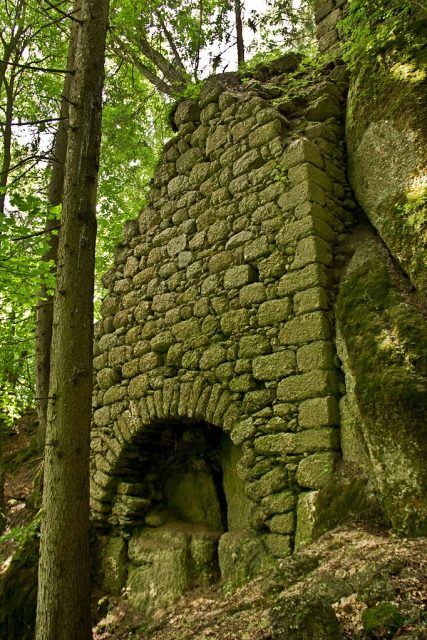
Saxenegg Castle

The remains of the Castle can be visited


Saxenegg Castle Ruin is a heavily dilapidated former castle complex in the municipality of St. Thomas am Blasenstein in the Perg district in the Mühlviertel region of Upper Austria. The village of the same name is located southwest of the castle ruin, already within the cadastral community of Innernstein in the market town of Münzbach, and consists of smaller settlements and scattered houses.

The former hilltop castle is situated on a wooded hilltop at an elevation of 530 m above sea level, sloping steeply to the south, east, and west, between the Käfermühlbach and Rechbergerbach streams. The complex is located approximately 2.3 km (as the crow flies) southwest of the center of St. Thomas, close to the municipal border with Münzbach. The castle ruin can be reached via the village of Saxenegg, which belongs to Münzbach.

Description+

The total built-up area of the former hilltop castle was 1,707 m2. The core castle, consisting of the palas and the keep, was located on a rock spur projecting to the south. To the north, the lower-lying, later-built outer bailey adjoined it, which was accessible from the core castle via a drawbridge and was itself secured on the northern slope side by a wide and deep neck ditch. Of the complex, which is now located in the forest, only remnants of walls remain, particularly the towering former north wall of the keep.

The exact time of construction of Saxenegg Castle is not known. It was first mentioned in a document on March 12, 1297. At that time, Ulrich and Wernhart den Sechseneker were named as owners. In 1342, Duke Albrecht II enfeoffed Burghart dem Kneusser with Saxenegg Castle. In 1382, Hans der Kneusser sold the complex to Duke Albrecht III. At that time, the Saxenegg dominion included 14 farms, 22 ½ fiefs, and 23 homesteads in the surrounding parishes. Thereafter, the dominion changed its feudal lord several times: First, it went to Wolf dem Schenk von Dobra, in 1403 to Hans den Ruckendorfer, in 1405 to Albrecht dem Schweinwarter, in 1410 to the brothers Erhard and Wilhelm von Zelking.

The Zelking family remained in possession of Saxenegg until King Albrecht allowed them on May 26, 1438, "to demolish and destroy the fortress Sechsenekg, which we hear is somewhat dilapidated, and our people shall help him in this." From this date, the castle was largely abandoned, and Christoph von Zelking bequeathed the inventory of the castle chapel to the parish church of Kefermarkt in 1473. The dominion of Saxenegg, which also included usufruct rights to the surrounding area, such as waters (fishing), forest (wood), or hunting rights, was acquired in 1493 by the Prüschek brothers of Greinburg, and in 1525 the property passed to the widow Anna Freifrau von Prag and her sons. The dominion was thereafter administered from the Windhaag dominion until the manorial rights were abolished in 1848. In that year, the citizens of Münzbach are said to have held a freedom festival at the foot of the former castle.

Take Mobile History with you

You are reading this text for free. Premium adds what matters on the road: descriptions read aloud, sites found through your camera, whole regions taken offline.

  • Every description, including the ~17,700 Premium sites
  • Audio guide: have descriptions read to you on location
  • AR finder: see sites through your camera, with distance and bearing
  • Unlimited saved sites

14 days free, then from €2.99 a month. Cancel anytime.

Source: Wikipedia · Licence: CC BY-SA 4.0 · Image: http://commons.wikimedia.org/wiki/File:Burgruine_Saxenegg_-_Nordseite.jpg

This description draws on the facts documented in the linked Wikipedia article; Wikipedia content is licensed under CC BY-SA 4.0. Wording and editing: Mobile History.

Location: 48.2970, 14.7413