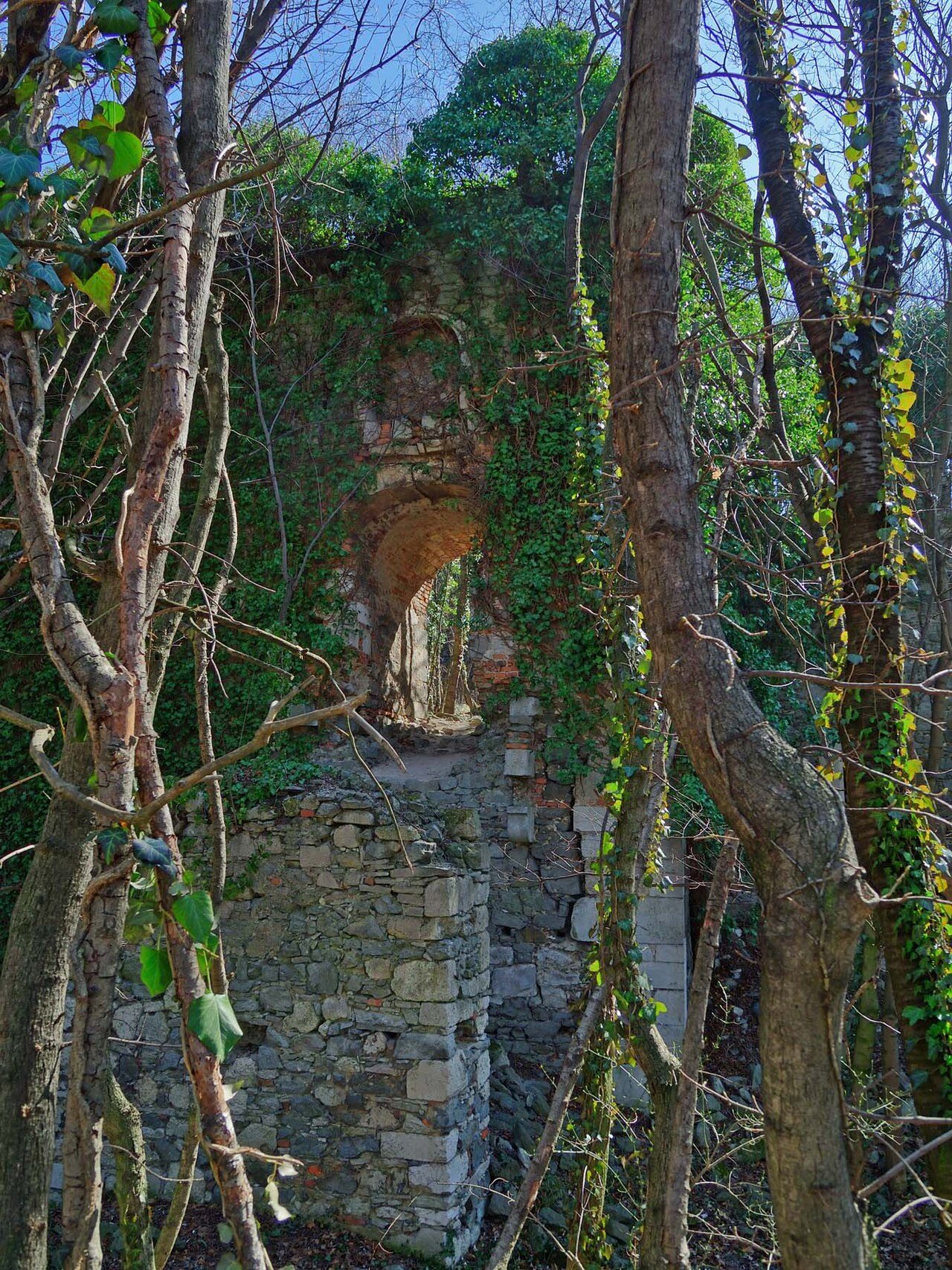
The remains of the Castle can be visited
Scharfeneck Castle

The ruin of Scharfeneck Castle (Hungarian: Sárfenék) is located in the municipal area of Mannersdorf am Leithagebirge, in the district of Bruck a.d. Leitha in Lower Austria.
The origins of the ruin, located in the Wüste Nature Park, probably lie in the 11th century, but are not documented.
Its name goes back to the Hungarian princely family of the Scharfeneckers, who were at the height of their power around the year 1400 and highly regarded by the Hungarian kings. Scharfeneck, which at that time lay on the border with Austria and thus must have had some significance as a border castle, was the starting point of numerous territorial struggles of the Scharfeneckers with Austrian nobles. For example, the Scharfeneckers attacked Deutsch-Altenburg in 1396 and appropriated Trautmannsdorf in 1404. In 1408, Stuchs von Trautmannsdorf, in turn, attacked Scharfeneck, whereupon they took bloody revenge in Edelsthal and Deutsch Haslau in 1412.
Soon after, the Scharfeneckers must have died out, possibly in one of their numerous feuds, because in 1417 Neuscharfeneck Castle was referred to as the property of the Hungarian King Sigismund. During this time, it was rebuilt after the model of French and English castles and leased or sold by the crown to several owners. King Matthias Corvinus, for example, sold the castle for the price of 6000 Hungarian gold florins to Ulrich von Grafeneck. Corvinus, who had also made himself King of Bohemia, was able to conquer Vienna in 1485 after a four-month siege, thereby making Scharfeneck not a border castle for the first time.
After his death in 1490, the tide turned and Austria fell back to the Habsburgs. Under the Roman-German King and later Emperor Maximilian I, they turned their gaze eastward. Already in his first year of reign in 1493, Maximilian seized Scharfeneck Castle, which thus came into Austrian possession. This possibly violent conquest is quite an example of the awakened interest of the Habsburgs in the East, which ultimately brought them sole power in Central and Eastern Europe.
However, the new lord seems to have brought little luck to the castle: in 1555, under the reign of Maximilian's grandson Ferdinand I, a lightning strike destroyed the keep, the core of the complex, which was then 24 meters high. The lightning probably affected the entire complex to such an extent that, despite attempts at reconstruction, it increasingly fell into disrepair and was finally no longer inhabited. However, this decay cannot be explained solely by the natural event, but also by its resulting insignificance: what was previously a contested possession in the border region had become a half-destroyed castle in the middle of the Habsburg hereditary lands.
Only in 1683, during the Second Turkish Siege, did the castle again play a role for the farmers of the nearby community of Mannersdorf, who fled to the protection of the ruin. Although the walls withstood the enemy assault, the 3000 refugees suffered from hunger and lack of hygiene. Despite the catastrophic conditions, however, the inhabitants refused to pay homage to the Turks.
When the Kurucs, Hungarian rebels, devastated the area between 1704 and 1708, Scharfeneck Castle again served as a refuge for the inhabitants. Since the 18th century, the castle fell into ruin and was reclaimed by nature.
Take Mobile History with you
You are reading this text for free. Premium adds what matters on the road: descriptions read aloud, sites found through your camera, whole regions taken offline.
- Every description, including the ~17,700 Premium sites
- Audio guide: have descriptions read to you on location
- AR finder: see sites through your camera, with distance and bearing
- Unlimited saved sites
14 days free, then from €2.99 a month. Cancel anytime.
Source: Wikipedia · Licence: CC BY-SA 4.0 · Image: Robert Heilinger / CC BY-SA 3.0 via Wikimedia Commons
This description draws on the facts documented in the linked Wikipedia article; Wikipedia content is licensed under CC BY-SA 4.0. Wording and editing: Mobile History.
Location: 47.9512, 16.6054