CastleOberkirch - Gaisbach

Schauenburg Castle
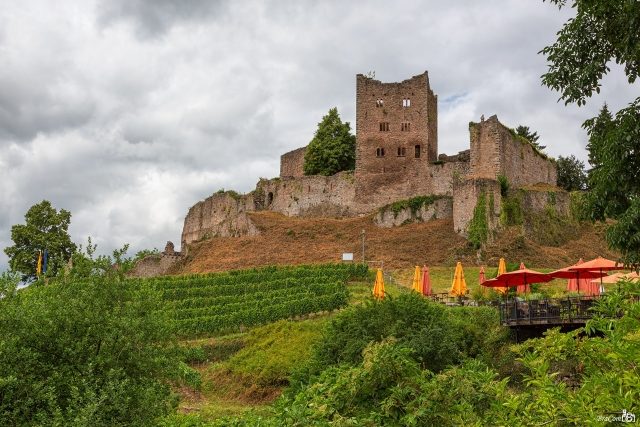
Schauenburg Castle

The remains of the Castle can be visited
Museum


The Schauenburg is the ruin of a hilltop castle on a 367 m above sea level spur terrace in the Renchtal above Gaisbach, a district of the city of Oberkirch, in the Ortenaukreis in Baden-Württemberg.

The spur castle was built in the 11th century by Duke Berthold II of Zähringen and first mentioned in 1120. Duke Welf VI, a brother of Henry the Proud of Bavaria, received the Schauenburg in 1131 as a dowry from his wife Uta, Countess of Eberstein and granddaughter of Count Palatine Gottfried of Calw. Count Gottfried was married to a Luitgard of Zähringen, who brought him the Schauenburg. With Uta of Schauenburg, the castle possesses a famous personality. Uta's brother Eberhard of Eberstein was a co-founder of the Allerheiligen Monastery, so she bequeathed the Schauenburg to him, as reported by the Sindelfinger Chronicle. The owners were now the Lords of Eberstein, until Wolf of Eberstein had to sell it in 1386 along with his half of the County of Eberstein to Rudolf VII of Baden. After the death of Ludwig Winterbach of Schauenburg, the last of his line, Heinrich Truchsess of Höfingen was to be enfeoffed by the Margrave with Ludwig's share of the castle. However, the other families of Schauenburg, who had also been enfeoffed with parts of the castle, resisted and invoked their status as a Ganerbenburg (jointly inherited castle). This led to the feud of the Lords of Schauenburg with Bernhard of Baden in the years 1402 and 1403, which they were able to win. After the Ebersteins, the castle passed to the Grand Duchy of Baden. The castle was besieged several times, but only captured twice. For the expansion of Gaisbacher Castle in the 17th century, stones from the castle were used. After various destructions (presumably in 1689 under the generals Vauban and Melac), the former castle has been a well-maintained ruin since the 18th century.

Current Use+

The Schauenburg is a popular excursion destination. A small museum is located in the cellar of the former chapel.

Layout+

The still well-preserved ruin of the castle complex with at least three residential towers, two of which are still partially preserved, still shows remnants of a gate tower, a curtain wall, a shield wall against which a chapel leaned, and remnants of an outer bailey, surrounded by a ring ditch and an embankment in front of it.

Take Mobile History with you

You are reading this text for free. Premium adds what matters on the road: descriptions read aloud, sites found through your camera, whole regions taken offline.

  • Every description, including the ~17,700 Premium sites
  • Audio guide: have descriptions read to you on location
  • AR finder: see sites through your camera, with distance and bearing
  • Unlimited saved sites

14 days free, then from €2.99 a month. Cancel anytime.

Source: Wikipedia · Licence: CC BY-SA 4.0 · Image: © BraCom (Bram)

This description draws on the facts documented in the linked Wikipedia article; Wikipedia content is licensed under CC BY-SA 4.0. Wording and editing: Mobile History.

Location: 48.5395, 8.0945