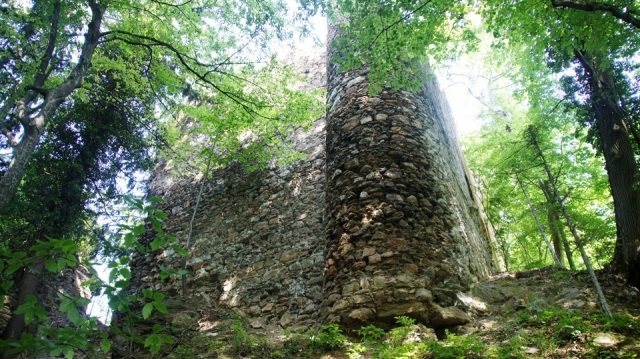
The remains of the Castle can be visited
CastleSchloßberg
Schmirnberg Castle
History+
The origins of Schmirnberg Castle likely date back to the 11th century, when it was built by the Spanheimers and gifted to St. Paul's Abbey around 1100. It was first documented around 1250 as "castrum Smilnburch" in the possession of Hadmar von Schönberch. The dominion once encompassed vast areas, including the entire Leutschach region. The castle frequently changed hands, including the Lords of Mureck, the Schönbergers, Count Ulrich von Heunburg, and later the Hohenlohe family. In 1292, the castle was captured by ducal troops during a noble uprising but returned in 1295. In 1326, the Hohenlohe family sold "Smyelenburch" to Ulrich von Walsee. In 1363, St. Paul's Abbey granted the castle to Duke Rudolf IV, and after his death, to the Counts of Cilli. King Frederick III seized the castle from the Cilli family in 1443, making it a princely fief and pledge dominion. Extensive construction work was carried out in the 16th century, including new vaults and the expansion of a four-story building.
Source: Wikipedia · Licence: CC BY-SA 4.0 · Image: http://www.wehrbauten.at
This description draws on the facts documented in the linked Wikipedia article; Wikipedia content is licensed under CC BY-SA 4.0. Wording and editing: Mobile History.
Location: 46.6314, 15.4881