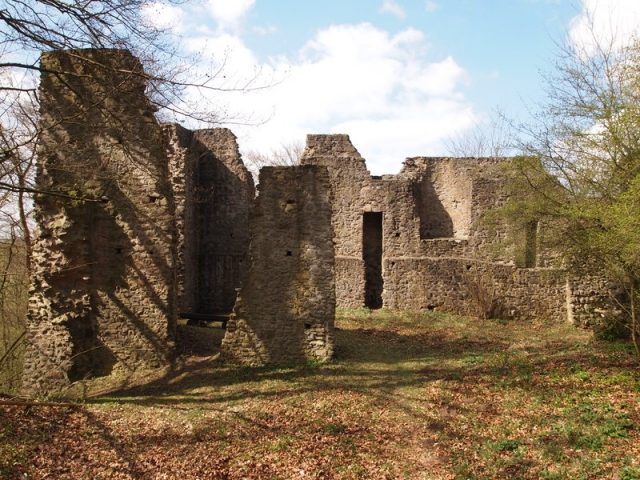
The remains of the Castle can be visited
Schönstein Castle

The castle ruin Schönstein is the ruin of a Romanesque hilltop castle in the municipality of Gilserberg-Schönau in the North Hessian Schwalm-Eder district, (Germany).
The spur castle is located on a western mountain spur of the 419 m above sea level Gilserberg "Schloßberg" (Castle Hill) east above the Gilsa valley. The Schloßberg is located on the western flank of the Hemberg ridge, which is situated in the Kellerwald-Edersee Nature Park. It lies a little more than 1 km (as the crow flies) south of the village of Schönstein, named after the castle, and about the same distance northwest of Schönau. Both are districts of Gilserberg.
The history of the castle's origin is only vaguely known: it was not until the 19th century that Felix von Gilsa zu Gilsa reported on the castle's history. Although first documented in 1350, the castle was probably built as early as the 12th century by the Counts of Ziegenhain. It served to control the Gilsa valley.
Godebracht von Linsingen is already mentioned as a Ziegenhain castellan in 1170/1177; his family built Jesberg Castle. Due to its strategic location, Schönstein Castle, alongside Jesberg and Densberg castles, played an important strategic role in the Hessian-Mainz conflicts of the 13th and 14th centuries.
In 1300, Count Gottfried VI of Ziegenhain enfeoffed the castle to Hermann von Löwenstein-Schweinsberg. Count Johann I, Gottfried VI's son, established a new office there in 1350. The Schönstein office included the villages of Lischeid, Moischeid, Winterscheid and Gerwigshain (now a deserted village), which had just been acquired from Haina Monastery, as well as the places Falkenhain, Frankenhain, Treisbach (near Sebbeterode), Schönau and Sachsenhausen, which previously belonged to the court on the Wasen (Ziegenhain). In 1358, he expanded the castle complex. Subsequently, Schönstein Castle and its office were repeatedly pledged, for example, as early as 1368 to the families von Linsingen and von Gilsa, who also received permission to expand and strengthen the castle.
During the Sterner War, the castle was conquered and destroyed by Landgrave Heinrich II of Hesse in 1371 or 1372 after a long siege. After its reconstruction, it was again conquered by Hessian troops in 1399 and subsequently destroyed. A renewed reconstruction followed, but this time without a keep. In 1406, the castle and the Schönstein office were pledged to Ekkebrecht von Grifte.
Through the inheritance contract of the last Count of Ziegenhain, Johann II, the castle fell to the Landgraves of Hesse in 1450 with the entire County of Ziegenhain. In the Hessian Fratricidal War in 1469, Bohemian mercenaries of Landgrave Ludwig II of Lower Hesse (Hesse-Kassel) destroyed the castle, which at that time belonged to his brother, Landgrave Heinrich III of Upper Hesse (Hesse-Marburg). (The neighboring castles Densberg and Jesberg suffered the same fate.)
Until 1543, the castle was still the seat of Hessian bailiffs who administered the northern part of the former County of Ziegenhain, the Schönstein office with 14 villages of the Gilserberg uplands. Otto Hund was the last bailiff of Schönstein. Until the destruction of the castle, court days were held at Schönstein.
From 1557, the castle gradually fell into disrepair. In 1601, residents of Schönau assured Landgrave Moritz the Learned that stones from the dilapidated castle had been used for the construction of Ziegenhain Fortress and not for the construction of their own houses.
Architectural description and current condition+
The remains of the castle lie on a rectangular plateau with a base area of 20 by 36 meters. It was separated from the sloping hillside by a deep ditch. To the southwest, ramparts and ditches served as security. The main building was three stories high. In addition, there was temporarily a keep, which was destroyed during conquests. The best preserved parts today are the walls, which probably belonged to the palas with its windows and fireplace. The local greywacke was used as building material for the constructions.
In 1987/1988, the remains of the castle were secured by the Schwalmstadt Forestry Office and the Hessian State Office for Monument Preservation.
Today, the castle ruin is a popular excursion destination, especially for hikers. The Kellerwaldsteig trail passes by the ruin.
Take Mobile History with you
You are reading this text for free. Premium adds what matters on the road: descriptions read aloud, sites found through your camera, whole regions taken offline.
- Every description, including the ~17,700 Premium sites
- Audio guide: have descriptions read to you on location
- AR finder: see sites through your camera, with distance and bearing
- Unlimited saved sites
14 days free, then from €2.99 a month. Cancel anytime.
Source: Wikipedia · Licence: CC BY-SA 4.0 · Image: http://www.wehrbauten.de/thread.php?threadid=1367
This description draws on the facts documented in the linked Wikipedia article; Wikipedia content is licensed under CC BY-SA 4.0. Wording and editing: Mobile History.
Location: 50.9804, 9.0629