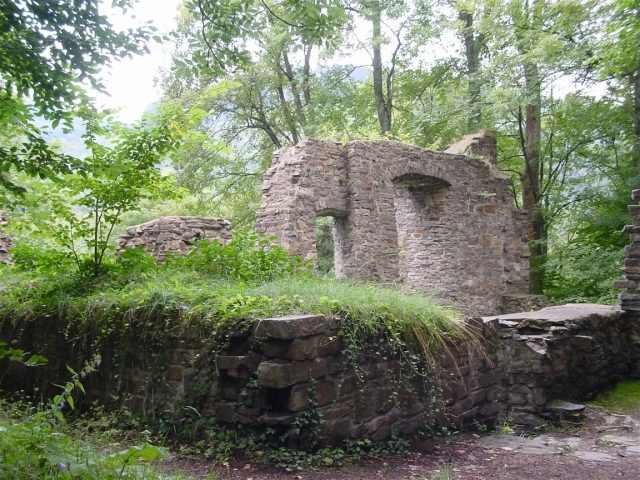
The remains of the Castle can be visited
Schwarzenberg Castle

Schwarzenberg Castle is the ruin of a hilltop castle in Plettenberg, North Rhine-Westphalia.
As a military stronghold, seat of Märkisch bailiffs, and temporary residence of the Counts of the Mark, the castle, built over 700 years ago and structurally altered several times thereafter, determined the fate of the region and its inhabitants until its final destruction by fire in the 19th century. Even in its ruined state, the castle, picturesquely situated above the Lenne Valley, has lost none of its appeal. The area around Schwarzenberg Castle was heavily contested in the Middle Ages. Here, the Archbishops of Cologne (together with the Counts of Berg) and the Counts of the Mark confronted each other. Eberhard I of the Mark destroyed the Cologne castles of Isenburg, Volmarstein, and Raffenburg, as well as the cities of Werl and Menden, in 1288. In the east of the Sauerland, Count Otto of Waldeck destroyed the castle and town of Hallenberg. The castles of Rodenburg (near Menden) and Waldenburg were taken over. The Archbishop of Cologne had to concede the right to fortify and agree in an agreement that neither party could erect fortifications on the other's territory. A castle policy directed against the Cologne archdiocese began.
In a peace treaty in 1289, Archbishop Siegfried von Westerburg renounced all claims, especially for compensation for losses suffered. In addition, he had to pledge Waldenburg to Count Adolf III of Berg, who then re-pledged the castle to Eberhard I of the Mark. In this precarious situation, the Archbishop had Burg Schnellenberg repaired by his marshal Johann I of Plettenberg, in order to be able to undertake sorties into the Mark from there if necessary.
After Wigbold von Holte, Archbishop of Cologne, had redeemed Waldenburg on December 15, 1300, the Märkisch comital house realized that its southern border urgently needed to be secured, as only the city of Lüdenscheid and Altena Castle had been available for this purpose until then. Both, however, were too far from the border. Possibly to obtain Arnsberg's consent for the construction of Schwarzenberg Castle, Count Engelbert II also allied himself with Count Ludwig von Arnsberg against his enemies. Engelbert II also seems to have obtained King Albrecht's approval for his right to fortify.
Construction of the Castle
On July 11, 1301, Eberhard II concluded an alliance with Count Ludwig von Arnsberg for the planned construction of Schwarzenberg Castle, which was also started by Rutger von Altena on October 2, 1301. Eberhard's successor, Engelbert III of the Mark, rid himself of the Arnsberg rights to Schwarzenberg Castle by having their castle house destroyed in 1352 during a feud against Count Gottfried IV of Arnsberg, and was now in sole possession of the complex. In 1353, the Märkisch sovereign instructed his Droste Gerhard von Plettenberg to expand and strengthen Schwarzenberg Castle, which primarily consisted of a "strong tower (residential tower)" and a compact core complex. Furthermore, he entrusted Gerhard von Plettenberg, who had administered the Märkisch possessions in Gummersbach (Oberbergischer Kreis) since 1351 and had held a castle fief on Schwarzenberg since 1343, with the task of founding Burg and Stadt Neuenrade in 1353 to secure Märkisch sovereign interests. Since Count Engelbert III preferred to stay at Schwarzenberg during his reign (1347-1391), and the castle thus temporarily served as a "residence" or center of power, a generous and representative furnishing of the complex can be assumed. The importance that Schwarzenberg Castle had for Count Engelbert III of the Mark is documented not only by the construction measures verifiable in 1353, but also by a foundation for the castle chapel there in 1385. On May 1, 1385, he endowed the already existing "altare to dem Swartenberge" with goods in Gevern, not far from Neuenrade. Although it was within sight of the Cologne border to the town of Rönkhausen, the Archbishop could not prevent the construction of the castle. This re-established a balance on the border with Cologne.
Schwarzenberg Castle, along with the castles of Mark, Altena, Wetter, and Blankenstein, was one of the most important state castles, which, however, hindered the development of Plettenberg into a city.
Takeover by the Dukes of Berg
In the course of a feud between Count Adolf II of Kleve and Duke Adolf of Berg, the castle fell to the then ally of the Duke of Berg, Eberhard von Limburg, around 1397. After Adolf had reached a reconciliation with the two in 1399, the pledge was redeemed for a payment of money. The required sum of money was advanced to Count Adolf by the knight Wennemar Dücker, who received the offices of Lüdenscheid Neustadt and Schwarzenberg as a pledge in return.
In connection with the inheritance disputes with his brother Gerhard, Duke Adolf of Kleve pledged the castle and the parish of Plettenberg for 1600 guilders to Diderich van Hemmerde in 1422, and his brother Gerhard then pledged it to Duke Adolf of Berg in 1423. For 25 years, the castle was now withdrawn from Märkisch power. Duke Adolf of Jülich-Berg appointed his follower Wilhelm II von Nesselrode as bailiff in 1423 and instructed him to feed "20 bread-eaters" at Schwarzenberg Castle. The twenty-man castle garrison consisted, among others, of six guards and one gatekeeper, one porter, one cook, and one cellarer each. The cellarer was responsible for accounting and managing the income from the district. Before Schwarzenberg was taken over by Heinrich Ovelacker in 1425, the castle was briefly in the hands of Heinrich Wrede, who had carried out construction work on the defensive and residential building. Hermann Ovelacker was succeeded in the pledged possession of the Märkisch state castle by his sons, one of whom, Gerhard von der Mark, was finally able to reacquire Schwarzenberg in 1444.
A year later, the fortification, along with Herscheid, Altena, Lüdenscheid, Neuenrade, and Dortmund-Hörde, came into the possession of the Cologne Archbishop Dietrich von Moers (1414-1463), with the consent of Gerhard von der Mark, the castles and offices of Schwarzenberg. After the Count of the Mark succeeded in redeeming Schwarzenberg again in 1447, the castle was pledged in 1450 for 1500 guilders to the Märkisch bailiff Wilhelm von Nesselrode, who also appears as pledge lord of the castle and office and the parish of Lüdenscheid. Six years later, in 1456, Count Gerhard von der Mark and his nephew, Duke Johann I von Kleve-Mark (+1481), allowed Evert von der Mark, an illegitimate son of Gerhard, to redeem the castle and office from Wilhelm von der Nesselrode for 1500 guilders. They transferred Schwarzenberg Castle to Evert for life with the condition that he should under no circumstances alienate the property.
Takeover by the Plettenberg Family
In 1513, the castle came into the possession of Heidenreich von Plettenberg through Duke Johann II von Kleve-Mark (1521) for a loan of 2600 gold guilders, who bequeathed his property to his descendants. After 140 years of the Schwarzenberg pledge by the Plettenberg family, Elector Friedrich Wilhelm of Brandenburg redeemed it again. In 1661, Christofer von Plettenberg succeeded in acquiring the neglected castle as appointed Droste, as well as the associated lands, rights, and income. The Plettenberg family. Finally, the castle came to the Plettenberg-Bodelschwingh line, founded in 1788 by Georg Theobald von Plettenberg and his wife Christine von Bodelschwingh, who lived here until about 1830 and laid out the Baroque garden located in the former Zwinger area. From 1836, the buildings served as accommodation for the forester Ludwig Vetter from Lehnhausen and later for his son.
In the 17th century, the residential tower and castle chapel were only preserved as ruins. After a lightning strike, the castle burned down completely in 1864 with all the remaining residential buildings, so that the still standing walls had to be largely demolished due to the risk of collapse. The stone material obtained was used for the new construction of the still preserved forester's house below the castle. Today, the castle ruin is owned by Mrs. Elisabeth von Chappuis, née Frei Freiin zu Inn- und Knyphausen zu Bodelschwingh. Since 1911, the ruin has been preserved in its current state.
Layout+
The castle initially consisted only of a keep with a side length of about 13 meters and, together with the well and the count's house, formed the first stage of expansion. Further developments included the expansion of the Roisthaus, forge, bakehouse, and the castle chapel. Presumably in the last construction phase in the 15th century, the core castle was walled, creating the outer castle courtyard with the garden. The castle well, which was uncovered between 1981 and 1985 by the Plettenberg Shooting Society, has a depth of 26 meters. Still recognizable today is the outdoor toilet visible on the east side of the former bakehouse. Foundation walls of the Droste's house, a round ascent, and the Elector's house are also preserved, as are the bakehouse and parts of the keep with the aforementioned well.
Take Mobile History with you
You are reading this text for free. Premium adds what matters on the road: descriptions read aloud, sites found through your camera, whole regions taken offline.
- Every description, including the ~17,700 Premium sites
- Audio guide: have descriptions read to you on location
- AR finder: see sites through your camera, with distance and bearing
- Unlimited saved sites
14 days free, then from €2.99 a month. Cancel anytime.
Source: Wikipedia · Licence: CC BY-SA 4.0 · Image: Roland Neubert, Halle (Saale)
This description draws on the facts documented in the linked Wikipedia article; Wikipedia content is licensed under CC BY-SA 4.0. Wording and editing: Mobile History.
Location: 51.2208, 7.9103