CastleSasbach am Kaiserstuhl-Jechtingen

Sponeck Castle
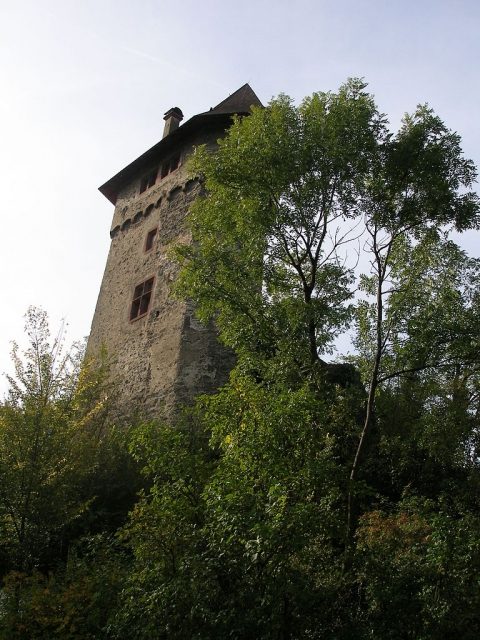
Sponeck Castle

The remains of the Castle can be visited

Sponeck Castle, formerly also known as Spanegge, is the ruin of a hilltop castle on a 202 m above sea level rock spur above the Rhine near the district of Jechtingen in the municipality of Sasbach am Kaiserstuhl in the Emmendingen district of Baden-Württemberg. The castle was built over the remains of a late antique fort.

Both the fort and the castle were built on the 25-meter-high rock spur, which was then surrounded by the Rhine on three sides. An attack was only possible from the east. It was only through Tulla's straightening of the Rhine that the Rhine was shifted about 200 meters to the west. Due to the associated change in topography, the rock located west of Sasbach-Jechtingen is now completely surrounded by land.

Late Antique Border Fort

In 1973, during excavations in the forecourt of Sponeck Castle, remains of a late antique fort, built around 370 during the reign of Emperor Valentinian I, were discovered. Walls, towers, and part of the interior buildings could be identified. The irregular layout resembles a medieval castle more than a Roman Limes fort and adapts its wall course to the terrain. The east side was sealed off by a 1.6-meter-thick wall with two corner towers. Another tower is assumed at the highest point of the rock, whose foundations could be partially excavated. From there, a line of sight to the next late antique military sites on the Rhine and in Alsace was ensured. The interior buildings consisted of half-timbered structures leaning against the walls; floor plans could not be determined. The relatively small but strong complex, measuring approximately 40 x 50 meters, together with the neighboring late Roman fortress on the "mons brisiacum" (Breisach) to the south and the forts of Oedenburg and Horbourg in present-day Alsace, served to secure the Rhine crossing and defend against the Germanic tribes. The number of four late antique military installations in a confined space is unique. In 378, the Alamanni crossed the Rhine either at the "Sponeck Fort" or at Breisach, but were repelled by Emperor Gratian in the Battle of Argentovaria. According to the finds within the fort and a nearby cemetery, where the soldiers' family members were also buried, the fort existed at least until the withdrawal of the border troops in 401, but probably beyond. There is much to suggest that the complex initially served the Alamanni, then the Franks, as a base for securing the Rhine crossing. After that, the fort fell into disrepair; the strategically favorable location of the rock spur was only used again in the late Middle Ages.

Hilltop Castle

The hilltop castle was built after 1281 by Herildebrand von Sponeck over the former fort. In 1302, a Hildebrand "de Sponecke" is mentioned. After 1333, the castle passed to the Counts of Württemberg, to whom it served as a bridgehead to the County of Horbourg in Alsace. After the expulsion of Duke Ulrich of Württemberg, the castle came into the possession of Caspar Fabri in 1525 and Jacob von Berckheim in 1540. Around 1550, the castle returned to Württemberg possession to the Montbéliard line, presumably already dilapidated. During the Thirty Years' War, the castle was a ruin. The name of the Counts of Sponeck, related to the House of Württemberg, derives from the castle. With the Exchange and Epurations Treaty of 1806, the castle passed from the Kingdom of Württemberg to the Grand Duchy of Baden.

In 1781 or 1802, the Anterior Austrian government councilor Ägid Karl von Fahnenberg from Burkheim am Kaiserstuhl tried to acquire the castle and the associated estate from the Württembergers. His plan was to admit Jews into this imperial immediacy territory in exchange for protection money.

Later, Sebastian Sichler, the innkeeper of the Adler in Burkheim, managed to obtain the castle as a hereditary fief. He had set up a tavern in the ruin and had become mayor. Against payment of a redemption sum of 1100 guilders, he received the castle from the Freiburg Oberhofgericht even after its transfer to Baden.

After several changes of ownership, in 1917 the painter Hans Adolf Bühler acquired the castle for 25,000 Goldmark, rebuilt it, and set up a studio in the former residential tower. The reconstruction involved, among others, the Freiburg architect Carl Anton Meckel and the company Brenzinger & Cie. After the painter's death in 1951, the castle remained in family ownership.

The Complex Today+

Nothing remains of the historic castle complex. It had a core castle of approximately 22 by 25 meters, with a palas of approximately 9 by 7 meters, a keep with a base area of approximately 12 by 12.5 meters and a wall thickness of approximately 1.7 meters, as well as an outer bailey with a residential tower. The buildings still visible today and partly ruined, like the tower, are structural additions from the 19th and 20th centuries. From the Roman fort, the restored remains of a stone wall and two corner towers are preserved.

Take Mobile History with you

You are reading this text for free. Premium adds what matters on the road: descriptions read aloud, sites found through your camera, whole regions taken offline.

  • Every description, including the ~17,700 Premium sites
  • Audio guide: have descriptions read to you on location
  • AR finder: see sites through your camera, with distance and bearing
  • Unlimited saved sites

14 days free, then from €2.99 a month. Cancel anytime.

Source: Wikipedia · Licence: CC BY-SA 4.0 · Image: http://commons.wikimedia.org/wiki/File:Kaiserstuhl_2012_134.jpg

This description draws on the facts documented in the linked Wikipedia article; Wikipedia content is licensed under CC BY-SA 4.0. Wording and editing: Mobile History.

Location: 48.1141, 7.5839