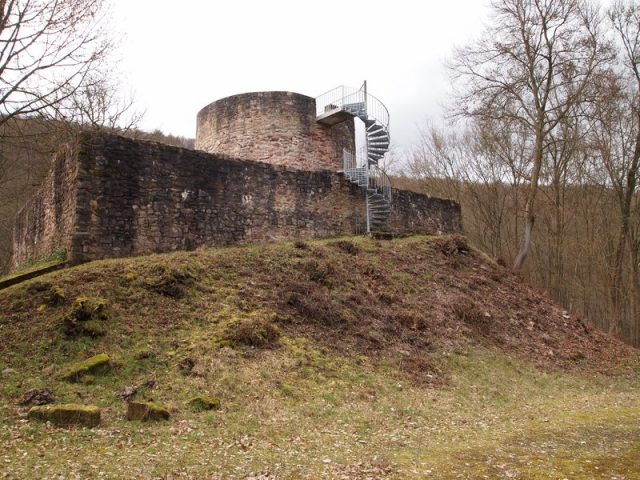
The remains of the Castle can be visited
Sprengelburg Castle

The Sprengelburg (or Springeburg) is the ruin of a hilltop castle in the Kusel district in Rhineland-Palatinate. It is located between the municipalities of Eßweiler and Oberweiler im Tal on the L 372. Since 1983, the ruin has been designated as a historical monument.
The Sprengelburg is located on an outcrop of the Königsberg between Eßweiler and Oberweiler im Tal directly on today's state road 372. The municipal boundary of the two communities runs through the castle grounds.
In the Middle Ages
Judging by the existing building remains, the Sprengelburg was probably built in the 13th century. The castle was built at the narrowest point of the Talbach valley and controlled the road that then ran below the castle in the valley floor.
The known lords of the castle were the Knights Mühlenstein, vassals of the Rheingrafen in Grumbach. Whether they were also the builders is uncertain. The Mühlenstein family is attested from 1317 to 1451. The Knights Mühlenstein acted as robber knights and caused severe damage to merchants using the road. Consequently, the castle was also destroyed by Strasbourg merchants as a retaliatory measure for the raids. The exact date of the destruction is not known. However, the Lichtenberg district clerk and surveyor Johannes Hoffmann wrote in his "Description of the Essweiler Valley 1595" that after the destruction, the castle grounds were cleared and sown several times by the local farmers, but the harvests always failed due to wet and cold summers. When, after a third clearing, "a great darkness came in the middle of the day in summer" and this harvest also failed, they finally gave up and the castle area became overgrown in the following years. This darkness after the third clearing could have been the solar eclipse of 1441.
Modern Era
After the futile attempts at use, the castle grounds became completely overgrown. Until the 1970s, no building remains could be found; the castle lay dormant under a hill covered with trees. Only the name "am alten Schloss" (at the old castle) and the remains of the neck ditch, which was partly built over by the L372, still reminded of what was hidden beneath.
From 1976, excavations were carried out on the site by students from the University of Maryland under the direction of Professor Higel. The remains of the outer walls, a rectangle of 20 by 15 m, and a round tower 8 m in diameter were uncovered. In the summer of 1978, the skeleton of a woman was also discovered inside the castle. After the excavations were completed, reconstruction measures were carried out, initiated by the Office for Monument Preservation in Speyer. The outer walls and the tower were rebuilt, and a round-arched gate was inserted into the outer wall on the back of the complex as an entrance. Some of the stones found during the excavation were used for this. The modern access to the tower, an iron spiral staircase, was also added at that time.
Stories about the Castle+
The following stories circulate about the castle ruin:
The Destruction of the Castle
Johannes Hofmann writes the following about the destruction of the castle in his "Description of the Eßweiler Valley 1595":
The Knights of Mülestein, two brothers, were once at a wedding in Eßweiler. The Strasbourg merchants took advantage of this, disguised themselves, and were mistakenly taken for the Mühlensteiners by the remaining castle garrison and let in. They conquered the castle, plundered and destroyed it. Attracted by the noise, the true lords of the castle returned, saw that they could do nothing more, and fled. They were overtaken by the Strasbourg merchants before Hinzweiler. One of the brothers was stabbed to death. A cross was later erected at this spot, and the field name "An den Kreuzäckern" (At the Cross Fields) bears witness to it. The other Mühlensteiner managed to escape to Grumbach.
The Hunchbacked Man
If you were on the road between Oberweiler im Tal and Eßweiler in the evening or at night, it could happen that you suddenly felt a heavy load on your back, which almost wanted to push you to the ground. The uphill path became increasingly arduous. However, once you had passed the "old castle," the weight suddenly disappeared. What was going on? The explanation is simple: the hunchbacked man who lives in the old castle ruin had let himself be carried home by the hiker.
The White Lady
Another apparition is a White Lady who is said to appear to passers-by from the castle tower and tries to entice them to follow her by waving and calling.
Tunnel to Wolfstein
Allegedly, there is a passage from the Sprengelburg that leads under the Königsberg to Wolfstein. It has not yet been found. However, mercury and barite were actively mined in the Königsberg until the 1950s, so there are many tunnels there.
Take Mobile History with you
You are reading this text for free. Premium adds what matters on the road: descriptions read aloud, sites found through your camera, whole regions taken offline.
- Every description, including the ~17,700 Premium sites
- Audio guide: have descriptions read to you on location
- AR finder: see sites through your camera, with distance and bearing
- Unlimited saved sites
14 days free, then from €2.99 a month. Cancel anytime.
Source: Wikipedia · Licence: CC BY-SA 4.0 · Image: http://www.wehrbauten.de/thread.php?threadid=1347
This description draws on the facts documented in the linked Wikipedia article; Wikipedia content is licensed under CC BY-SA 4.0. Wording and editing: Mobile History.
Location: 49.5663, 7.5578