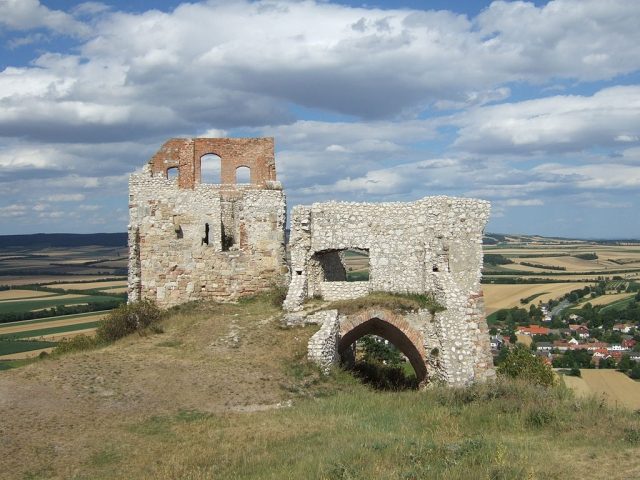
CastleStaatz

Staatz Castle

Staatz Castle

The remains of the Castle can be visited

The Staatz castle ruin is located in the northern Weinviertel in the market town of Staatz. The castle lies on the Staatz Cliff, as the mountain is called, which stands as a solitary peak in the hilly landscape of the Weinviertel.

This excellent strategic location led to the construction of a castle on the Staatz Cliff as early as the 11th century; in 1072, a Pucho de Stoz is mentioned for the first time in a document. Until the middle of the 13th century, representatives of the Staatz family repeatedly appear in documents.

In 1246, the armies of Frederick II the Quarrelsome and Ulrich of Carinthia faced each other in the plain below the castle. Ulrich had invaded Austria on behalf of his Bohemian relatives. The Carinthian, who was ultimately defeated in the battle against the last Babenberg, was subsequently held captive at Staatz. King Ottokar II Přemysl enfeoffed Otto von Maissau with the castle. Under the Maissauers, the castle experienced its heyday, and the village below the castle is referred to as a town in documents. After a failed uprising against Duke Albert V, Staatz was taken from the Maissauers in 1430 and pledged in 1431 as a princely fief to Niklas Truchseß von Drasenhofen. In the first half of the 16th century, Staatz came into the possession of the Barons of Roggendorf. In 1551, the Roman-German King and later Emperor Ferdinand I pledged Staatz from the sovereign to the Barons of Breuner, who further expanded the castle. In 1600, Seyfried Christoph von Breuner bought Staatz from Emperor Rudolf II. Since then, the castle has been in private ownership.

The Destruction of Staatz+

Staatz was considered impregnable. All the more surprising was the rapid capture and destruction of the castle during the Thirty Years' War by the Swedes under General Lennart Torstensson on April 24, 1645. The leader of the Swedish troops responsible for the destruction of the castle was Colonel Jordan. He forced the Staatz garrison to surrender the town through a ruse of war. From the Enzersdorfer Auberg, the Swedes began to bombard the castle. Traces of this are still visible today on the ashlar stones of the watchtower. Subsequently, the castle was set on fire and the main gate facing Ernsdorf was destroyed. This allowed the Swedes to enter the castle without major losses. After occupying the castle, it served as a connecting fortress to Moravia.

After 1645, the castle was abandoned and a new palace was built at the foot of the castle rock. In 1671, the Breuners sold the dominion of Staatz to the Barons of Kuenritz; in 1675, Staatz came into the possession of the Colloredo family. In 1945, the palace burned down and was demolished. Today, the granary, converted into a music society hall, the rock cellar, and two residential buildings from the palace complex are still preserved.

The Castle Today+

After the fall of Staatz, Staatz quickly fell into ruin. Today, remnants of the first gate are still preserved, as are parts of the palas with remnants of a coupled Romanesque window. At the top of the cliff, remnants of the keep still stand. The castle ruin can be visited freely, and the ascent is also worthwhile for the impressive view. Adventure tours for children are offered at the castle.

At the foot of Staatz Castle lies the Felsenbühne (rock stage) with musical performances in summer.

Take Mobile History with you

You are reading this text for free. Premium adds what matters on the road: descriptions read aloud, sites found through your camera, whole regions taken offline.

  • Every description, including the ~17,700 Premium sites
  • Audio guide: have descriptions read to you on location
  • AR finder: see sites through your camera, with distance and bearing
  • Unlimited saved sites

14 days free, then from €2.99 a month. Cancel anytime.

Source: Wikipedia · Licence: CC BY-SA 4.0 · Image: https://commons.wikimedia.org/wiki/File:Burgruine_Staatz.jpg

This description draws on the facts documented in the linked Wikipedia article; Wikipedia content is licensed under CC BY-SA 4.0. Wording and editing: Mobile History.

Location: 48.6767, 16.4897