CastleMariahof

Stein Castle

Stein Castle

The remains of the Castle can be visited

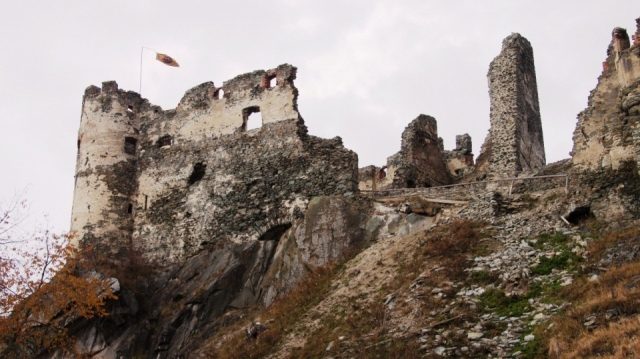
The Steinschloss ruin, at 1180 m above sea level, is the highest castle ruin in Styria (Austria). It is located in the Upper Murtal in the municipality of Mariahof, on the northwest slope of the Steinberg towards Teufenbach.

This castle was probably built in the 12th century by the noble family "von Stein". In 1503, Steinschloss was sold by its then owner, the noble family Liechtenstein, to St. Lambrecht Abbey. In 1525, the castle was fortified during peasant uprisings and Turkish invasions.

The size of this ruin is impressive and clearly shows the original dimensions of this defensive structure.

Pipin, the son of Charlemagne, richly rewarded his brave heroes after the victories over the Hungarians and Avars. Thus, the free man Engelschalk received, in addition to noble dignity, a large forest above Scheifling as a fief. Engelschalk then had the fortress Stein built on the high rock and lived there for several years. When he died, his subjects mourned their good lord, who left behind seven beautiful daughters and a son. The latter served in the German imperial court. The daughters found the best support in Lord von Saurau, their deceased mother's brother. The beauty of the sisters was so well known that the number of marriage-minded nobles in the castle of Stein increased daily. But none of the sisters wanted to be the first to be conquered. They sent the wooing knights out into the world to undertake impossible adventures.

A Welsh knight was also enchanted by the charms of the castle maidens. Until late into the night, they entertained him with string music and dance and served him the most fiery wine. He threw himself at the feet of Gisela, the most beautiful but also the proudest of the sisters, and confessed his love to her. Gisela mockingly replied to the knight: "How dare you speak of love? Prove by deeds that you are worthy of the love of the daughters of Stein! If you can throw a chain around the horns of the moon and shackle it to the rocks of this castle, then ask again for an answer here!" Thereupon, the like-minded sisters retreated to their chambers. The knight's passionate love turned into hatred.

He left the hall and hid behind the tower stairs, where he plotted his revenge. The night was warm and bright. He saw Gisela, clad in a nightgown, walk through the castle courtyard and then through a small gate into the garden. The knight immediately crept after her, exacted his revenge, and galloped away. Gisela rushed to her sisters and told them about the knight's shameless act of revenge. Thereupon, the sisters of Stein swore to hate all men. The seven women then had a castle built on a steep rock, where they then lived in complete seclusion. This castle was named Frauenburg after them.

Gisela's son earned his spurs in the emperor's battles. He became the owner of the castle and the progenitor of the now extinct Knights of Frauenburg, who bore the moon shackled by its horns as their coat of arms.

The Legend of the Vanished Knight

Bitter enmity arose between the lords of Kaisersberg and those of Stein. A Kaisersberger wanted to marry the maiden of Stein. However, the suitor was rejected because the lord of Stein wanted a prince, not an ordinary knight, as his son-in-law. A verbal altercation erupted between the two castle owners, during which the Kaisersberger was thrown down a staircase and fell to his death.

Years later, a knight of Kaisersberg and a maiden of Stein fell in love again. The family feud reawakened in the maiden's father. He drew his sword against the young Kaisersberger, but the maiden intercepted the fatal blow. Senselessly, the old man swung his sword again and split the Kaisersberger's head. From that hour on, the old knight was no longer seen in his castle - he remained vanished. In Seckau Abbey, where the knight's maiden was buried, a tall, serious, and silent man later entered as a lay brother. He prayed for nights in the crypt, and one day he was found dead lying on the grave of the maiden of Stein.

If disaster threatens in this area, a monk appears in the cloister of the abbey, carrying a coffin in which lies a white-clad girl with a bleeding chest wound. A youth with a split forehead gazes longingly at the deceased.

Take Mobile History with you

You are reading this text for free. Premium adds what matters on the road: descriptions read aloud, sites found through your camera, whole regions taken offline.

  • Every description, including the ~17,700 Premium sites
  • Audio guide: have descriptions read to you on location
  • AR finder: see sites through your camera, with distance and bearing
  • Unlimited saved sites

14 days free, then from €2.99 a month. Cancel anytime.

Source: Wikipedia · Licence: CC BY-SA 4.0 · Image: http://www.wehrbauten.at

This description draws on the facts documented in the linked Wikipedia article; Wikipedia content is licensed under CC BY-SA 4.0. Wording and editing: Mobile History.

Location: 47.1288, 14.3826