The remains of the Castle can be visited
CastleLoßburg-Sterneck
Sterneck Castle
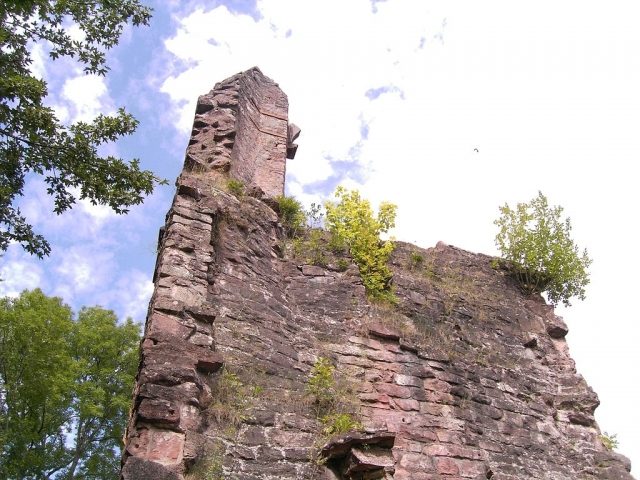
The Sterneck ruin, also called Sterneneck, is a castle and palace ruin on a spur in the Sterneck district of the municipality of Loßburg in the Freudenstadt district in Baden-Württemberg.
The ruin stands on the western edge of the Gäu to the eastern Black Forest on a spur above the Heimbach, a tributary of the Glatt, which flows eastward here. It is located at 551.2 m above sea level, about 40 meters above the river, which forms a south loop around the spur, a little over 200 meters long and slightly less wide. North of this, on the plateau above the valley, begin the houses of the scattered hamlet of Sterneck; to the south, at the foot of the spur on this side of the bank, lies the residential area of Schloßmühle. Downstream, the Heimbach is now dammed by the Heimbach dam, whose backwater almost reaches the mill.
The Sterneck ruin near the Schloss-Schenke above the Heimbach valley is a popular attraction for hikers and spa guests.
The builder of Sterneck Castle, Vollmar von Brandeck (between 1230 and 1250), as bailiff of Dornhan, got into a dispute with Alpirsbach Abbey over jurisdiction. He took revenge by robbing and plundering in the abbey's territory. He probably overextended himself with the large new castle complex; for after his death, his widow and children had to sell Breitenwies near Aischfeld and Oberehlenbogen in 1276. The only potential buyer was Alpirsbach Abbey. And the abbey first asserted the damages caused by the testator. Almost half of the purchase price was offset against the damages caused by the testator Volmar.
In the Middle Ages, the Sterneck dominion included four villages (Fürnsal, Walde, Breitenau, and Busenweiler), the parish estate of Unterbrändi with the interesting boundary stones still preserved today, farms in Geroldsweiler and Dottenweiler, and the noble Trollenberg. Originally, it also included Breitenwies, the upper Ehlenbogental, the Trollenberg, the Grabenhof, the Stuhlhof with a former court seat, and the Vogelsberg, where according to Sattler, a castle once stood. The Brandeckers had further possessions in surrounding places, including Dornhan.
The upper, still preserved Renaissance frieze on the keep dates from the time of the last Brandecker, also a Vollmar († 1549). The wealthy son-in-law Georg von Ow certainly played a part here.
According to two drawings from around 1600, the castle stood on the eastern side of the castle and palace area. The sketch from the description of the Burgfrieden can be seen on one of the panels attached to the ruin. Another drawing comes from Johannes Öttinger [Map: Alpirsbacher Forst]. Two local historians therefore inspected the smaller cellar under the house on the east side and considered it to be the older one. They therefore asked Dr. Wein, the former district archivist of Freudenstadt, for an opinion. He examined the masonry and confirmed the assumption. He also came to the conviction that, according to the two drawings, the castle must have been located on the eastern side. So far, this fact has not been mentioned in the literature. The small cellar must therefore have belonged to the castle and was probably directly under the castle. It must be a good 750 years old.
From the east side, the Brandeckers could control the important traffic road below and collect road tolls. The road led from Dornstetten via Wittendorf, Oberbrändi, Sterneck, Gundelshausen, Dornhan to the crossroads at the Roman fort Waldmössingen. Roman sites are located along this road, but there is no evidence of a Roman road. The Wittendorf local history book describes the route with the corresponding evidence.
Road tolls improved the Brandeckers' coffers. The income from the small dominion was meager due to the division of inheritance among the various descendants. Thus, the four cousins Kuno, Hans the Lamparter, Klein-Hans, and Vollmar committed incursions into Württemberg territory. They probably believed the Württembergers were far away. But even Count Eberhardt III, the Mild, no longer wanted to tolerate their actions and, with the help of the Rottweilers, the notorious castle breakers, besieged Sterneck Castle. The result was burned farms around Sterneck and the surrender of the castle to the Württembergers. However, the Brandeckers got it back as a fief.
For decades, over two or three generations, the livestock population had not yet recovered. The Vogelsberg in 24-Höfe eventually had to be sold to Alpirsbach Abbey.
Source: Wikipedia · Licence: CC BY-SA 4.0 · Image: https://commons.wikimedia.org/wiki/File:BurgSterneckklein.jpg
This description draws on the facts documented in the linked Wikipedia article; Wikipedia content is licensed under CC BY-SA 4.0. Wording and editing: Mobile History.
Location: 48.3882, 8.4937