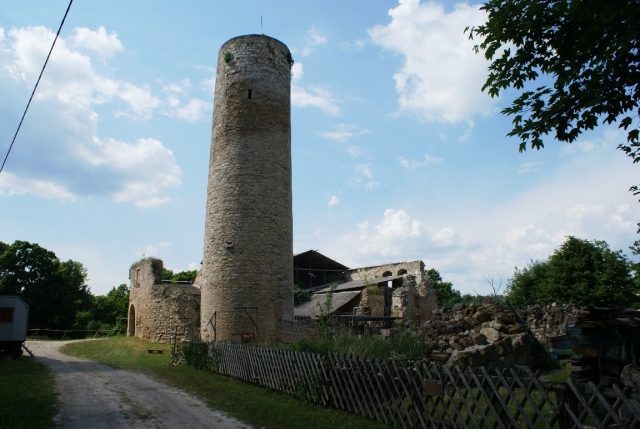
The remains of the Castle can be visited
Straußberg Castle

Straußberg Castle is a spur castle complex in the Sondershausen district of Straußberg in the Kyffhäuser district in Thuringia. The keep is climbable; the buildings have apparently only become ruins again in the last 50 years – during the GDR era. A dedicated association is working on the restoration of the castle under expert guidance. A visit to the buildings is possible through the local castle association.
The castle is located about 16 kilometers north of the town of Schlotheim, the former administrative seat, and rises on a mountain spur in the locality of Straußberg.
The castle was built around 1200 as a ministerial seat, possibly when the Landgraves of Thuringia took possession of territories that had become free with the outlawing of Henry the Lion. It was initially a military structure and a local center of power for the Landgraves.
The castle complex was first mentioned in a document in 1267, when Berthold von Schlotheim, as seneschal of Schlotheim, now a supporter of the new Thuringian Landgraves descended from the House of Wettin, issued a document at the castle. The content of the document concerns a land donation to his brother.
As an administrative center, the castle was also a meeting point for negotiations with local administrators. From 1285 to 1316, for example, the chamberlains of the neighboring imperial city of Mühlhausen issued documents there. Knightly families from the service nobility of the region were entrusted with the "Burghut" (castle guard) for the defense and administration of the castle. Around 1318, the castle had passed into the possession of the Counts of Hohnstein. Through inheritance, it passed to the Counts of Schwarzburg in 1356. Even in the 15th century, the castle had retained its strategic value; in 1421, the Counts enfeoffed the dominion to the Archbishop of Mainz. This helped the Archbishop of Mainz achieve a partial success in connection with the ongoing disputes with the Landgraves over supremacy in Thuringia.
From 1465–1548, the dominion was pledged to the Lords of Tütcheroda. After its redemption, Count Wilhelm von Schwarzburg made the castle his residence from 1552–1598. Structural changes in 1581 under his rule resulted in the renewed castle kitchen and the gatehouse. After Wilhelm's death, the castle complex became state property and was converted into a domain. The still intact buildings henceforth served as grain storage. Provisional securing measures were carried out by installing support pillars and partition walls. From the 1950s onwards, the castle, which had been structurally intact until then, was exposed to further decay. Only since 1990 have building-preserving measures been carried out by the local association. The castle today (2012) largely presents itself as a ruin.
Complex+
The castle has a trapezoidal floor plan and an extent (with moat) of about 70 x 70 m. The oldest part of the castle complex is considered to be the round keep projecting from the wall front on the south side of the castle area, which is separated from the surroundings by a moat. The masonry of the tower, built from small broken stones, has only a few window slits; the high-lying access to the interior of the tower was probably originally reached via a ladder. The platform, now used as a viewpoint, has no battlements; an illustration from the 19th century still shows the tower with a high, conical roof and weather vane. Under the protection of the keep was the access via a drawbridge on the south side of the castle. The former gatehouse is now a ruin. The living quarters of the castle were in the palas on the north side of the castle courtyard. The associated dilapidated outbuildings were still shown around 1880 as "forge" and "old kitchen" (with a ruined chimney). The castle chapel is located west of the tower and was "restored" around 1870. During the conversion, only the choir area remained as a "chapel" from the church building; the then owner designated the relatively dry space of the nave as a storage area for grain. Within the building complex, alterations were made in 1581 to enable the continued use of the already up to 300-year-old, partially dilapidated buildings. The residential buildings were also affected by this.
Miscellaneous+
Three peculiar stones were displayed in the castle, which, although standing in an antechamber of the chapel, were originally intended for entirely profane purposes; they resemble old official hollow measures with which, for example, wooden grain measures (bushels) could be checked. For this purpose, the grain determined with the wooden grain measure had to be poured into the corresponding cavities of the stone for the calibration test; if these were then incompletely filled, the wooden measure used was too small and was destroyed to prevent fraud. Until 1850, the castle was the seat of a Schwarzburg-Rudolstadt office; the administrator had to store various physical measures.
Take Mobile History with you
You are reading this text for free. Premium adds what matters on the road: descriptions read aloud, sites found through your camera, whole regions taken offline.
- Every description, including the ~17,700 Premium sites
- Audio guide: have descriptions read to you on location
- AR finder: see sites through your camera, with distance and bearing
- Unlimited saved sites
14 days free, then from €2.99 a month. Cancel anytime.
Source: Wikipedia · Licence: CC BY-SA 4.0 · Image: Roland Neubert, Halle (Saale)
This description draws on the facts documented in the linked Wikipedia article; Wikipedia content is licensed under CC BY-SA 4.0. Wording and editing: Mobile History.
Location: 51.3885, 10.7451