CastleTaxenbach

Taxenbach Castle

Taxenbach Castle

The remains of the castle can be visited

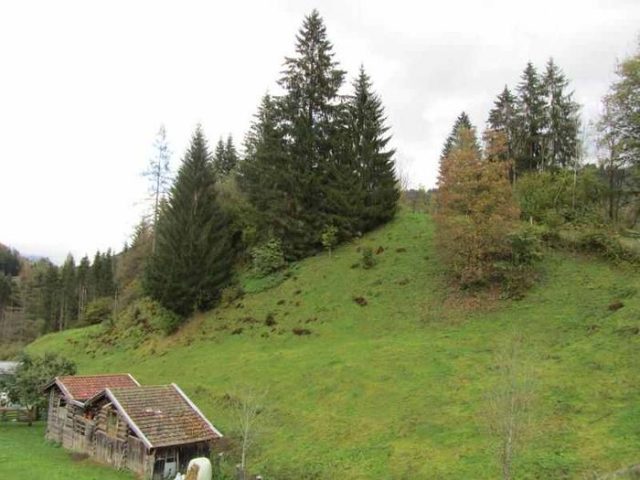
The castle ruin Taxenbach is located in the municipality of Taxenbach in the Zell am See district of Salzburg (Schloßberg 1). The Schlossberg is situated south of the market on the orographically left side of the Salzach. The castle presumably consisted of a masonry tower and a surrounding curtain wall. A manor farm was located below the masonry.

Archbishop Friedrich III. von Leibnitz acquired the Taxenbach court in 1323. A suitable building had to be found as the seat of the district court. The Edtburg, which had existed here until then, had been destroyed in the aftermath of the German Throne Dispute and the Battle of Mühldorf; therefore, a new location was sought. The Archbishop exchanged a plot of land belonging to the parish priest of Taxenbach for one in Dienten. This plot, then called Dechantshofbühel, was found suitable for erecting a fortified structure to protect the market and the crossings over the Ache. From this new castle, the district court was administered from 1325. The administrator and the court clerk were housed here, and there was also a prison.

During the Peasants' War against Archbishop Matthäus Lang in 1525/26, this castle was destroyed; however, the ultimately defeated peasants were obliged to rebuild the castle, which happened in 1564. Towards the end of the 16th century, the aqueduct leading to the castle was considered completely dilapidated. In 1606, a description read: "Schloss Täxsenpach is merely a tower, which is not only in the roof but also in the masonry entirely dilapidated, with a small courtyard, enclosed by a small ring wall, in which there is a stable for two horses." Due to the bad air from the smelter smoke of Lend and alleged ghost haunting, no one wanted to live in the complex anymore. The Taxenbach administrator Christoff von Hirschau therefore took up residence in Zell am See, from where he rode to Taxenbach several times a week. Archbishop Markus Sittikus von Hohenems ordered in 1615 that the administrator should live in the castle again to prevent its decay. Already under the new administrator Josef Wilpendorfer, the castle was sufficiently habitable again. After the market fire of 1622, the local administrative building was rebuilt, and the court clerk lived there from 1657. In the mid-17th century, cracks were found in the kitchen, cellar, and vaults of the castle. In 1673, the walls of the castle were reinforced and an archive was installed. In 1690, great damage was caused by an earthquake. In 1699, the administrator sent a list of building defects to the archiepiscopal court chamber, including the complaint that a fresco of Archbishop Paris Lodron, above the gate towards the market, had faded and should be renewed. In the last decade of the 17th century, all windows of the castle were glazed with broken and bull's-eye panes. Until 1770, 100 muskets were stored in the castle's depot, although most of the ammunition was missing, then these went to Salzburg. In the course of the new construction of the district court in the village, the administrator moved there in 1768 (in 2013, the police station is located here).

Castle Ruin Taxenbach Today+

During the Napoleonic Wars, fierce fighting took place in the vicinity of Taxenbach (Halbstundenbrücke) in 1809. 400 Pinzgau peasants prevented the Bavarian Division Deroy from advancing towards Tyrol for a day. Ultimately, Taxenbach fell to Bavaria. The Royal Bavarian Finance Chamber auctioned off Taxenbach Castle with all surrounding properties in 1812. Johann Rathgeb was awarded the bid. In 1872, the already heavily neglected building belonged to Rupert Grabmaier; private parties lived in the castle at that time. In November 1872, the castle burned down due to carelessness and was not rebuilt. Stones from the castle were used in 1938 for the expansion of the elementary school. In 1960, the ruin with foundations up to 5 m was said to have still been standing; the east wall (towards the Kitzlochklamm) was 15 m long, the north wall (towards the market) 46 m, the south wall (towards the Salzach) 46 m, the west wall (towards Dechantbühel) had already been removed, formerly having a length of 19 m. The castle had an emergency exit to the Salzach and an underground passage that led through the Dechantbühel into the market. The entrance to this tunnel was still visible within the ruin in 1930.

In 1962, new buildings were erected on the old foundations. The Schlossberg was acquired by the market municipality of Taxenbach in 1991. Only a few remnants of the former curtain wall now recall the history of the former castle. These remnants, however, have been secured and cleared of vegetation.

Take Mobile History with you

You are reading this text for free. Premium adds what matters on the road: descriptions read aloud, sites found through your camera, whole regions taken offline.

  • Every description, including the ~17,700 Premium sites
  • Audio guide: have descriptions read to you on location
  • AR finder: see sites through your camera, with distance and bearing
  • Unlimited saved sites

14 days free, then from €2.99 a month. Cancel anytime.

Source: Wikipedia · Licence: CC BY-SA 4.0 · Image: http://www.wehrbauten.de/thread.php?threadid=1284

This description draws on the facts documented in the linked Wikipedia article; Wikipedia content is licensed under CC BY-SA 4.0. Wording and editing: Mobile History.

Location: 47.2926, 12.9731