To be privately owned
Tharandt Castle

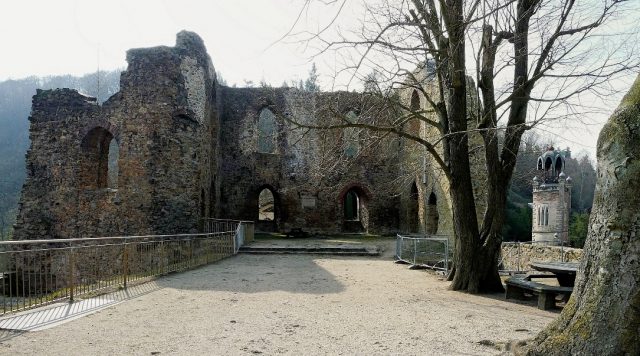
Tharandt Castle is the ruin of a spur castle important for Saxon history, located on a mountain spur in the town of Tharandt near Freital in the Sächsische Schweiz-Osterzgebirge district. It is a site of 19th/20th century castle romanticism. Only a few structural remains are preserved. Tharandt Palace, next to the castle ruin, however, is a repeatedly rebuilt, romantic residential palace in Tudor style from the 19th century.
Tharandt Castle+
Margrave Dietrich of Meissen had a small complex built between 1206 and 1215 for protection against the neighboring burgraves of Dohna, who had their border castles in Rabenau and Ruppendorf. At the same time, another representative complex was built in the neighboring Grillenburg, in the Tharandt Forest.
As Vogt, he appointed a ministerialis to Tharandt Castle, who probably came from Vinschgau, South Tyrol, or from the castle garrison in Döbeln. In 1216, he was documented as castle captain Boriwo de Tarant and is traceable until 1242, among other things, as the founder of Pohrsdorf and the now defunct Pohrsdorf Castle. Tharandt Castle was modeled after the Tyrolean Tarantsberg Castle (or Dornsberg, municipality of Naturns) in function and layout, as far as the topographical location allowed.
When Dietrich was murdered in 1221, Landgrave Ludwig of Thuringia took over the guardianship of his son Heinrich. To secure Heinrich's claim to the Margraviate of Meissen, Ludwig led a military campaign into the Mark Meissen in 1224. During this campaign, he stormed Tharandt Castle. The castle burned down during the storming.
Under Margrave Heinrich the Illustrious, the castle, whose remains still exist today, was built between 1240 and 1256. The only access at that time was at the lower castle, the current ascent to the church. Heinrich subsequently stayed at the castle many times. It can be assumed that he representatively expanded his favorite residence. However, this could also apply to the neighboring complex in Grillenburg, which probably had the same name at the time, as Tharandt Castle was a difficult-to-access border castle that did not even have a well.
In 1316, Margraves Waldemar and Jan of Brandenburg are mentioned as feudal tenants of the castle from the Meissen diocese. In 1350, Friedrich and Heinrich von Tharandt are listed as castle lords in Friedrich the Strict's Mannbuch.
Between 1371 and 1400, the castle was pledged to the Counts of Schönburg. During this time, the fortifications were expanded to such an extent that the castle was considered one of the strongest in the country. It also served as the administrative seat of the Tharandt office.
The account books of the castle vogts, available since 1399, show no major construction work on the castle for the beginning of the 15th century. This is because the castle lost its border protection function after the Dohna Feud. In the main recess of Naumburg in 1410, Tharandt was awarded to Landgrave Friedrich the Younger.
During the Hussite invasion in 1429, Tharandt was contested. Due to its solidity, important documents and valuables of the Elector's house were stored in the castle. In 1436, the castle was equipped with additional firearms. Compared to other castles in the country, it had a strong garrison.
Only in the late 15th century can it be assumed that more comfortable furnishings were provided for Duchess Sidonie, who resided at the castle intermittently from 1476 and had her widow's seat there from 1500. To enable more convenient access to the castle, a new castle entrance, also usable for horse-drawn carriages, was created. For this purpose, a new gate with a drawbridge was broken into the mountain-side wall of the palas of the upper castle, and a bastion was built in front of it at the moat for protection. From this time on, the castle was also referred to as a palace.
Sidonie (Zděnka) was the daughter of the Bohemian King George of Poděbrady and became the wife of Duke Albrecht on November 11, 1459, in Eger, to seal the Treaty of Eger concluded on April 25, 1459. The consummation of the marriage (Beilager) took place on May 11, 1464, at Tharandt Castle.
After Sidonie's death on February 1, 1510, in Tharandt, the castle was no longer inhabited. Doors and windows were removed and reused in Grillenburg hunting lodge, where the seat of the Tharandt office, now as the Grillenburg office, was also moved in 1558. In 1568, lightning struck. In 1572, the roof slates were dismantled for reuse for Annaburg Palace near Torgau. After the demolition permit was granted in 1579 by Elector "Father" August of Saxony, the demolition of the walls began in 1582 to obtain building material by the population and the transfer of ownership of the complex to the municipality. On the walls or using parts of the lower castle (Schösserei), the City and Mountain Church of the Holy Cross, consecrated in 1631, was built between 1626 and 1629.
Around 1800, the remaining ruins of the castle were secured in the spirit of castle romanticism, vaults were filled in, and trees were planted. Between 1790 and 1850, almost every famous painter, draftsman, or engraver of that time (including Ludwig Richter, Caspar David Friedrich, Adrian Zingg, Carl Blechen) immortalized the ruin in their works. In the second half of the 20th century, an open-air stage was built on the grounds of the upper castle. Only after 1976 did the local castle association begin to renovate the castle, which is owned by the town and the Tharandt church community, according to monument preservation requirements.
However, it was not until 2013 that the fundamental renovation of the castle ruin could begin, with the support of the Ostdeutsche Sparkassenstiftung and the Ostsächsische Sparkasse Dresden, among others. On this occasion, partnership agreements were also concluded with Poděbrady (Podiebrad), the birthplace of Sidonie of Bohemia, and her wedding place with Duke Albrecht, Cheb (Eger). Every year at the town festival in early October, a medieval market with a field camp takes place in the castle ruin, supplemented by guided tours of the area, into the church, and into the exposed cellar vault.
Take Mobile History with you
You are reading this text for free. Premium adds what matters on the road: descriptions read aloud, sites found through your camera, whole regions taken offline.
- Every description, including the ~17,700 Premium sites
- Audio guide: have descriptions read to you on location
- AR finder: see sites through your camera, with distance and bearing
- Unlimited saved sites
14 days free, then from €2.99 a month. Cancel anytime.
Source: Wikipedia · Licence: CC BY-SA 4.0 · Image: Thomas Eichler
This description draws on the facts documented in the linked Wikipedia article; Wikipedia content is licensed under CC BY-SA 4.0. Wording and editing: Mobile History.
Location: 50.9826, 13.5812