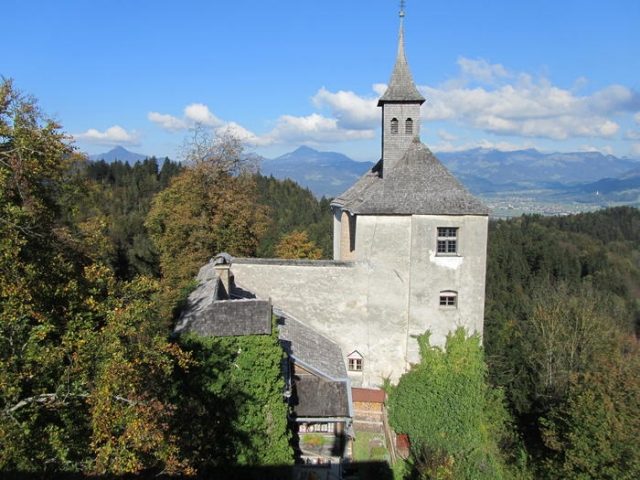
The remains of the Castle can be visited
Thierberg Castle

In the second half of the 13th century, the Freundsberger family likely built Thierberg to protect their estates on the left bank of the Inn. The first lord of the castle mentioned is Konrad von Freundsberg in 1290, who is also known as Chunrat von Tyrberch. In 1303, the small castle was conquered by the Rattenbergers, which, however, did not change the ownership, as in 1312, Thomas von Thierberg from the Freundsberger family resided here. In 1363, Thierberg, along with Tyrol, fell to the Habsburgs. The Freundsberger family had at that time pledged the fortress to Rudolf von Haslang. After Kufstein fell to Bavaria in 1369, they sold the castle to the Bavarian dukes in 1379. These had it administered by caretakers. Due to the expansion of the fortresses of Kufstein and Rattenberg, the importance of Thierberg declined, so that the buildings there were left to decay in the second half of the 15th century.
When Emperor Maximilian I conquered Kufstein in 1504, he gifted Thierberg to his valet and his doorkeeper, which indicates the low status of the castle. Both hardly cared for their new possession. Now the owners changed frequently. When Christof Philipp Graf von Liechtenstein received the Hofmark Thierberg as a princely fief in 1539, it was only referred to as a castle ruin. An improvement only occurred when Georg Voglmayer took over Thierberg in 1584. He had half of the already dilapidated palas rebuilt, as it was now to house the pilgrimage chapel. Voglmayer used the remains of the former curtain wall as building material for his new house below the castle.
In 1653, the fief passed to Dr. Jacob Hueber, an Innsbruck lawyer. His widow sold the property in 1691 to the industrialist Franz Bernhard von Millau zu Weidenburg. Johann Georg von Millau zu Weidenburg was able to convert the fief into free allodial property in 1848. Nevertheless, in the same year, he sold Thierberg to Roman Mayr, a merchant from Munich. His son-in-law Matthias Oberhummer inherited the property. In 1939, Hugo Oberhummer sold the fiefdom with the remains of the castle to the industrialist family Henkel from Düsseldorf. They remain the landowners of Thierberg to this day.
The Stations of the Cross are often the scene of events organized by Catholic youth.
Take Mobile History with you
You are reading this text for free. Premium adds what matters on the road: descriptions read aloud, sites found through your camera, whole regions taken offline.
- Every description, including the ~17,700 Premium sites
- Audio guide: have descriptions read to you on location
- AR finder: see sites through your camera, with distance and bearing
- Unlimited saved sites
14 days free, then from €2.99 a month. Cancel anytime.
Source: Wikipedia · Licence: CC BY-SA 4.0 · Image: http://www.wehrbauten.de/thread.php?threadid=1286&sid=e0cf3b25144c5abbb20a4f161af1a193
This description draws on the facts documented in the linked Wikipedia article; Wikipedia content is licensed under CC BY-SA 4.0. Wording and editing: Mobile History.
Location: 47.6000, 12.1643