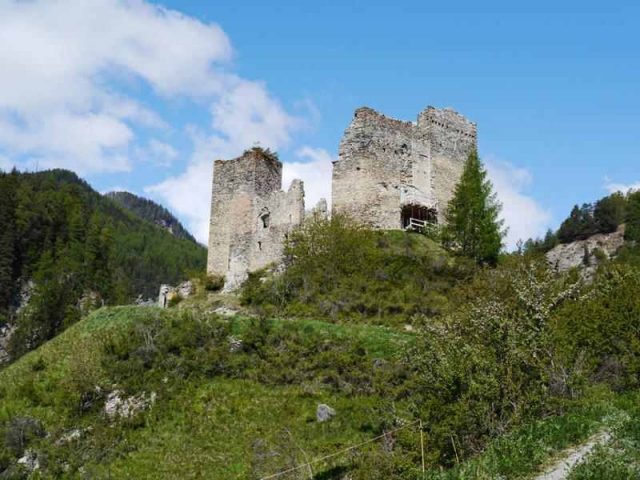
CastleRamosch

Tschanuff Castle

Tschanuff Castle

The remains of the Castle can be visited

The ruin of Tschanüff Castle lies on a spur of land at the edge of the Val Sinestra gorge west of the village of Ramosch in the Lower Engadine in the Swiss canton of Graubünden. Tschanüff was, alongside Tarasp Castle, the most significant castle complex in the Lower Engadine.

The name Tschanüff derives from the Rhaeto-Romanic Casa Nova and means "new house". The name only appears in the 16th century; before that, the castle was simply called Ramosch or Remüs.

Complex+

The complex consists of a main castle with a tower, residential wing, and outbuildings, surrounded by a curtain wall, as well as a southern outer bailey, which is enclosed by a ring wall of varying thickness. The two parts were connected by the gatehouse, through which a vaulted passage led into the main castle's courtyard. Numerous mortar joints and differences in the wall structure indicate that the construction must have taken place in several stages. The oldest part apparently includes a wall fragment of a curtain wall in the southeast of the complex, which probably dates back to before 1200. The main tower in the north, the inner shield wall, and parts of the southern residential wing in the outer bailey probably date from the first half of the 13th century. The tower still has five stories. The high entrance was at the height of the fourth story in the south wall. Since the masonry of the tower is not connected to the surrounding walls, these must be of a more recent date.

The building south of the tower was probably accessible via the high entrance. Beam holes at a height of four stories are preserved, as are the remains of an unusually thick (shield?) wall to the south. To the west of this is the south wing from the 15th century, a four-story, transversely divided building. The barrel vaults of the lower stories have partially collapsed. On the third story was a continuous hall with a beamed ceiling, above which was the attic space with firing slits. The individual rooms were accessible from the courtyard side.

To the north of this wing was a more recent building, of which only a few wall remnants remain. The south wing was enclosed by an older shield wall three meters thick, which was probably reinforced to double its thickness in the age of firearms. Together, the two walls now form a massive tower-like block without interior spaces, which was probably topped with a battle platform.

To the west of the main tower was a two-story building from around 1500; Poeschel suspected a kitchen or forge, with living quarters on the upper floor. Remnants of sgraffito decoration have been preserved in the exterior plaster. Window openings in the adjoining western enclosure wall indicate an original continuation to the west; however, these parts of the building have slipped away.

The Lords of Ramosch are documented as early as the 12th century as servants of the Bishop of Chur and the Lords of Tarasp. In 1256, Count Meinrad I of Görz and Tyrol permitted the knight Nannes of Ramosch to build a castle. However, since the oldest parts of Tschanüff date back to the 12th century, it is more likely that an expansion of the existing complex took place.

After the middle of the 14th century, a dispute arose between the brothers Schwiker and Konrad of Ramosch. The conflict was settled in 1365 by Duke Leopold of Austria, who received the right of access in return. In 1367, Schwiker stabbed his brother, whereupon Leopold declared Schwiker's property forfeited and enfeoffed Ulrich von Matsch with the castle and lordship. The von Matsch family was chosen because the murdered Konrad had been married to Margarete von Matsch. In 1369, von Matsch was also able to acquire the rights of the murdered Konrad's son. In 1372, Margarete also renounced all claims.

The Austrian advance into the Lower Engadine thwarted the plans of the Bishop of Chur. In 1394, Bishop Hartmann seized the castle and forced the von Matsch family to cede their rights to the fortress of Ramosch in exchange for compensation. The Lords of Matsch resisted; in 1395, they attacked and plundered the castle. Although Austria renewed Ulrich von Matsch's enfeoffment with Ramosch in 1403, the castle remained in the hands of the bishop. In 1415, a compromise emerged, but it was not until 1421 that an arbitration court in Bolzano confirmed the episcopal rights to Ramosch. Austria retained the right of opening, and the Lords of Matsch received further compensation from the diocese. The von Planta family usually served as episcopal bailiffs.

In 1468, people from Gotteshaus occupied the castle in connection with a dispute with the bishop, but caused no major damage. In 1475, during the so-called "Chicken War," when the Engadiners refused to pay the Austrians the carnival chickens, Tschanüff was set on fire by the Austrians. In the Swabian War of 1499, the episcopal pledge lord himself set the castle on fire on March 25 to avoid having to surrender it to the imperial troops. After its restoration, it again became the episcopal administrative center of the Lordship of Ramosch, which encompassed the entire lower part of the Lower Engadine.

In 1565, during a popular uprising, the castle was plundered and set on fire by sixteen young locals. A court forced the conspirators to finance the reconstruction and assist with the construction work. During the Bündner Wirren (Graubünden Troubles), Ramosch Castle was again set on fire by troops from Glarus on August 2, 1622. It was hastily restored and continued to be used as an episcopal administrative seat. Nicolin Sererhard found the castle in 1760 probably still intact but decaying inside and described it as not well built. Due to increasing decay and landslides of western building parts, the castle was abandoned in 1780.

Today+

The Pro Tschanüff association has set itself the goal of saving the ruin from further decay. For several years, safeguarding work has been underway (as of summer 2009). The owner of the castle is the Fundaziun Tschanüff.

Take Mobile History with you

You are reading this text for free. Premium adds what matters on the road: descriptions read aloud, sites found through your camera, whole regions taken offline.

  • Every description, including the ~17,700 Premium sites
  • Audio guide: have descriptions read to you on location
  • AR finder: see sites through your camera, with distance and bearing
  • Unlimited saved sites

14 days free, then from €2.99 a month. Cancel anytime.

Source: Wikipedia · Licence: CC BY-SA 4.0 · Image: http://www.wehrbauten.de

This description draws on the facts documented in the linked Wikipedia article; Wikipedia content is licensed under CC BY-SA 4.0. Wording and editing: Mobile History.

Location: 46.8329, 10.3756