CastleOldisleben-Sachsenburg

Untere Sachsenburg Castle
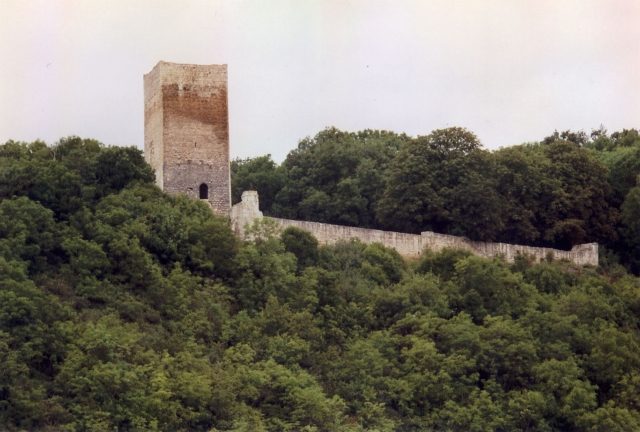
Untere Sachsenburg Castle

The remains of the Castle can be visited

The Lower Sachsenburg, also called Unterburg or Hakenburg, is the ruin of a hilltop castle near Sachsenburg, a district of the municipality of Oldisleben in the Kyffhäuser district in Thuringia.

From the medieval castle, the keep, parts of the curtain wall, and cellars are still preserved.

The ruin of Lower Sachsenburg is located north above the village of the same name on the summit of the outermost east-southeast spur of the Hainleite ridge. Surrounded by forest, slightly above the Thuringian Gate, through which the Unstrut flows, it is located about 450 m southeast of the Upper Sachsenburg.

The castle is the older of the two Sachsenburg castles. The time of the castle's construction has not been conclusively clarified. There is no evidence for a construction by a knight of Hake around 940, as occasionally stated in literature.

The counts of Orlamünde, to whom the dominion belonged until the middle of the 11th century, or the landgraves of Thuringia, to whom the dominion belonged at the latest since 1180, could be considered as builders of the castle.

The purpose of the castle was to secure access to the central Thuringian Basin.

After the death of the last Ludowingian Landgrave Heinrich Raspe in 1247, Count Siegfried of Anhalt (1252–1310) occupied the Palatinate of Saxony. He probably also took the castle. To reinforce it, he had the Upper Sachsenburg built.

From the subsequent disputes with the Margraves of Meissen, they emerged victorious. Whether the demolition of the castle "Saxinberg" stipulated in the Treaty of Weißenfels in 1249 actually took place is doubtful. In 1287, the castle must have been present, as it was successfully defended against Adolf of Nassau.

Through the marriage of Dietrich von Hohnstein with Sophia von Anhalt, the castle came to the Counts of Hohnstein in 1316.

In 1319, a distinction was first made in documents between the upper and lower castles. After a feud, the Counts of Hohnstein had to recognize the feudal sovereignty of Landgrave Friedrich I (1292–1324).

Also through marriage, the castle came to the Counts of Beichlingen from 1335 to 1407. From 1407, the castle was the property of the Landgraves of Thuringia and Dukes of Saxony. From this point on, it served as the seat of the Sachsenburg office.

With the relocation of the administrative seat to the village in 1815, the complex lost its importance and was abandoned.

Take Mobile History with you

You are reading this text for free. Premium adds what matters on the road: descriptions read aloud, sites found through your camera, whole regions taken offline.

  • Every description, including the ~17,700 Premium sites
  • Audio guide: have descriptions read to you on location
  • AR finder: see sites through your camera, with distance and bearing
  • Unlimited saved sites

14 days free, then from €2.99 a month. Cancel anytime.

Source: Wikipedia · Licence: CC BY-SA 4.0 · Image: https://commons.wikimedia.org/wiki/File:Untere_Sachsenburg_01.jpg

This description draws on the facts documented in the linked Wikipedia article; Wikipedia content is licensed under CC BY-SA 4.0. Wording and editing: Mobile History.

Location: 51.2935, 11.1653