CastleVils

Vilsegg Castle

Vilsegg Castle

The remains of the Castle can be visited


Vilsegg Castle is a former fortified complex in Tyrol, located about one kilometer northwest of the town of Vils, between Pfronten and Füssen, a few hundred meters from the German-Austrian border.

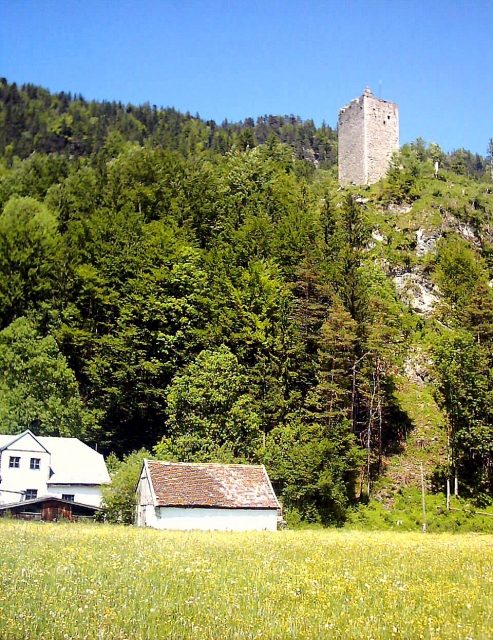
The ruins of the hilltop castle lie about 60 meters above the Vils Valley on an 887-meter-high rocky hill at the edge of the Salober mountain, where the state border between the Federal Republic of Germany and Austria runs today.

The castle hill slopes steeply on all sides, making the fortress difficult to attack despite its relatively low position above the valley. Vilsegg is about 350 meters lower than the neighboring Falkenstein Castle, which is already on German territory.

In 1263, Heinrich von Vilsegg, a vassal of the Lords of Hohenegg, is mentioned at the castle. The Hohenegger themselves were vassals of Kempten Abbey. However, the castle was probably built around 1220/30 and is considered one of the most significant examples of Staufer architecture in Tyrol.

The ministerials of Vilsegg are last mentioned in documents in 1314, after which the Hohenegger themselves resided at the castle.

At the beginning of the 14th century, Count Meinhard II of Tyrol (?) tried to expand his territory at the expense of his neighbors. He also seized some of the Hohenegger castles, such as the nearby cave castle Loch near Pinswang, but they held Vilsegg as a fief of Kempten Abbey until 1408. Subsequently, the abbey enfeoffed the Duke of Austria with the castle and the lordship, who returned both as a sub-fief to the Hohenegger.

In 1671, Johann Franz, the last Hohenegger, died, and the sub-fief reverted to Austria, meaning the Roman-German Emperor legally became the direct vassal of the abbey regarding the lordship of Vilsegg. The castle was inhabited by Austrian administrators until at least 1709, but was already designated as a ruin on a map in 1774.

The year 1806 brought the transfer to Bavaria, but in 1816, the town, castle, and lordship had to be definitively ceded to Austria after the Congress of Vienna.

In 1939, larger sections of the wall collapsed after an earthquake (e.g., the east wall of the keep with the high entrance), and in 1953, the keep was secured by the Austrian Federal Monuments Office. Currently, the remaining wall remnants of the palas and the fortification are being excavated and renovated.

Description+

Of the relatively small castle, essentially only the mighty keep remains.

From the Sankt-Anna Chapel below, a steep path leads directly to the former outer gate. The curtain wall up to the keep is still largely preserved, and after another 50 meters of steep ascent, one encounters the few remains of the ring wall and the palas. To the west, slightly elevated, rise the impressive remains of the almost square keep, measuring 10.7 by 10.1 meters. The mighty tower seems to have been habitable at least temporarily (window openings) and originally had four unvaulted floors and a crenellated battle platform. Later, the tower was raised and topped with a gable roof. The wall thickness of the basement is just under two meters, the east wall has been missing since the 1939 earthquake.

Take Mobile History with you

You are reading this text for free. Premium adds what matters on the road: descriptions read aloud, sites found through your camera, whole regions taken offline.

  • Every description, including the ~17,700 Premium sites
  • Audio guide: have descriptions read to you on location
  • AR finder: see sites through your camera, with distance and bearing
  • Unlimited saved sites

14 days free, then from €2.99 a month. Cancel anytime.

Source: Wikipedia · Licence: CC BY-SA 4.0 · Image: http://commons.wikimedia.org/wiki/File:Burg_Vilsegg_Gesamt.jpg

This description draws on the facts documented in the linked Wikipedia article; Wikipedia content is licensed under CC BY-SA 4.0. Wording and editing: Mobile History.

Location: 47.5567, 10.6264