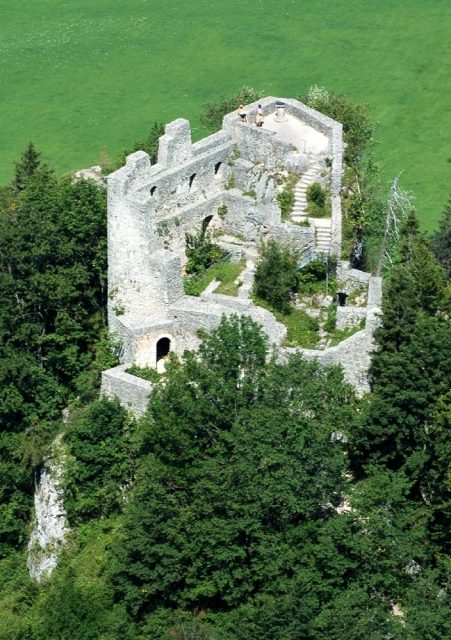
The remains of the Castle can be visited
Wartenfels Castle

The castle ruin Wartenfels is located in the municipality of Thalgau in the state of Salzburg, Austria. It lies about 20 kilometers east of Salzburg on a small rocky outcrop at the foot of the Schober (1020 m above sea level).
Wartenfels Castle was built in 1259 by Konrad von Steinkirchen (presumably a member of the Tanner family) together with his son-in-law Konrad zu Kalham, who then called himself Konrad von Wartenfels. The castle appears in documents from 1267 and was sold in 1301 by another Konrad von Kalham with the associated estates to Archbishop Konrad IV of Salzburg (daz purchstal ze Wartenuels), but he received it back as a fief. After the extinction of the Kalham family, the Archbishop established a district court (Pfleggericht) at Wartenfels, which existed until 1564. During the Peasants' War of 1525/26, the castle was burned down and, despite compensation payments from the court officials, was never fully rebuilt. In 1552, interior finishing work was still being settled. In 1557, the castle roof was re-covered. Afterwards, the district court moved to a house in the center of Thalgau. For a time, the castle was still inhabited by hunters and gamekeepers, but it was increasingly left to decay and fell into ruin, with only a few remnants of the outer masonry remaining.
In 1541/42, Paracelsus frequently stayed at the castle and is said to have had a close relationship with the wife of the castle administrator.
The castle also included a "Bauhof" or Maierhof (farmstead). This is the estate "In Prichsen" (Thalgau-Egg No. 3). Its first owner was a Chunradus, who appeared in the court register of the bishopric in 1336. The farm was renovated in 1578. Today, the Wartenfels ruin belongs to this farmstead.
Wartenfels Castle Ruin Today+
The castle has a triangular floor plan, with the wall on the less protected east side having a thickness of two meters. The castle gate must have stood in the eastern part, and the foundations of an outbuilding can be seen in the lower courtyard area. From here, a narrow access area, secured by defensive walls, leads up to the main castle. In the late Middle Ages, a small, ground-level annex was added in front of the main castle, which had its own Zwinger (outer bailey). Where the access to the high castle was located (possibly secured by a drawbridge) can no longer be determined. Significant wall remains are preserved on the wide west wall with wall teeth and the indication of three windows. No trace remains of the formerly existing chapel.
Little can be said about the former appearance of the castle, as the existing windows were only created during the renovation. Due to the danger posed to visitors of the old masonry, the ruin was restored in 1981, with not too much emphasis placed on historical correctness.
Take Mobile History with you
You are reading this text for free. Premium adds what matters on the road: descriptions read aloud, sites found through your camera, whole regions taken offline.
- Every description, including the ~17,700 Premium sites
- Audio guide: have descriptions read to you on location
- AR finder: see sites through your camera, with distance and bearing
- Unlimited saved sites
14 days free, then from €2.99 a month. Cancel anytime.
Source: Wikipedia · Licence: CC BY-SA 4.0 · Image: http://commons.wikimedia.org/wiki/File:RuineWartenfels.jpg
This description draws on the facts documented in the linked Wikipedia article; Wikipedia content is licensed under CC BY-SA 4.0. Wording and editing: Mobile History.
Location: 47.8157, 13.3062