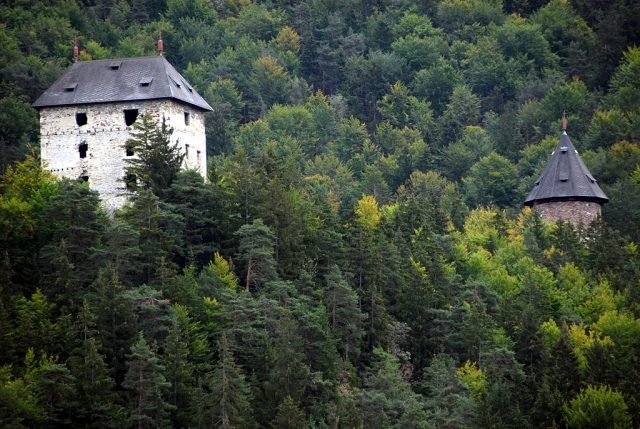
CastleRuden

Weißenegg Castle

Weißenegg Castle

To be privately owned

Weißenegg Castle stands on a wooded rocky outcrop above the Griffen Valley northeast of Ruden in Carinthia. The twin castle, built in the first half of the 12th century, is partly dilapidated, and the remains of the structure are under 34777!monument protection.

In the Austrian lands, there were a total of four castles named Weißenegg, of which the castle near Ruden was probably the ancestral seat of the Weißenegger family. The oldest known descendant of the Weißenegger family is said to have been Wülfing von Wizzeneck, who is believed to have lived around 1120. The castle was first mentioned in a document in 1243 as dominus de Wizenekke. Dietmar von Weißenegg, a ministerialis of the Diocese of Bamberg, appears several times in documents between 1244 and 1263. The Weißeneggers were a significant noble family in Carinthia in the 13th and 14th centuries; they provided several bishops and were also militarily active. From 1300 onwards, Weißenegg was the seat of a regional court, which also included Ruden. In 1332, the property was sold to the Lords of Walsee. Eberhard von Walsee († 1363), who had remained childless, bequeathed the castle and lordship to his cousins Ulrich and Hermann I of Cilli. The Counts of Cilli remained at Weißenegg until 1425, when Hermann II of Cilli exchanged Weißenegg and Hartneidstein with the Diocese of Bamberg for the lordship of Mauthenberg (Hohenmauthen/Muta). Weißenegg remained Bambergian until 1759, when the diocese sold its properties in Carinthia to the Austrian Empire. The castle was already abandoned at this time. In 1775, Maximilian Thaddäus Freiherr von Egger acquired the castle, which remained in the possession of his descendants for over a century thereafter. In 1885, the Barons Ferdinand and Karl Helldorf bought the property, and in 1936, the extensive forests with the ruin passed to the industrialist family Leitgeb from Kühnsdorf, who are still the owners today.

Architectural Description+

Considerable remains of the once extensive castle complex are still present, situated on a heavily wooded rocky outcrop, but their buildings rise above the treetops and are visible from afar. On the mountain side, there is a 13th-century round tower with walls up to two meters thick. This complex was built first and later served as an outer bailey. Northwest of it and separated by a deep moat is the main castle, built only in the 16th century on a rectangular plan. It was encompassed in a horseshoe shape by an outer courtyard. To the west of the complex lies the palas, whose outer walls are preserved up to the third story. In the inner courtyard are the remains of a well.

The remaining buildings have recently been cleared of vegetation, renovated, and provided with new roofs.

Take Mobile History with you

You are reading this text for free. Premium adds what matters on the road: descriptions read aloud, sites found through your camera, whole regions taken offline.

  • Every description, including the ~17,700 Premium sites
  • Audio guide: have descriptions read to you on location
  • AR finder: see sites through your camera, with distance and bearing
  • Unlimited saved sites

14 days free, then from €2.99 a month. Cancel anytime.

Source: Wikipedia · Licence: CC BY-SA 4.0 · Image: http://commons.wikimedia.org/wiki/File:Ruden_Weissenegg_01.jpg

This description draws on the facts documented in the linked Wikipedia article; Wikipedia content is licensed under CC BY-SA 4.0. Wording and editing: Mobile History.

Location: 46.6651, 14.7791