CastleWaldershof - Weißenstein

Weißenstein Castle
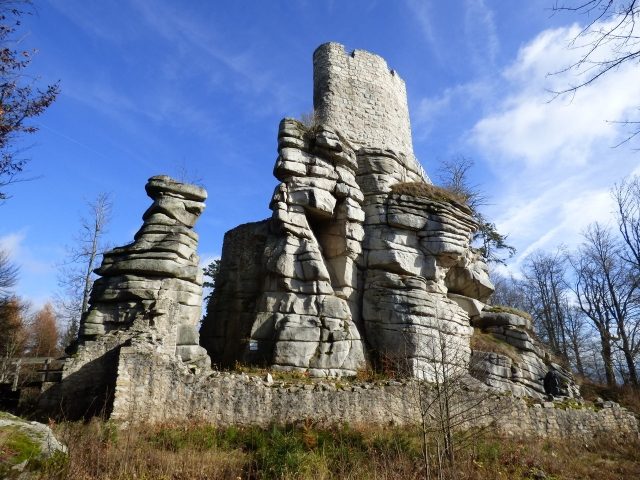
Weißenstein Castle

The remains of the Castle can be visited

The Weißenstein ruin stands on the 863.5 m above sea level Weißenstein in the Steinwald between Waldershof and Erbendorf in the northern Upper Palatinate.

The name of the Steinwald castle Weißenstein first appeared in documents on March 21, 1279, as "Wisstenstein". At that time, a "Wolff de Wisstenstein" appeared as a witness to a transfer of property. Other witnesses were representatives of the Notthafft family. The Wolffs were probably the builders of a first small castle complex on the then important road from the Friedenfels area over the Steinwald to Hohenhard, although this cannot be proven by documents. The complex at that time was described as a "Blochwerk", a castle with a tower whose upper floor was built in half-timbered or block construction. Around 1290, Ludwig, Dietrich, and Nicklas Wolff von Weißenstein were named as owners. Already in 1309, Albert Notthaft VI., a descendant of an old ministerial family that was formerly richly endowed in Bohemia, had acquired a part of the Weißenstein.

In 1333, his son Albrecht Notthafft XI. was co-owner of the Weißenstein. When Ludwig the Bavarian granted him the imperial and ducal fiefs, it was explicitly emphasized that he should suffer no harm because of his father's partisanship for Frederick the Fair of Austria, who was defeated in the dispute over the throne. The Weißenstein had probably been severely damaged in the warlike conflicts of the throne dispute as well as in the war between King Ludwig the Bavarian and King John of Bohemia. But already on July 25, 1339, Burgrave Johann II of Nuremberg, King Ludwig's field marshal, allowed Albrecht Notthafft XI. "that he may and shall build and improve the fortress Weißenstein as he wishes", but it had to be an "open house" for the Burgrave.

After Albrecht Notthafft XI. had also acquired the last third of the Weißenstein from Gerhard the Wolff von Thumsenreuth in 1341, he must have initiated the generous construction and expansion of Weißenstein Castle. It may have then reached the extent that can be seen from the partly exposed or still buried foundations, a very considerable complex for this location. In 1373, Albrecht Nothafft XII., the son of Albrecht Notthafft XI., was the owner of the Weißenstein. He founded the Weißenstein line of the Notthafft family. Their descendants owned the Weißenstein until their extinction in 1718. In the meantime, the lordship of Weißenstein had been sold for economic reasons from 1552 to 1566 to the von Waldenfels, who were related to the Nothafft, but then bought back. Then their relatives from the Bodenstein line followed as owners until 1882. From the very beginning, the castle was not always owned by a single person; it belonged to the family association. Each member of the Notthaft von Weißenstein had a more or less large share in the castle (Ganerbschaft). In a castle peace treaty of 1464, the then owners Fritz, Gilg III. and Ulrich Nothafft regulated the maintenance and use of the castle. At that time, a caretaker as castle administrator and two gatekeepers were mentioned. This shows that Weißenstein Castle was rarely used as a residence by the owners at that time. The Nothafft built their new residences in Friedenfels and Poppenreuth.

Weißenstein Castle was probably finally abandoned after 1560. The buildings fell into disrepair and buried part of the walls under their rubble. The tower also lost its superstructure and certainly part of its original height. This is proven by the many tower ashlar stones found at the foot of the rocks. In 1882, the Notthafft lost their estates and thus also the Weißenstein through the purchase by Bianca Eiserhart from a Silesian manufacturing family. After her death, Gustav Siegle from Stuttgart acquired the possessions in 1885. In 1918, his daughter Dora and her husband Fritz von Gemmingen-Hornberg took over the property. In 1955, their son Wolf Dieter Freiherr von Gemmingen-Hornberg became the successor, and since 1973, his son Eberhard Freiherr von Gemmingen-Hornberg in Friedenfels has been the owner of the former lordship of Weißenstein.

In 1995, little more than the keep, built on a high rocky cliff, and two approximately four-meter-high wall remnants in danger of collapse were recognizable from the castle ruin. Further wall lines were at best recognizable in the form of rampart-like ground elevations. The Steinwaldia Pullenreuth e. V. society restored the existing parts of the building between 1996 and 2000 with considerable time and expense and ensured the preservation of the cultural-historical monument. In an info pavilion, hikers receive information about the history of the Weißenstein and the renovation of the facilities. The Weißenstein castle ruin is an attraction for hikers, but also a backdrop for concerts, theater performances, and other cultural events.

Keep+

The approximately 7.5 m high keep now serves as an observation tower. In the course of the renovation, the tower, which was preserved in its original masonry up to a height of about 5.5 m, was raised by 2 m with ashlar stones found in the vicinity. From the laterally located castle courtyard, a four-part wooden staircase leads to the entrance of the keep, which is located at about 1/3 of the height of the southeast-facing front wall. Inside, further wooden stairs lead to the observation platform made of maple wood.

Take Mobile History with you

You are reading this text for free. Premium adds what matters on the road: descriptions read aloud, sites found through your camera, whole regions taken offline.

  • Every description, including the ~17,700 Premium sites
  • Audio guide: have descriptions read to you on location
  • AR finder: see sites through your camera, with distance and bearing
  • Unlimited saved sites

14 days free, then from €2.99 a month. Cancel anytime.

Location: 49.9138, 12.0832