CastleLeiben-Weitenegg

Weitenegg Castle
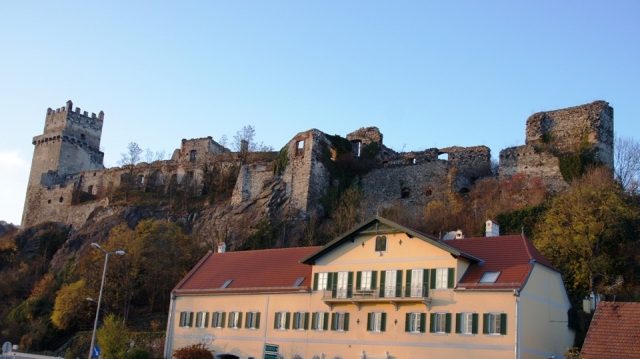
Weitenegg Castle

The remains of the Castle can be visited

The castle was probably built in the 12th century by the Counts of Tengling-Peilstein. In 1108, a Luitpold de Wideniche is mentioned for the first time in a document. Around 1150, Weitenegg came into the possession of the Counts of Pernegg through marriage.

From 1218 to 1235, the property was in the hands of the elder Lengenbachers. After their extinction, the Babenbergs took over. Duke Albrecht I of Austria confirmed the rights of the county, which had been taken over in 1265, in 1284. Temporarily, the Kuenringers held the fief, but they lost it again to the Habsburgs with the uprising of Leuthold von Kuenring in 1290. Subsequently, Weitenegg was administered by burgraves. From 1301 to 1364, it belonged to the widow's pension of Queen Agnes of Hungary, a daughter of Duke Albrecht I.

Thereafter, the castle was pledged multiple times. In the feuds of the 15th century, it repeatedly changed owners. In 1452, citizens of Melk conquered it on behalf of the Lower Austrian estates. Five years later, it came into the possession of the young King Ladislaus Posthumus. The Viennese mayor Wolfgang Holzer, who wanted to betray Duke Albrecht VI, retreated to Weitenegg, which had been entrusted to him, after his plan failed. By order of the sovereign, Jörg von Seisenegg besieged the castle with heavy artillery and finally conquered it.

In 1513, Emperor Maximilian I ceded Weitenegg in exchange for Wimberg Castle to Georg von Seisenegg, who sold it in 1531 to the Lords of Lappitz. Weitenegg was then united with Leiben and subsequently had the same owners. In the 16th century, the building was once again expanded into a fortress. During the Turkish Wars, the complex was designated as a refuge for the population. In 1645, the castle was still so defensible that it successfully repelled a siege by Swedish troops. Towards the end of the 17th century, however, it was abandoned as a residence and fell into disrepair. In 1832, several parts of the building on the Danube side collapsed. Around 1870, the eastern keep was largely demolished.

In 1983, the last owners of the united lordships of Weitenegg-Leiben sold the former to E. Wipplinger, the owner of the neighboring paint factory, whose family still owns the ruin today.

Take Mobile History with you

You are reading this text for free. Premium adds what matters on the road: descriptions read aloud, sites found through your camera, whole regions taken offline.

  • Every description, including the ~17,700 Premium sites
  • Audio guide: have descriptions read to you on location
  • AR finder: see sites through your camera, with distance and bearing
  • Unlimited saved sites

14 days free, then from €2.99 a month. Cancel anytime.

Source: Wikipedia · Licence: CC BY-SA 4.0 · Image: http://www.wehrbauten.at/noe/niederoesterreich.html

This description draws on the facts documented in the linked Wikipedia article; Wikipedia content is licensed under CC BY-SA 4.0. Wording and editing: Mobile History.

Location: 48.2300, 15.2939