CastleSimmelsdorf-Wildenfels

Wildenfels Castle
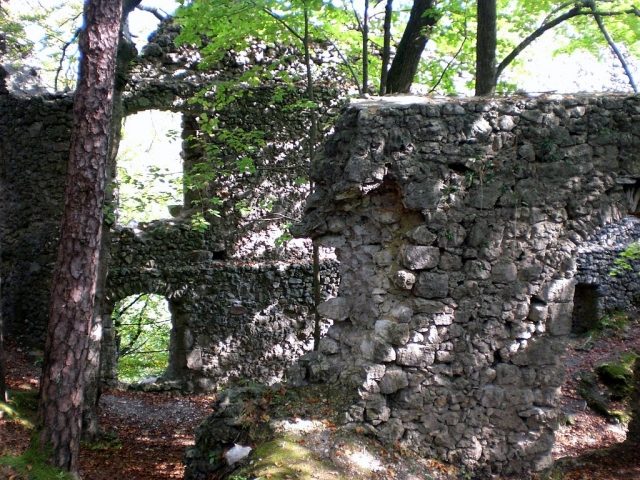
Wildenfels Castle

The remains of the Castle can be visited

Wildenfels Castle was built in the late 13th or early 14th century by the high-ranking ministeriales of Wildenstein, who originated from the Altmühl region. Presumably through a marriage with a daughter from the important imperial ministerial family of Hiltpoltstein-Lauf-Rothenberg, Dietrich I von Wildenstein came into possession of Rothenberg Castle and property in the region after the middle of the 13th century. The ducal-Bavarian followers gained considerable influence during the time of Duke Ludwig II. Dietrich I von Wildenstein appears in 1276 as Viztum (governor) in Nuremberg, and from 1280 as Viztum for the ducal lands north of the Danube. The family fought on the front lines in the 1290s for Duke Rudolph of Bavaria in the war against the Count of Hirschberg. In this context, a fierce feud also developed against the Lords of Henfenfeld, who were allied with the Count. In 1323, Dietrich III von Wildenstein then called himself "sitting at Wildenfels," thus testifying for the first time to the castle, which was probably built around 1290/1300.

Evidently, the placement of the new building opposite Strahlenfels Castle, located immediately to the east, held a special, symbolic significance. The idea that it was intended to demonstrate the Wildensteiner's claim to power around 1300 gains some plausibility given the attested close relations between the Strahlenfelser and the feuding Lords of Henfenfeld.

For generations, the castle remained in the family's possession, even though Emperor Charles IV enfeoffed it in 1356. The right of access in case of war was also granted to the Emperor. Wildenfels remained under Bohemian feudal rule thereafter. However, Dietrich VII, who was temporarily bailiff of Roth, transferred the right of access in 1378 for the duration of his Roth term of office to his liege lord, the Burgrave of Nuremberg. In 1397, Dietrich's son Hans resided at Wildenfels. He was known as a contentious spirit who had disputes with almost all his neighbors. In 1410, he simultaneously quarreled with Count Palatine Johann of Neunburg-Neumarkt and with the Imperial City of Nuremberg. In this context, he abducted a Prague citizen, whereupon the Wildensteiner was captured by the Imperial City. In October 1410, he had to swear Urfehde (end of the feud with observance of a peace decree). In the exciting following years, marked by the Bavarian War of 1420/21 and the Hussite invasions, he was administrator of the Electoral Palatinate office of Hirschau until around 1429. Wildenfels Castle therefore probably did not see him as often. At this time, Hans III von Wildenstein also called himself "at Wildenfels." In 1406, he had married the daughter of Jörg I Haller, then owner of Gräfenberg, and was close to the Imperial City. In 1431, Hans III was active in Nuremberg's war services and opened Wildenfels Castle to the Imperial City.

Alexander I von Wildenstein was the last of this family branch at the castle. His daughter Christina was married to Christoph von Lentersheim, administrator of Lauf, who took possession of the castle after Alexander's death around 1500. Only after the death of Christina von Lentersheim, Wildenfels is said to have passed to the related Wildensteiner of Strahlenfels around 1503, presumably by purchase, who finally sold the castle in 1509 to the Nuremberg citizens Conrad and Friedrich, called Pelcken. Already in 1511, the brothers ceded it to the Imperial City of Nuremberg.

Initially, Wildenfels was administered by the imperial city's bailiwick of Hiltpoltstein. The council initially only placed a Vogt (bailiff) in the castle. Only in 1518 did Nuremberg establish its own bailiwick here. However, no major structural damage from this period is recorded. Only in 1538, a cattle shed, a very narrow stable building with a living area, was built by a Betzenstein carpenter at the foot of the castle. Since maintenance was apparently neglected, the buildings soon deteriorated: in 1550, a part of the outer wall, presumably the outer shell of the wall, collapsed "towards the village." A master mason from Gräfenberg had to support the structure and probably only provisionally repair the damage.

The end of Wildenfels Castle came shortly thereafter in the Second Margrave War. Already in the first year of the war, on May 27, 1552, margravial troops set fire to the Nuremberg administrative seat. In May 1553, the enemy came to Wildenfels again and burned down two houses and two barns. The castle no longer saw a bailiff: after the war, only the Vogt's house in the economic courtyard below the castle was renewed. However, the Vogt was again under the regiment of the Hiltpoltstein bailiff. For his official residence at the foot of the castle, expenses for building maintenance are recorded for a longer period, while otherwise, only in 1596, an assessment of the ruins took place. Jörg Dilman was appointed as the last imperial city Vogt in 1616.

Although the fortress remained a burnt-out ruin since 1552, it still boasts a quite impressive masonry today. It is reached via a path laid out east of the former economic courtyard. The old access, on the other hand, led through the economic courtyard and southwest past the castle rock to the lower castle. Both paths now meet in front of the former gatehouse, whose extent is visible in the terrain. The southern lower outer wall of the gatehouse was obviously modernly reconstructed during a repair. While to the southeast, the considerable remains of a larger building of the lower castle (perhaps a former barn or granary) can still be seen, the path leads steeply upwards to the upper castle. Formerly, as written sources attest, one ascended via an enclosed and tiled staircase.

The upper castle is dominated by the quite high east wall of the once square keep, which even presents the original high entrance. Unfortunately, the joint pattern was completely disturbed during a modern repair with cement-based mortar and partial additions and patches, so that hardly any observations on the building history are possible. In 1827, the tower, which had been largely preserved until then, was struck by lightning, causing the west wall to collapse. Almost the entire north side of the upper castle is occupied by the remains of the former residential building. The enclosing walls of limestone rubble, some of which are still several meters high, still show traces of the floor division. Parts of the cellar vaults are also preserved inside. During a safeguarding measure in the 20th century, masonry and wall openings were reconstructed quite arbitrarily, without regard to building-historical findings. Only a few remains immediately south of the keep bear witness to a second, but much smaller, building of the upper castle.

Take Mobile History with you

You are reading this text for free. Premium adds what matters on the road: descriptions read aloud, sites found through your camera, whole regions taken offline.

  • Every description, including the ~17,700 Premium sites
  • Audio guide: have descriptions read to you on location
  • AR finder: see sites through your camera, with distance and bearing
  • Unlimited saved sites

14 days free, then from €2.99 a month. Cancel anytime.

Source: Wikipedia · Licence: CC BY-SA 4.0 · Image: http://commons.wikimedia.org/wiki/File:Wildenfels_01.jpg?uselang=de

This description draws on the facts documented in the linked Wikipedia article; Wikipedia content is licensed under CC BY-SA 4.0. Wording and editing: Mobile History.

Location: 49.6575, 11.3661