The remains of the Castle can be visited
CastleWindhaag bei Perg
Windhaag Castle
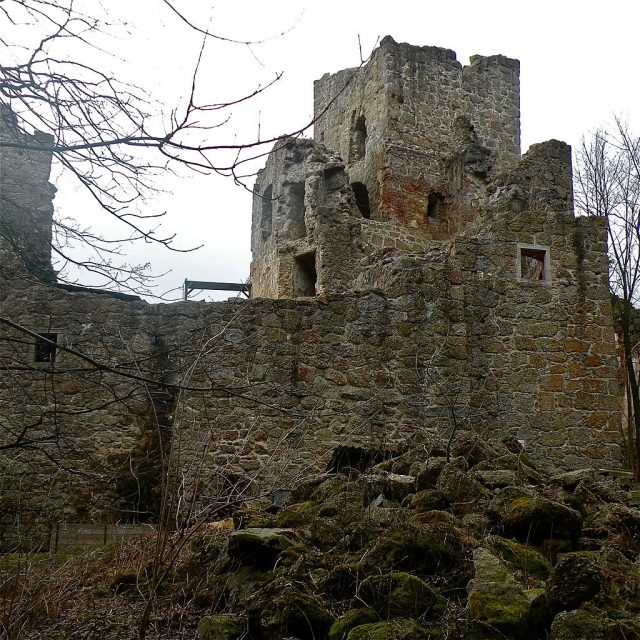
The castle ruin Windhaag, also known as Old Windhaag Castle, is located approximately five hundred meters east of the town center of the municipality of Windhaag bei Perg in the Perg district in the Mühlviertel region of Upper Austria.
In contrast to the New Windhaag Castle, which was built in the 17th century by Joachim Enzmilner in the immediate vicinity and soon thereafter completely destroyed, the old castle has been preserved as a ruin. In the old castle, the (first) Windhaag monastery was established in 1664, which shortly thereafter moved to the new Dominican convent of Windhaag in the town center. The ruin, which fell into disrepair in the 18th century, was acquired by the municipality of Windhaag in 1990 and has since been made usable for tourist purposes.
Windhaag Castle was first mentioned in 1290, but it is likely older. The owners at that time and until 1379 were the brothers Heinrich and Freitel von Windhaag. Hans von Au followed; Duke Albrecht III enfeoffed him with half of the lordship. In 1380, Hans received the second half as a fief. In 1395, Konrad Schaffer was in possession of the castle, and around 1400, Leopold Drosendorfer followed.
In 1407, Thomas Tannpeck bought the castle. Through marriage, the castle came to Laßla Prager in 1485. In 1486, another Tannpeck followed. The Tannpecks were on the wrong side in the war between Emperor Friedrich III and Matthias Corvinus, and the castle, like Aich Castle, was confiscated. In 1488, Laßla Prager was again enfeoffed with the castle; he had the castle chapel built in 1499.
Around 1505, he was elevated to the rank of baron by Maximilian I and now called himself von Windhaag. Laßla died in 1515; his widow and children expanded the castle into a palace and enlarged the lordship. In 1597, Lorenz Schütter auf Klingenberg bought Windhaag Castle, whose descendants sold it to Joachim Enzmilner in 1636 due to high debts.
After the purchase, Enzmilner had a large, new, three-story building in Renaissance style, the New Windhaag Castle, erected next to the rather small old castle starting in 1642. He used stones from surrounding castles or ruins, such as Mitterberg Castle ruin, as building material. The shell was completed in 1648; the furnishing and design lasted until 1673. Castle and palace were connected by a bridge. The new palace was at that time one of the most beautiful and magnificent palaces in Upper Austria, boasting, among other things, an extensive library (Bibliotheca Windhagiana) and a valuable art collection.
Enzmilner's only child was Eva, who entered the Dominican order in Tulln in 1648 against her parents' will. In 1664, she returned to Windhaag as Sister Eva Magdalena. Her father established a monastery in the old castle, and Eva Magdalena became the first prioress in 1668. Joachim Enzmiller died on May 21, 1678; his daughter inherited the old and new castle and the entire lordship of Windhaag.
Source: Wikipedia · Licence: CC BY-SA 4.0 · Image: http://commons.wikimedia.org/wiki/File:Ruine_Windhaag.JPG
This description draws on the facts documented in the linked Wikipedia article; Wikipedia content is licensed under CC BY-SA 4.0. Wording and editing: Mobile History.
Location: 48.2844, 14.6847