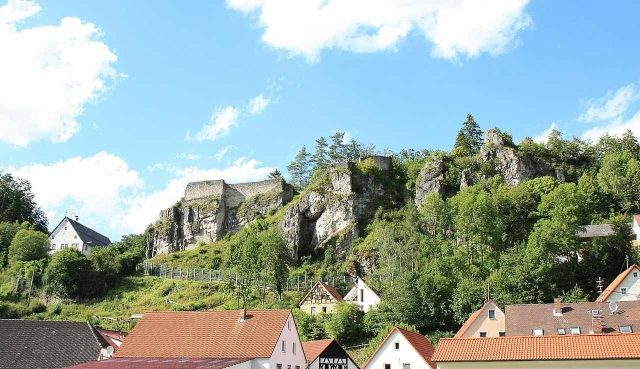
RuinWolfsberg

Wolfsberg Castle

Wolfsberg Castle

The remains of the Castle can be visited

The castle ruin of Wolfsberg is a former high medieval noble castle high above the Trubach valley, above the village of Wolfsberg. The village belongs to the municipality of Obertrubach in the Upper Franconian district of Forchheim in Bavaria.

The upper castle is freely accessible at all times and now serves as a viewpoint; the lower castle is partly privately owned and not accessible there.

The castle ruin of the hilltop castle is located in the Franconian Switzerland-Veldenstein Forest Nature Park on an eastward-extending mountain spur at an altitude of 449 meters, which is separated from the high plateau to the west by a natural saddle.

The mountain spur is formed by the Trubach valley to the south and a dry valley on the north side of the spur, which flows into the Trubach valley.

The ruin can be reached from the village of Wolfsberg.

Downstream in the Trubach valley, one can see Egloffstein Castle; in the opposite direction, there is a castle site in Obertrubach and further on the castle ruins of Bärnfels and Leienfels. To the south lies Hiltpoltstein Castle.

Wolfsberg Castle was presumably built around 1150 by the noble free lords of Wolfsberg. The Lords of Wolfsberg are documented with Gozpold de Wolfesperch since 1169. It can be assumed that they descended from the noble free family of Schönfeld-Gößweinstein.

With the extinction of the Lords of Wolfsberg around 1204, the castle passed to the Lords of Stein, who named themselves after the castle since 1244. The Lords of Stein were ministeriales of the Bamberg bishops. Around 1333, the castle came into the possession of the Lords of Egloffstein through purchase. In 1358, a Siboto von Egloffstein is documented as the owner of the castle.

Since 1383, the castle was mentioned among the possessions of the Prince-Bishopric of Bamberg. It is unclear how this came about. The castle became the seat of a bishopric office and was repeatedly pledged from the 15th to the 17th century.

During the South German Cities' War, the castle was destroyed in 1388. Reconstruction only took place in 1408 under the bailiff Albrecht von Egloffstein. In the German Peasants' War in 1525, the castle was destroyed again and rebuilt from 1547 under Philipp von Egloffstein.

The last pledge holder of the castle from 1568 was Wilhelm von Wiesenthau. Under him, the castle was greatly neglected, so that when it reverted to the Prince-Bishopric in 1609, it was uninhabited and dilapidated.

During the Thirty Years' War, further destructions occurred in 1631 and 1632 by the Swedes, and in 1633 by Tilly's cavalry and Bavarian troops.

In 1803, the castle fell to the Bavarian state, which left it vacant. In 1823, it was sold for 50 guilders to the stonemason Müller from Brunn. He gave it to his son-in-law, who demolished the castle and sold it piece by piece.

Take Mobile History with you

You are reading this text for free. Premium adds what matters on the road: descriptions read aloud, sites found through your camera, whole regions taken offline.

  • Every description, including the ~17,700 Premium sites
  • Audio guide: have descriptions read to you on location
  • AR finder: see sites through your camera, with distance and bearing
  • Unlimited saved sites

14 days free, then from €2.99 a month. Cancel anytime.

Source: Wikipedia · Licence: CC BY-SA 4.0

This description draws on the facts documented in the linked Wikipedia article; Wikipedia content is licensed under CC BY-SA 4.0. Wording and editing: Mobile History.

Location: 49.6887, 11.3117