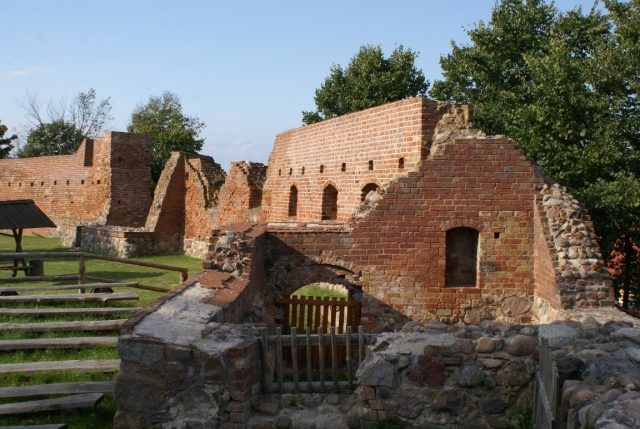
The remains of the Castle can be visited
Wredenhagen Castle

Wredenhagen Castle is the ruin of a castle complex in Wredenhagen in the Mecklenburg Lake District in Mecklenburg-Vorpommern, with its associated manor farm.
Origin and Structure of the Castle
The castle was first documented in 1284 as Novum Castrum Wenden (New Wendish Castle). In 1296, the new castle was in the possession of the Lords of Werle. It had been built on a natural hill, which was additionally raised with the earth from the surrounding moat, and served as a border and defensive castle for the protection of the surrounding areas.
The structure was laid out as an almost circular ring wall made of fieldstones and bricks. The only access to the complex was through the gatehouse in the northwest. Inside the castle was a round stone keep, as well as residential and economic buildings. The original residential building of the complex was located to the right of the gatehouse; the bailiff's office was later built on its foundations. The keep was located to the left behind the gatehouse; nothing remains of it today. To the north and east, the surrounding moat was surrounded by wooden palisades, while to the south and west, Lake Mönchsee and wet meadows offered natural protection. In front of the gatehouse in the northwest of the complex was an outer bailey, also surrounded by palisades, which also enclosed the fortified village church of Wredenhagen and other buildings.
Change of Ownership and Princely Seat
In the early 14th century, the castle temporarily came into the possession of the Brandenburg margraves. However, through the Treaty of Rendsburg in the Pomeranian-Brandenburg War of 1329, the complex reverted to the Lordship of Werle. After the pledging of the land around Röbel to Duke Albrecht II of Mecklenburg in 1362, it came into the possession of the Lords of Flotow of Stuer. After the extinction of the Werle lineage in the 15th century, the castle fully passed into the possession of the Mecklenburg dukes. After several pledges, the complex was the residence of Duke Karl I in the late 16th century.
Wredenhagen Estate as Domain Land
After 1586, Wredenhagen Castle was no longer a princely seat. Instead, a ducal domain office was established, from which the entire Röbel region was administered. The agricultural estate of Wredenhagen itself, belonging to the castle, together with the estates of Hinrichshof and Mönchshof, formed a common estate within the Duke's domain, which was leased for a period. The landlord remained the regional sovereign. Although the changing tenants mostly came from the surrounding lower nobility and also took up residence in the castle, the defensive character of the complex was lost during its use as an economic estate. To open up the surrounding pastures, breaches were made in the walls, and damaged parts of the defensive walls were no longer repaired. Rather, the ring wall served as an outer wall for a multitude of economic buildings that were subsequently added in half-timbered construction.
In the late 17th century, Tsar Peter the Great is said to have learned blacksmithing at Wredenhagen Castle. In the 18th century, under the tenant Johann Heinrich von Brandt, the impressive current manor house was built. During the Imperial Execution, the complex came under Prussian pledge ownership. After 1840, the administrative seat was moved to Röbel. The domain office there was henceforth called "Domanialamt Wredenhagen zu Röbel". In 1888, the Wredenhagen estate, together with the Hinrichshof and Mönchshof estates, comprised an agricultural area of 1,589 hectares, making it the largest agricultural enterprise in the domain of the Grand Duchy of Mecklenburg-Schwerin. The estates continued to be leased. Wredenhagen estate was given in hereditary lease, while Hinrichshof and Mönchshof each had a temporary tenant. In the 19th century, a bailiff's office was built on old foundations from the 14th century, and the residential buildings were renovated; later, a distillery and a steam mill also followed.
Public Buildings
In 1927, the municipality of Wredenhagen acquired the complex and established a school there. After the Second World War, the registry office was located in the castle, and later, until 1984, a kindergarten.
The extensive stock of dilapidated stables and outbuildings was largely demolished in the 1990s, making the 365-meter-long ring wall largely visible again. In 1992/93, a comprehensive renovation of the ring wall took place. After the gatehouse was restored to its historical state in 1997, it was established as a cultural venue in 2000. Since then, guided tours have been offered. Further renovations followed, including the renovation of the school rooms in 2003.
The castle houses a hunting and a local history museum. a school museum displays a classroom with utensils dating back to around 1900. In the recent past, the "Freie Burgschule Wredenhagen" (private school, integrated comprehensive school as a full-day school with grades 5 to 10) and, until 2007, a falconry were located here.
Take Mobile History with you
You are reading this text for free. Premium adds what matters on the road: descriptions read aloud, sites found through your camera, whole regions taken offline.
- Every description, including the ~17,700 Premium sites
- Audio guide: have descriptions read to you on location
- AR finder: see sites through your camera, with distance and bearing
- Unlimited saved sites
14 days free, then from €2.99 a month. Cancel anytime.
Source: Wikipedia · Licence: CC BY-SA 4.0 · Image: Roland Neubert, Halle (Saale)
This description draws on the facts documented in the linked Wikipedia article; Wikipedia content is licensed under CC BY-SA 4.0. Wording and editing: Mobile History.
Location: 53.2895, 12.5206