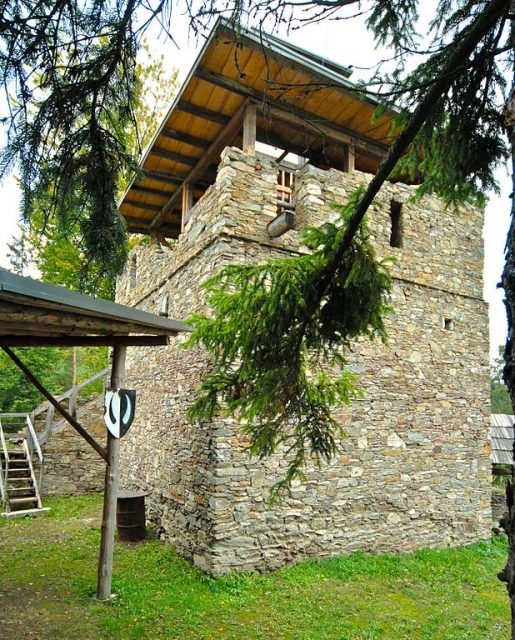
The remains of the Castle can be visited
Zeiselberg Castle

The Zeiselberg castle ruins, or Zeiselburg for short, refer to the remains of a medieval castle on a hill above the village of the same name in the municipality of Magdalensberg in Carinthia, which presumably existed for only a few decades in the 13th century. In recent times, parts of the complex have been excavated and reconstructed. Zeiselburg is now a popular excursion destination.
The Zeiselberger family, who were ministeriales of the Carinthian dukes, is historically verifiable for the year 1202. The family was a branch of the Freibergers, who resided in the 12th century at the ducal castle of Freiberg north of St. Veit. The castle on Zeiselberg was first mentioned in a document in 1250 as being in the possession of the Lords of Zeisel. Albert de Zeyselberg, son of Heinricus Ziesel, was a ducal cupbearer and between 1267 and 1269 the supreme judge in Carinthia. Under him, the castle was rebuilt in the second half of the 13th century. With Albert's death, the Zeiselberger family died out in the male line in the 1270s. Albert's widow Aleiza had to return properties alienated by her husband before her death. Her sons-in-law were involved in an uprising against the Habsburgs in 1292, after which Zeiselburg was besieged and destroyed in May 1293. It was probably not rebuilt. In the 15th century, the Mordax family appears as owners of the Zeiselberg dominion, and in 1493, the Siegerdorfer family was enfeoffed with Zeiselberg by Emperor Frederick III. After that, the Zeiselberg dominion was no longer mentioned in documents.
In 1989, the owner of the property, Kurt Zechner, began to excavate the buried remains of Zeiselburg and to reconstruct parts of the complex using the available material.
Description+
The complex is located at an altitude of 600 meters above the village of the same name. Zeiselburg was a small castle, protected by a neck ditch and an outwork, with an irregular enceinte. Through the gate in the east of the complex, one enters a small inner courtyard, which was surrounded by a two-room palas to the right of the gate, as well as other residential and utility buildings. Northwest of the palas, a forge and a filter cistern were connected. Opposite the gate was the keep, which has now been rebuilt to a height of eight meters. In the west of the complex was another forge, and to the left of the gate, further buildings were connected. A small chapel with two staircases was built on the outside of the ring wall.
For research, Zeiselburg is interesting due to its destruction after only a few decades, as its remains and archaeological finds – metal and ceramic finds, including horseshoes, belt buckles, crossbow bolts, and an alembic (distilling apparatus) – within the complex provide a precise picture of daily life in this era, undisturbed by later repairs and alterations.
Take Mobile History with you
You are reading this text for free. Premium adds what matters on the road: descriptions read aloud, sites found through your camera, whole regions taken offline.
- Every description, including the ~17,700 Premium sites
- Audio guide: have descriptions read to you on location
- AR finder: see sites through your camera, with distance and bearing
- Unlimited saved sites
14 days free, then from €2.99 a month. Cancel anytime.
Source: Wikipedia · Licence: CC BY-SA 4.0 · Image: http://commons.wikimedia.org/wiki/File:Magdalensberg_Zeiselberg_Zeiselburg_06102006_776.jpg
This description draws on the facts documented in the linked Wikipedia article; Wikipedia content is licensed under CC BY-SA 4.0. Wording and editing: Mobile History.
Location: 46.6626, 14.3841