The remains of the ancient city can be visited.
Ancient BuildingAvellino
Ancient city Abellinum
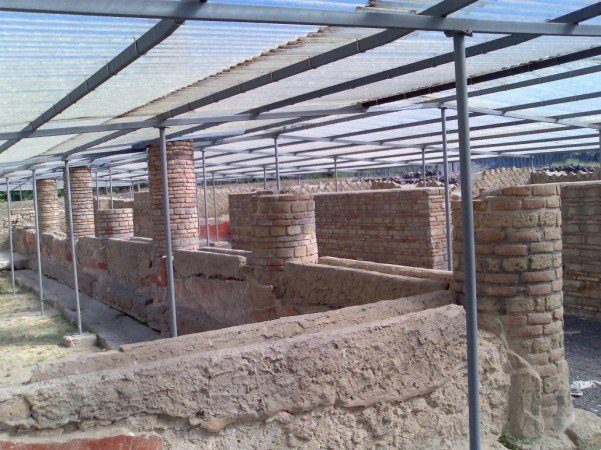
Abellinum (near modern-day Avellino) was an ancient city of the Hirpini in Campania. It was located on the southern border with Samnium on a terrace to the left of the Sabato river, west of the modern town of Atripalda.
Since the Samnite Wars in the 3rd century BC, the city belonged to the Roman dominion and became Colonia Veneria Abellinatium under Sulla, belonging to the Tribus Galeria. It was expanded under Augustus (with the addition of his wife Livia's name, who owned property in the Hirpinian territory: Colonia Veneria Livia Abellinatium) and Severus Alexander (Colonia Veneria Livia Alexandriana Abellinatium). After an earthquake (346), a volcanic eruption (472), and the invasions of the Goths and Lombards in the 6th century, the city was abandoned. The inhabitants settled on the surrounding hills, where modern-day Avellino emerged. Two city walls from the 3rd century BC with towers and a ditch from the Augustan period, baths, and residential houses are preserved. Outside the city walls, there are also remains of an amphitheater and an aqueduct leading to Misenum. To the east, there is a necropolis (San Ippolisto) used until Christian times. Finds can be seen in the Museo Irpino in Avellino.
Take Mobile History with you
You are reading this text for free. Premium adds what matters on the road: descriptions read aloud, sites found through your camera, whole regions taken offline.
- Every description, including the ~17,700 Premium sites
- Audio guide: have descriptions read to you on location
- AR finder: see sites through your camera, with distance and bearing
- Unlimited saved sites
14 days free, then from €2.99 a month. Cancel anytime.
Source: Wikipedia · Licence: CC BY-SA 4.0 · Image: Razzairpina at Italian Wikipedia · Wikimedia Commons · Public domain
This description is a machine translation of an excerpt from the linked Wikipedia article. The source text was written by its authors, the translation is by Mobile History; like the original it is licensed under CC BY-SA 4.0.
Location: 40.9221, 14.8312