The church can be visited
ChurchNantes
Cathédrale Saint-Pierre-et-Saint-Paul de Nantes
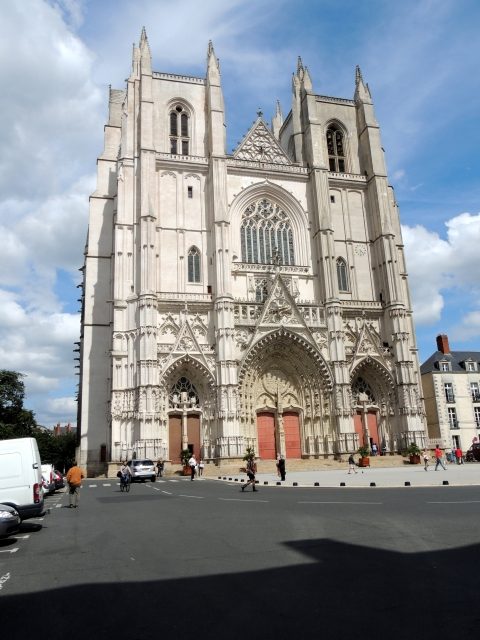
Dedicated to Saints Peter and Paul, the Cathédrale Saint-Pierre-et-Saint-Paul is a sacred building in Nantes. It stands in the city of Nantes, in the Loire-Atlantique department of the Pays de la Loire region in France. It has one of the country's highest vaults and is an example of French late Gothic architecture.
History+
The cathedral's history begins with an initial cathedral construction in 527, completed in 549. This early structure was severely damaged by Norman invasions between 843 and 919, and by 940, only ruins remained. Under Bishop Benedict of Cornouailles, a Romanesque reconstruction took place between 1079 and 1112. The foundation stone for the current Gothic cathedral was laid on April 14, 1434, by Duke John V, with construction unusually beginning with the west facade. The towers remained unfinished, and the Gothic nave was consecrated only in 1577. After a construction hiatus, work resumed in 1627, and parts such as the nave's central aisle and the south transept were completed in the 17th century. During the French Revolution, the building served as a stable and warehouse before being used as a church again after 1800. In the 19th century, a comprehensive completion in the Gothic style took place, concluding with the cathedral's consecration in 1891. During World War II, the cathedral was damaged by bombs in 1944, and a fire in 1972 destroyed the wooden roof structure. Extensive restoration until 1985 removed the damage and restored the building.
Location+
The Cathédrale Saint-Pierre-et-Saint-Paul is located in the city of Nantes, in the Loire-Atlantique department, which belongs to the Pays de la Loire region in France. It stands at an elevation of approximately 36 meters above sea level.
On site+
The cathedral is now accessible to visitors and can be explored. Its interior presents itself as an ensemble of late and post-Gothic architecture, which acquired its current form through the restorations of the 19th and 20th centuries.
Take Mobile History with you
You are reading this text for free. Premium adds what matters on the road: descriptions read aloud, sites found through your camera, whole regions taken offline.
- Every description, including the ~17,700 Premium sites
- Audio guide: have descriptions read to you on location
- AR finder: see sites through your camera, with distance and bearing
- Unlimited saved sites
14 days free, then from €2.99 a month. Cancel anytime.
Source: Wikipedia · Licence: CC BY-SA 4.0 · Image: Jean Thiers
This description is an excerpt from the linked Wikipedia article and was written by its authors. Like the original it is licensed under CC BY-SA 4.0 and may be reused under the same terms.
Location: 47.2183, -1.5506