CastleNyon

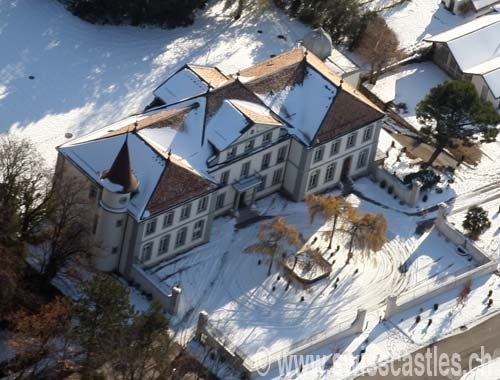
Château Changins (Nyon)

Château Changins (Nyon)

Agronomic research center

The Château de Changins was probably built in the 18th century on the remains of an old Roman building. During the construction of the castle, the remains of a thick rubble stone wall dating from that period were found.

Owners of the castle included the de Changins family, counts from Savoy, and burghers from Nyon. Subsequently, the Changins property passed to Pierre Noël, assessor to the bailiffs of Nyon, to whom the first construction of the castle is attributed. In 1712, his widow sold the property (6.8 hectares) to Jean Crespin, a merchant from Gévaudan (Lozère), who died in 1728. In 1730, Changins was bought for 79,800 guilders by Armand-Louis de Saint George, Count de Marsay, originally from Limousin and Minister for Her British Majesty in Geneva, thanks to the dowry of his wife Henriette-Catherine de Mestral de Pampigny. He had the molasse orangery built, which is located west of the castle.

After the death of Armand-Louis de Saint George in 1762, his two sons, Gabriel-Louis and Henri-Auguste, inherited the property, which since 1780 also included the lordship of Duillier. Subsequently, it was owned by the latter's son, Gabriel-Henry de Saint George, who owned three territories in 1809: Changins, Duillier, and Chardonney. His son Alexandre followed him and hired the city writer Urbain Olivier as a surveyor. In 1905, the last of the Saint Georges of Changins, William-Henry, had the castle's facade decorated with a rounded bay window with a balcony, the construction of which cost the lives of four workers due to the fall of a six-ton slab.

Until 1933, Changins belonged to Sophie Cérésole-de Mestral. Gradually, the property passed to Dr. Francois-Placide Nicod of Lausanne, who had rooms created in the attics to accommodate boarding school students – then Edgar Glauser, an entrepreneur from Locle. In 1953, the Confederation acquired the property to establish a new center for agricultural research. Although the Changins area has not changed externally since its purchase by the Confederation, it can be noted that the federal station for agricultural research of Changins (SFRA or more precisely RAC), with the castle as its central administrative office, has become the most important in Switzerland.

Indeed, it manages approximately 230 employees and researchers, including 56 scientists and 136 technicians, who oversee more than 200 hectares of experimental crops in Vaud, Valais, and Ticino. Changins particularly deals with cereals, hoed crops, fodder, fruit, horticultural crops, and viticulture, with the protection and improvement of plants, seed control, and chemistry and physiology. Other areas of the RAC specialize in pastures, forest and livestock, corn and potatoes, small fruits, flower and tree cultivation.

Take Mobile History with you

You are reading this text for free. Premium adds what matters on the road: descriptions read aloud, sites found through your camera, whole regions taken offline.

  • Every description, including the ~17,700 Premium sites
  • Audio guide: have descriptions read to you on location
  • AR finder: see sites through your camera, with distance and bearing
  • Unlimited saved sites

14 days free, then from €2.99 a month. Cancel anytime.

Source: Wikipedia · Licence: CC BY-SA 4.0

This description draws on the facts documented in the linked Wikipedia article; Wikipedia content is licensed under CC BY-SA 4.0. Wording and editing: Mobile History.

Location: 46.3987, 6.2330