The Castle can be visited
CastleAlex
Château d'Alex
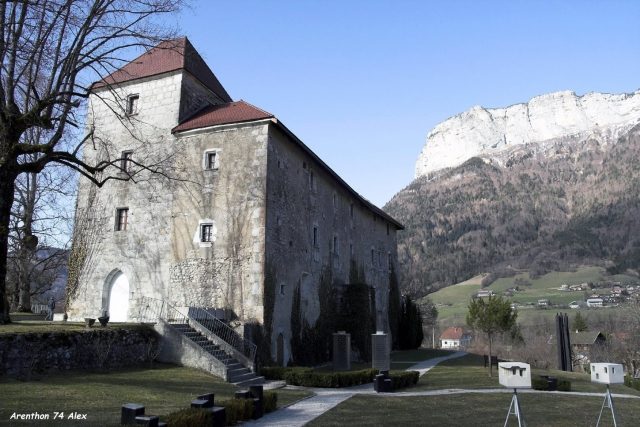
Alex Castle, also known locally as Arenthon, is a former fortified house from the 14th century, the center of the seigneury of Alex, elevated to a county in 1783, which stands in the commune of Alex in the department of Haute-Savoie, in the Auvergne-Rhône-Alpes region.
Location+
Alex Castle is located in the French department of Haute-Savoie on a hill in the commune of Alex. It monitored the outlet of the Col de Bluffy and the Fier valley on the road from Annecy to Thônes, facing Dingy Castle, which has since disappeared.
History+
In the 14th century, Alex Castle belonged to the lords of Les Clets, while neighboring lordships were the possession of the Menthon family. In 1340, the castle is mentioned as a possession of the Alex family. In 1383, Marguerite d'Alex, the last member of the family, brought the castle as a dowry to Pierre d'Arenthon, giving birth to the Arenthon d'Alex family. In 1420, François d'Arenthon, in a recognition he held from the Prince of Savoy, cited: "a fortified house behind Alex with a piece of meadow and a curtil (garden), a mill and a fulling mill on the bank of the Alex stream with sluices and appurtenances". In August 1541, Pierre Favre stayed two days at the castle. Jean d'Arenthon d'Alex was born at Alex Castle in 1620; he would become prince-bishop of Geneva in 1661 and would have the grand seminary of Annecy built in 1684. Upon the extinction of this family at the beginning of the 18th century, with Denis d'Arenthon d'Alex, captain in the Tarentaise regiment, president of the Sovereign Senate of Savoy, Alex passed to the Favier family, barons of Noyer, who in 1772 sold it to François-Marie de La Fléchère. He would see his lands of Alex elevated to a county in 1783 by the King of Sardinia. Following the insurrection in the Thônes valley in the spring of 1793, of which Alex was one of the strongholds, François-Marie de la Fléchère was placed at the head of the riots that shook Annecy in August and his massacre at Les Marquisats, the castle was confiscated and then sold as national property. The families Perravex, Laffin, Bardet, Gay, Duret then succeeded each other. Between 1884-1894, Philippe Gay, the new owner, had most of it demolished. In 1960, according to testimonies, the owners, farmers, used parchments stacked in wooden chests as toilet paper. It housed the Salomon Foundation for Contemporary Art from June 2001 to the end of 2014. Since its closure, the castle has been put up for sale. Alex Castle and its surroundings are listed as natural monuments and sites by decree of June 2, 1947.
Source: Wikipedia · Licence: CC BY-SA 4.0 · Image: Hervé Rebours
This description draws on the facts documented in the linked Wikipedia article; Wikipedia content is licensed under CC BY-SA 4.0. Wording and editing: Mobile History.
Location: 45.8897, 6.2407