To be privately owned
ManorAmpoigné
Château d'Ampoigné
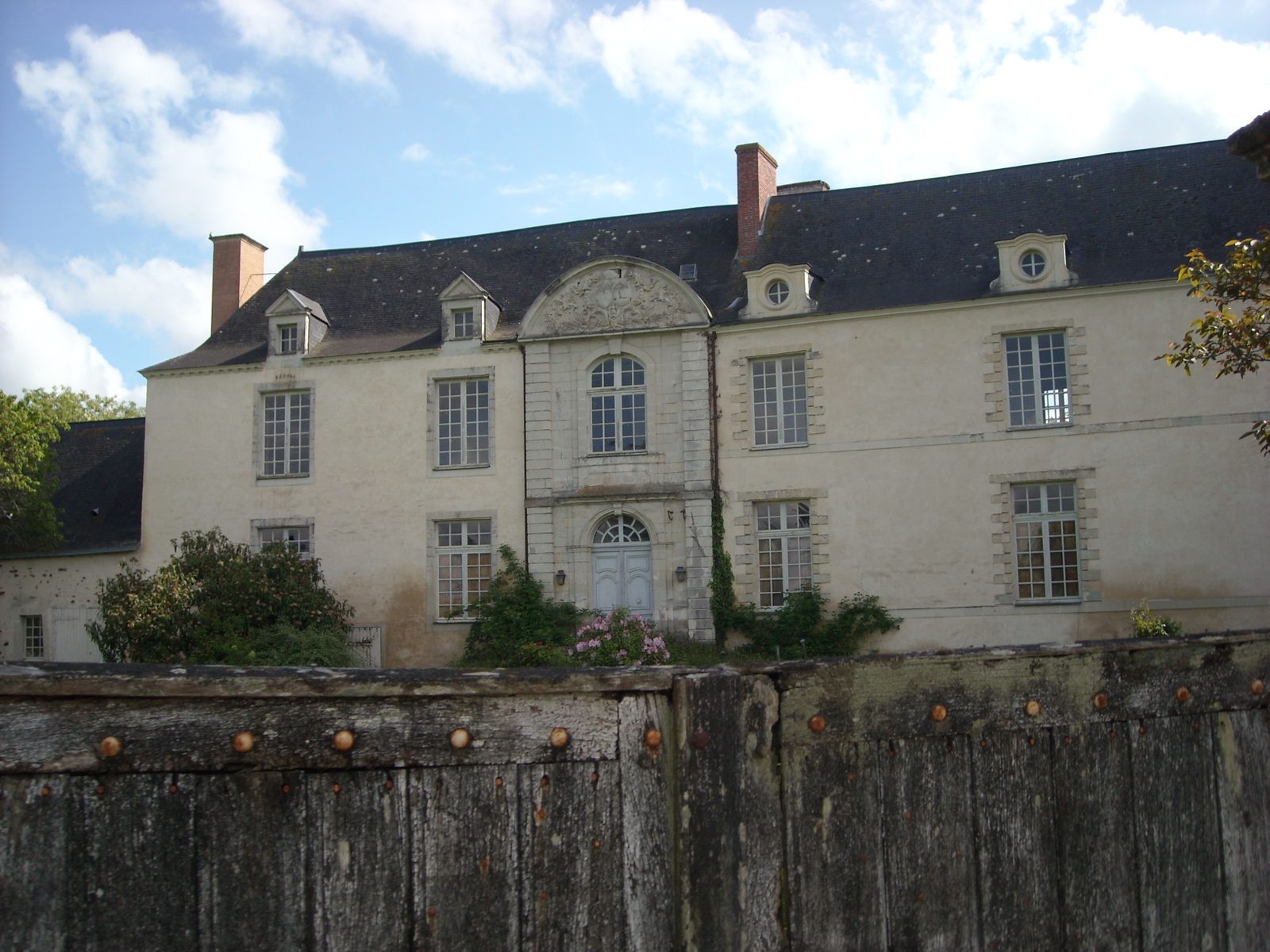
Ampoigné Castle, also known as Château de la Cour, is a monument located at the entrance to the commune of Ampoigné in the French department of Mayenne, just a few steps east of the parish church. Like the locality to which it belongs, it has preserved the name of its first lords, who came from a knightly family whose coat of arms was a silver shield fretty red six times.
Architecture+
At the beginning of the 17th century, the d'Héliand family had a castle built on a site already fortified in the 13th century. This castle, which has a pavilion, was extended in the 18th century by the construction of an independent dwelling. Both parts were registered as historical monuments on January 26, 1987.
Lords and Owners+
This is not a genealogy, but a list of the lords and owners of Ampoigné Castle.
d'Ampoigné Family+
They owned the land and bore the name Ampoigné from the 11th century until the middle of the 13th century. Their coat of arms was silver, fretty red six times. The fief of Ampoigné – sometimes referred to as a châtellenie – owed allegiance and homage to Château-Gontier. Its lord was obliged to keep watch for forty days at the Saint-Rémy gate of Château-Gontier, for himself and his vassals of the Ampoigné land, and to stay in the town with his wife, his family, and his men, adequately equipped. They also had the honor and... the task of requesting men from the Lord of Verger to provide said watches.
Alleaume d'Ampoigné is a witness around 1080 to a donation to the nuns of the Ronceray d'Angers Abbey in the town of Château-Gontier. Hugues d'Ampoigné, also a witness to an agreement between the chaplain of Château-Gontier and the abbot of Saint-Nicolas d'Angers, in 1120, handed over a few years later to the monks of La Roë the rent they owed him on the fief of Renaud de Montfanter. Thibault d'Ampoigné was present at the granting of a tithe in Livré, granted to the Abbey of La Roë in the 12th century. Philippe d'Ampoigné, parish priest of Segré, lived in 1227. Guillaume d'Ampoigné, who declared on December 15, 1470, at the muster of the Arrière-Ban of Angers, that he was "very old, but would nevertheless serve in brigandine if he could, but that he was so poor that he had no clothes," did not belong to the previous family, nor did Renée, called d'Ampoigné, who married Guillaume Ernoul in 1607 and was the mother of a child whose godmother was Marguerite d'Ampoigné.
Cheorchin Family+
Around 1250, the land of Ampoigné became the property of the Chéorchin family, an old knightly family that gave its name to La Motte-Sorchin de Cosmes. By 1250 at the latest, the land of Ampoigné had passed to Jean Chéorchin, the husband of Mathée de Coesmes, father of Jean Chéorchin and grandfather of Payen Chéorchin, who was a benefactor of the Abbey of La Roë and supposedly married Jeanne de Château-Gontier, long after the extinction of that name in the elder branch.
Gervais Chéorchin, Lord of Ampoigné, concluded an agreement in 1300 with the Abbot of Clermont concerning properties in Genest. In 1328, Guillaume Cheorchin – who is listed in the cartulary of the Bons-Hommes d'Angers – died, leaving his properties, including this land, to his sole heir, his sister Jeanne, who had married Jean de Quatrebarbes, Lord of La Membrolle.
La Tour-Landry Family+
Towards the end of the 14th century, Marguerite d'Auvers, widow of Jean de Quatrebarbes, received the land of Ampoigné as dower, and Marie de Couliette, widow of Gilles de Quatrebarbes, rendered homage in Château-Gontier in 1413 and 1414.
Marie de Couliette married Guillaume d'Avaugour in her second marriage, one of Charles VII's most loyal servants. He was among the men-at-arms assigned to the person of the Dauphin and participated in the expedition to relieve the fortress of Saint-Florentin near Auxerre, which was attacked by the Duke of Burgundy. As a widower of Marie de Couliette, he married Blanche de la Tour-Landry, who had to claim back the considerable sums lent by her husband, who died in 1447, to the King of France. In 1434, d'Avaugour had claims to the lordship of Ampoigné and succeeded in obtaining an exemption from guard duty in Château-Gontier from Jean II d'Alençon. In 1435, Louis de La Tour-Landry, husband of Jeanne de Quatrebarbes, himself rendered homage for the land of Ampoigné.
Louis de la Tour-Landry owned Ampoigné through Jeanne de Quatrebarbes, his wife, and rendered homage himself in 1435. His widow, a benefactor of the Abbey of Champagne in 1455, mentioned at the assizes of Château-Gontier in 1456, made her will in 1459. Christophe de la Tour-Landry, to whom René had ceded his birthright, was Lord of Ampoigné in 1463, but died childless, leaving the land to Louis de la Tour-Landry, his younger brother, who had only one daughter by Catherine Gaudin, Françoise de la Tour-Landry, married to Hardouin de Maillé, called de la Tour-Landry. Hardouin X de Maillé (1462-1524), (Lord of Benais), married Françoise de La Tour-Landry, heiress of her family, on July 30, 1494, and passed on the name and land of La Tour-Landry to their descendants.
de Maillé de la Tour-Landry Family+
Jean de Maillé de la Tour-Landry, their son, rendered homage for Ampoigné in 1526, 1561, and left this land to his younger son, René de Maillé de la Tour-Landry, who, through his imprudence and "poor household management," lost this land for the family. He did not marry but had two bastards, one of whom, Victor, became parish priest of Maisoncelles; after a long lawsuit against Claude d'Avaugour, Dame de la Ferrière, and later resuming it against her heirs, Ampoigné and its dependencies were seized in 1595. Raphaël, his brother, is also mentioned in the records of the time, but it was Charles, his nephew, son of François de Maillé, the eldest of the family, who tried to recover the châtellenie from the creditors. He even obtained from Henry IV, Baron of Château-Gontier, the remission of the sales rights (1598); but he was killed in a duel in Paris in 1605. Urbain de Laval Boisdauphin, Marshal of France, also wanted to claim ownership in the name of his son in 1599, but without success.
d'Héliand Family+
The d'Héliand family is a noble family that, according to the declarations of 1667, dates back to Adam Héliand, Lord of Vivier, parish of Challes, living around 1450. Their coat of arms is: Or, three eagles Azure, beaked and armed Gules. They owned in Mayenne the parish lordships of Ampoigné, Chantrigné, Molières, Saint-Fraimbault-de-Prières, Saint-Loup-du-Gast, and the estates of Autheu, Ingrandes, etc. In 1606, René de La Tour-Landry drew up a deed of sale for the property in favor of Jean and Julien Guilloteau, but Jean d'Héliand, secretary to the King, eventually became the buyer in 1609. His descendants retained the lordship of Ampoigné and often adopted its name or surname.
René d'Héliand, son of the buyer. Born on September 24, 1601, married on March 10, 1629, to Jeanne de Dommaigné and on November 30, 1639, by contract of November 30, 1639, to Louise du Breuil, daughter of the Lord of Ingrandes. He served as an infantry captain in the cavalry under Count Strozzi in Germany, then under Marshal of France Louis II de Marillac; he was a captain in the Lemont regiment and shortly thereafter received orders to raise a company of one hundred men. After long service, he retired to Ampoigné. The King wrote to him from Saumur on February 12, 1652, "that he counted on his devotion to bring the rebels to their duty." Infantry captain in the Strozzi regiment, then lieutenant in the Dauphin's regiment, governor of Verdun, confirmed on April 19, 1635, with Antoine and Charles, his brothers, still alive in 1690. He made his will on July 13, 1656, and was buried in the same tomb as his two wives. Some words of their epitaph were still legible in the mid-19th century in the choir of the Saint-Jean-Baptiste d'Ampoigné church. He had numerous children by his two wives and died in Ampoigné in 1659. In 1652, Lord d'Héliand claimed the right, as Lord of Ampoigné, to have a stake with his coat of arms in Chemazé. Ampoigné Castle, built in the 17th century by the d'Héliand family, has two round turrets guarding each side of the entrance portal. The main building, consisting of a ground floor, an upper floor, and an attic, is topped with a triangular gable, preceded by a double-flight staircase. On the gable, the remains of a double coat of arms can be seen, mutilated and framed by foliage. The interior of the castle houses a monumental staircase that preserves a very original creeping arch on the ground floor.
René d'Héliand, principal heir, married in 1665 or earlier to Marguerite Lefebvre, was buried in the family vault on January 26, 1676. His widow married Lord de Chenedé in 1682. The children inherited the paternal wealth and also the baronies of Ingrandes and Azé through the extinction of their grandmother's family. Around 1688, Jean Leroux drafted a memorandum concerning the gold mine of Ampoigné Castle.
René Claude d'Héliand, who was the eldest since his marriage (1692) to Philippe de Hardouin, daughter of the Lord of La Girouardière, began to neglect Ampoigné Castle to reside in Château-Gontier in the parish of Saint-Jean l'Évangéliste. In this church, his wife, who had been a widow since 1727, was buried on October 17, 1752. Pierre-Philippe d'Héliand, who succeeded them, also became Lord of Mollières through his marriage (1730). He was buried in the church of Saint-Jean-l'Évangéliste of Château-Gontier in 1771. As Lord of Ampoigné, he was a lieutenant in the Antwerp regiment, married on June 15, 1730, to Renée de Juigné, Lady of Molière and l'Ile-du-Gast; his widow was buried in the cemetery of the Saint-Jean-Baptiste church of Château-Gontier in 1786. Of their children, Georges-Jacques-Camille, who resided in Echasseraie, in N.-D. d'Allençon (Anjou), allied himself with the daughter of Marie-Urbain-Charles de la Tour-Landry; Henri-René d'Héliand, officer of the French Guards, Knight of the Order of Saint-Louis and the Order of Saint-Lazare, died unmarried; Pierre d'Héliand is referred to as Baron d'Ingrandes, ensign of the French Guards, husband of Marie Guérin, Knight of the Order of Saint-Louis, admitted to the Order of Saint-Lazare in 1768, commander in 1787, residing in his castle of du Vivier des Landes (Courcelles-de-Touraine). Augustin-Pierre d'Héliand, the eldest, was Lord of Ampoigné and l'île du Gast. He married Élisabeth-Victoire-Éléonore de Montécler in Grenoux in 1771. One of their children was born in l'Ile-du-Gast in 1777. The eldest, baptized in Grenoux on October 17, 1771, married Françoise-Adélaïde Gallery de la Tremblaye on 17 Floréal of year II and died on September 18, 1837, at l'Ile Castle, leaving Pierre-Georges d'Héliand, Count d'Héliand, married to Marie-Pauline de Quatrebarbes. Hyacinthe-Marie d'Héliand, his daughter, was married to Emmanuel Bernouilli, son of the mathematician Jean Bernoulli; she died on April 30, 1835, in Ampoigné. In 1885, the land and the castle became the property of the de Champagné family.
Gold Mine of Ampoigné Castle+
In the 17th century, some claimed that the well of Ampoigné Castle contained a gold mine. Indeed, around 1688, Jean Leroux, a former officer of the salt warehouse of Pouancé, addressed a memorandum to the Intendant of Tours, assuring him that the precious ore existed in the castle's well. The Intendant, in turn, forwarded the famous memorandum to the Comptroller General; he could believe in the presence of a gold mine in the well of Ampoigné. Leroux, tasked with providing proof of his claims, had "a poor man, when the water was low, descend into this well under the pretext of retrieving his accidentally dropped bowl." It is said that the bowl was retrieved and brought back "full of sand mixed with gold ore." Completely satisfied with this discovery, Leroux sent the bowl and its contents to the Intendant with the advice "not to rely on the Lord of Ampoigné," a simple nobleman more attached to his property than to the interest of the King, who, according to Article 6 of the Custom of Anjou, had a right to all gold and silver mines in the kingdom. However, this discovery had no further consequences. Abbot Angot notes that he was informed that the soil might contain iron sulfide, which would have a more or less golden appearance.
Take Mobile History with you
You are reading this text for free. Premium adds what matters on the road: descriptions read aloud, sites found through your camera, whole regions taken offline.
- Every description, including the ~17,700 Premium sites
- Audio guide: have descriptions read to you on location
- AR finder: see sites through your camera, with distance and bearing
- Unlimited saved sites
14 days free, then from €2.99 a month. Cancel anytime.
Source: Wikipedia · Licence: CC BY-SA 4.0 · Image: Yodaspirine · Wikimedia Commons · CC BY-SA 4.0
This description is a machine translation of an excerpt from the linked Wikipedia article. The source text was written by its authors, the translation is by Mobile History; like the original it is licensed under CC BY-SA 4.0.
Location: 47.8111, -0.8242