Children's Care Home
CastleLa Montagne
Château d'Aux
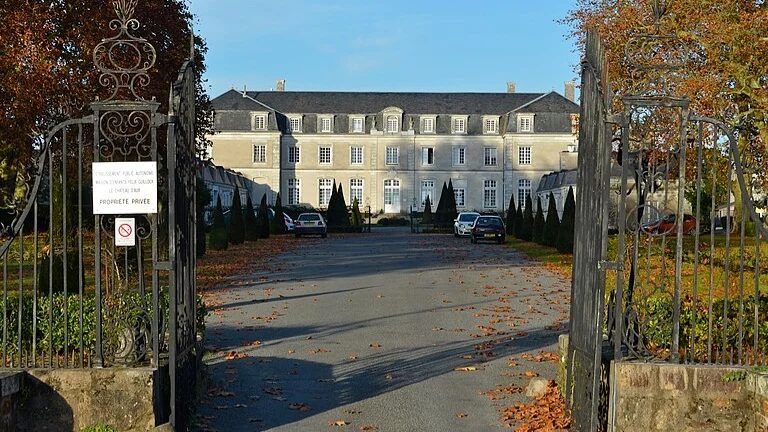
The Château d’Aux is a historic château located in La Montagne (formerly partly in the commune of Saint-Jean-de-Boiseau), in the Loire-Atlantique department of the Pays de la Loire region in western France. It stands on high ground overlooking the Loire, about 6 km southwest of Nantes, in a strategically important position that once protected the approaches to the city and the royal cannon foundry at Indret.
The first château on the site was built in 1626 by Jean Peillac (also known as M. de la Hibaudière). In the 18th century the estate passed to the Vincent d’Aux family. In 1764 Count François d’Aux de Bournay, who had made his fortune with pineapple plantations in Saint-Domingue, had the residence rebuilt on the ruins of the earlier building. The reconstruction was entrusted to the architect Jean-Baptiste Ceineray, a major figure in 18th-century Nantes architecture (responsible for works such as the Place du Bouffay, the Cours Saint-Pierre and the Place Royale).
During the French Revolution and the War in the Vendée the château was occupied by Republican forces. On 10 August 1793 Vendéen troops under Louis-François Ripault de La Cathelinière attacked it in an attempt to isolate the Indret foundry, but were repelled (Battle of the Château d’Aux). On 2 and 3 April 1794 the site became the scene of the “Massacre du château d’Aux”: 209 inhabitants of Bouguenais, suspected of royalist sympathies, were shot there after summary judgment by the Commission Bignon.
After the Revolution the property remained in the hands of the d’Aux heirs but was largely neglected. It was sold in 1879–1880 to Louis-Félix Cadou, who attempted restoration. From 1903 to 1926 it belonged to Madame Say. During the First World War German prisoners were housed there and sisters from Amiens briefly occupied the building. On 27 January 1923 the City of Nantes purchased the by-then reduced estate (the château and about 3 hectares of park and gardens) for 225,000 francs. From 1926 until 1967 it served as an open-air school-sanatorium for sick children from the Nantes area. In later decades it continued to be used for children’s residential care.
The château remains a notable landmark linked both to the architectural history of the Nantes region and to the dramatic events of the Vendée wars.
Take Mobile History with you
You are reading this text for free. Premium adds what matters on the road: descriptions read aloud, sites found through your camera, whole regions taken offline.
- Every description, including the ~17,700 Premium sites
- Audio guide: have descriptions read to you on location
- AR finder: see sites through your camera, with distance and bearing
- Unlimited saved sites
14 days free, then from €2.99 a month. Cancel anytime.
Source: Wikipedia · Licence: CC BY-SA 4.0 · Image: https://fr.wikipedia.org/wiki/La_Montagne_(Loire-Atlantique)#/media/Fichier:La_Montagne_-_Chateau_Aux.jpg
This description draws on the facts documented in the linked Wikipedia article; Wikipedia content is licensed under CC BY-SA 4.0. Wording and editing: Mobile History.
Location: 47.1867, -1.6733