CastleChauvigny

Château d'Harcourt

Château d'Harcourt

The remains of the Castle can be visited

The Château d'Harcourt takes its name from Jean II, a member of the rather significant d'Harcourt family from Normandy, who around 1280 married a Vicomtesse de Châtellerault and through this union became Viscount of Châtellerault. In the 13th century, he had the Château d'Harcourt built next to the episcopal castle, presumably on the remains of a predecessor castle. The fortress remained in the possession of the d'Harcourt family for about 200 years and was transferred in 1447 to their neighbors, the Bishops of Poitiers, Barons of Chauvigny.

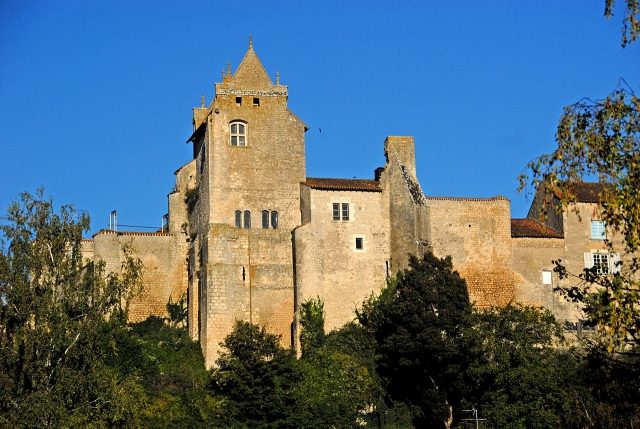
Before the current renovation of the de Gouzon keep, the Château d'Harcourt is the best-preserved castle complex in the upper town of Chauvigny. It consists of an outer bailey and a keep. The outer bailey is rectangular and measures 29 x 39 meters externally. The valley-side, east-facing wall of the outer bailey extends and connects to the defensive walls of the fortified upper town, meaning it also stands on the outer edge of the steep rock face of the castle hill. The other three sides have defensive walls over 2 meters thick and high, which are partially sloped outwards at their base.

Cylindrical towers, almost 4 meters in diameter, are arranged at the corners of the outer bailey and also in between. The loopholes within them identify them as active defensive elements of the castle. Due to the towers protruding from the walls, by about half their diameter, the archers enduring within them in case of defense have a wide-angle field of fire. The access gate is flanked by a kind of double tower, which could be secured with a portcullis and a drop gate. Between the towers, niches are arranged on the inside of the walls, in the middle of which loopholes are again recessed, from which two archers could operate their weapons simultaneously.

The keep consists of two towers, of which only the southern one rises high, with three very high floors above courtyard level due to the dome vaults, plus roof structures. It is built entirely outside the defensive wall of the upper town and the outer bailey, and extends far down from there onto the significantly lower rock embankment. The walls are reinforced by generous, right-angled wall projections that increase in thickness downwards.

In the lowest floor of the south tower, a vaulted cellar served as a prison until the 19th century. The outer door of the cell had a peculiar mechanism. It could stand slightly open, but prevented inmates from escaping with a bolt.

The interior of the keep (south tower) is now accessed via the staircase in the north wing through a door on the first floor. The entire floor plan is occupied by a hall, covered with a barrel vault, in a medieval ambiance. The large room served as living quarters and for the guard. There are windows on three sides of the room, letting in ample daylight. On the gable walls, larger niches are covered with round arches, each with 2 narrow window openings. On the reveals of the niches, there are benches on both sides, which are known to have led to the expression "window seats".

A small door leads to a staircase that provides access to the living and common rooms on the upper floors. The upper parts of the north tower were redesigned in the 16th century.

The keep (south tower) is covered with a steep gable roof, which is significantly overtopped by the gable walls on the east and west sides.

The north tower, which has been greatly altered over time, is only two stories high from courtyard level. However, its substructure, like that of the south tower, extends down in front of the vertical rock face to the massive rock embankment. Here too, increasing pillar projections and supports for the building corners are found downwards. In the rooms of the two upper floors, temporary exhibitions of fine art are currently presented.

Take Mobile History with you

You are reading this text for free. Premium adds what matters on the road: descriptions read aloud, sites found through your camera, whole regions taken offline.

  • Every description, including the ~17,700 Premium sites
  • Audio guide: have descriptions read to you on location
  • AR finder: see sites through your camera, with distance and bearing
  • Unlimited saved sites

14 days free, then from €2.99 a month. Cancel anytime.

Location: 46.5698, 0.6492