Aktuelle Nutzung
CastleBallon
Château de Ballon
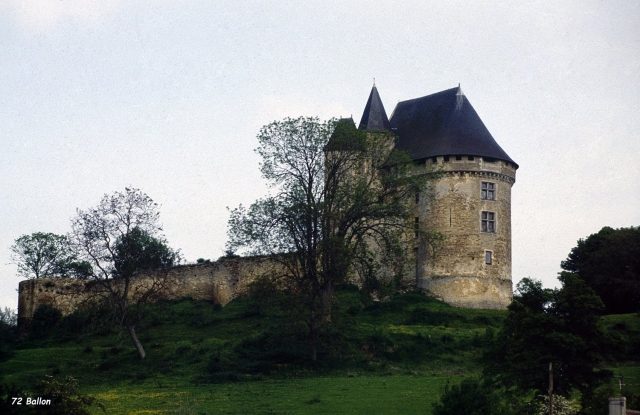
The Château de Ballon is located in the territory of the former French commune of Ballon, in the Sarthe department, in the Pays de Loire region. It was a very important fortress for much of the Middle Ages and the scene of numerous battles. Its current appearance is characteristic of the late 15th century. The keep and the ruins of the castle are classified as historical monuments.
Location+
The castle, built in a dominant position on a rocky spur at the top of a plateau overlooking the Saosnois, between Maine and Normandy, is located in Ballon, now integrated into Ballon-Saint Mars, in the French department of Sarthe. It controlled the road from Mamers, which passed at its feet and bypassed the town.
History+
The Origins+
The castle's origins are ancient, as it is mentioned as early as the beginning of the 11th century. It is said to have been built by Robert I de Bellême to serve as a base against the family of the Counts of Maine. The fortress quickly became a target for the Normans, who wanted to conquer the south of the region. The castle was given by Richard II of Normandy as a dowry for one of his daughters, whom he had with a concubine, after her marriage to Mauger, the second son of the Count of Cotentin, Néel I of Saint-Sauveur, in recognition of his services. In the possession of the Lords of Mondoubleau from the Doubleau family, the castle was besieged about twenty times in the 11th century. It was occupied, among others, in 1031 by the Count of Maine, Herbert Éveille-Chien, in 1064 by William of Normandy, and in 1080 (1098?) by Robert II de Bellême, who had the castle rebuilt on its current site. In 1089, Hélie de la Flèche conquered Ballon and took the opportunity to devastate the surrounding area. From the 12th century, Ballon passed into the possession of the de Chaources family, who kept the castle for two hundred years. The lordship was then under Anglo-Norman influence. To end the hegemony of the Plantagenets, Philip Augustus traveled to Maine. He conquered Ballon twice, in 1189 and 1199. The fortress of Ballon was then burned down and dismantled. Philip Augustus had it rebuilt and installed Hugues de Beauçais there.
The Hundred Years' War+
During the Hundred Years' War, the fortress had to endure a series of sieges. In 1361, Robert Le Mareschal, an English knight, besieged the castle. He took the opportunity to plunder the surrounding area. The French recaptured Ballon and installed Jean de Laval as commander. He adopted the name Jean de Ballon. The English besieged the castle again in 1392. Then the land of Ballon was bequeathed by the will of Jeanne de Beauçay, dated 1394, to her nephew Olivier de Prez, who took possession of it in 1402. Ballon was recaptured by the English in 1417 and 1419. After ten days of siege, Ballon fell back to the French on September 14, 1421. The army was commanded by the Duke of Aumale and the Marshal of La Fayette. It seems that Ambroise de Loré participated in this battle. In 1434, the English returned to Ballon again to conquer the town and destroy the fortress, which was then led by the Lord of Thouars (Ballon) and the Lord of Maridort (Souligné). After this period of conflict, the daughter of Hardouin VIII, Renée de Maillé, Lady of Ballon, married Jacques de Surgère, chamberlain to the king, in 1452. This rich and powerful lord began rebuilding the keep and the part of Ballon burned by the English from 1469. The reconstruction of the castle was completed in 1505 by Jeannot d’Iynurse.
Description+
The castle today presents itself as a rounded triangular enclosure wall, about sixty meters long, flanked by dismantled towers and a moat. A large, elongated 15th-century keep rises at the western tip. The 13th-century drawbridge gate was altered in the 16th century. The residential building, whose shape resembles a horseshoe, is protected by 2 m thick walls. These, heavily rebuilt in the 15th century, are very old. This four-story tower is crowned by an upper gallery on machicolations, which was later provided with large openings. Its east facade facing the courtyard was fitted with mullioned windows adorned with sculptures at the end of the 15th century. The remains of a machicolation are preserved on the walls.
Context of the reconstruction period: The fear of war is still present, as is the desire to assert one's power through the castle with symbolic elements. The castle becomes more habitable, as the defenses have become almost useless in the face of artillery. The mullioned windows show that the castle has real residential value. The fortresses of previous centuries had none for defensive reasons. With the advent of artillery, the entire concept of defense has changed. Whether castles had windows or not no longer matters. The lords at the end of the 15th century were receptive to comfort. Light is comfort and luxury. After the war, the owners of castles and manor houses primarily sought to protect themselves from robbery. Therefore, grilles were placed on the windows, and traces of them are visible on the mullions of the first two levels of the residential building. The towers are very important elements due to their symbolism: every lord wishes to have a tower built to assert his power. They have no military function, and the square tower of the castle contains no defense system, but small rooms illuminated by beveled openings. The tower, integrated into the residential building up to the fourth floor, ends in a slate roof and contains a stone spiral staircase. At its top, it takes the form of a polygonal tower and contains a machicolation. Questions arise about the presence and function of this defensive element. Did it really have a military or only a symbolic role? In the first case, it controls the entrance gate, but the presence of large windows on the left side makes it lose efficiency. It is certainly used against robbery, as its size and location can deter a small force. In sieges, however, it is completely useless. Its symbolic function is important, as the construction of any defensive element only takes place with the permission of the feudal lord. The Lord of Ballon therefore had the privilege of being allowed to erect such a building, which shows that he was able to retain significant power. The splendor of the decorations is a significant element of the lord's wealth. The more money he has, the more he cultivates the ornaments of his castle. This facade is decorated with sculptures.
Source: Wikipedia · Licence: CC BY-SA 4.0 · Image: Hervé Rebours
This description is a machine translation of an excerpt from the linked Wikipedia article. The source text was written by its authors, the translation is by Mobile History; like the original it is licensed under CC BY-SA 4.0.
Location: 48.1789, 0.2329