To be privately owned
CastleRennes-en-Grenouilles
Château de Bois-du-Maine
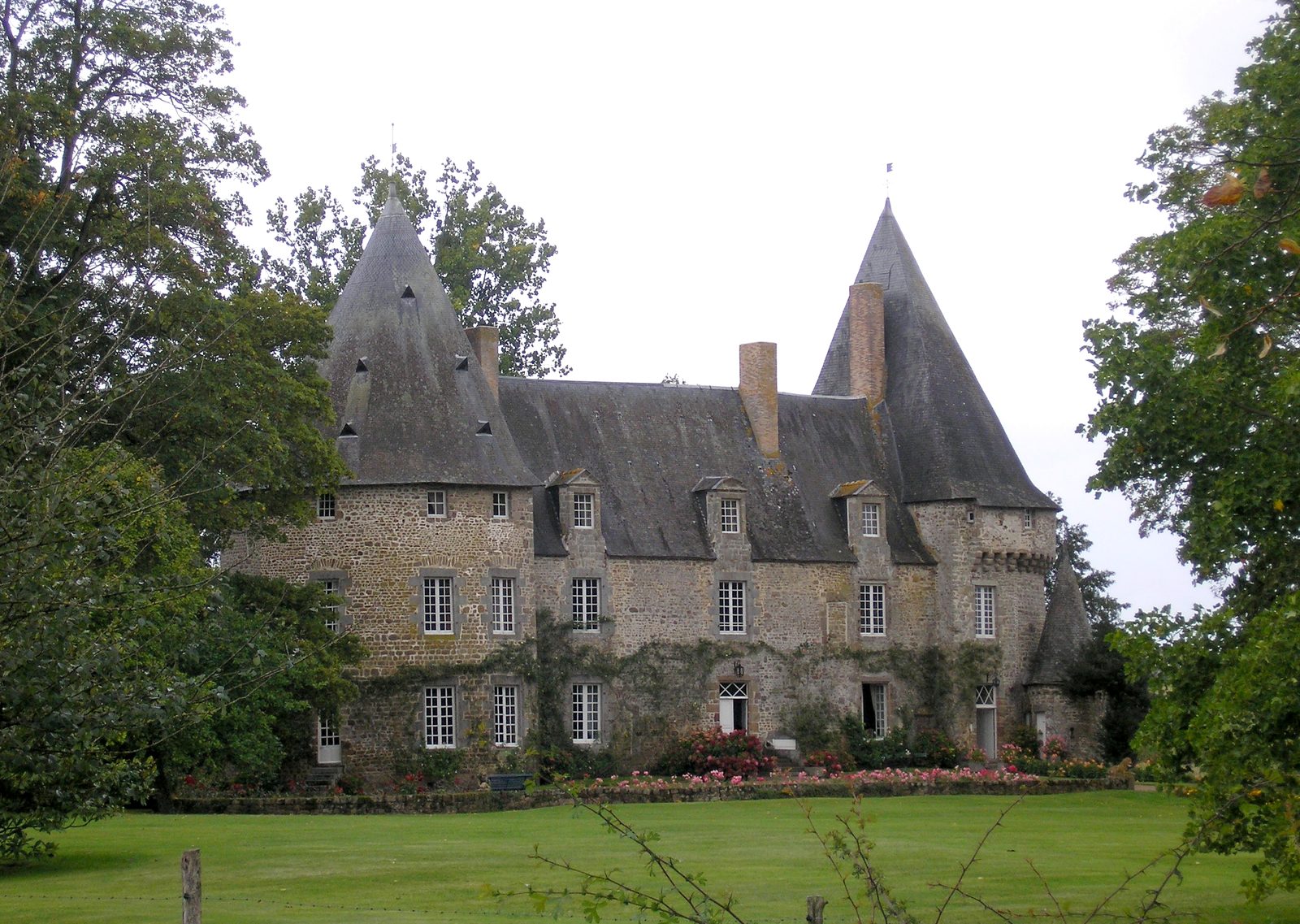
The Château Bois-du-Maine or Bois-de-Maine is located in the commune of Rennes-en-Grenouilles on the south bank of the Mayenne.
History+
The existence of a castle has been documented since the 11th century. The facades and roofs have been listed as historical monuments since 1967.
Description+
The castle is located on the left bank of the Mayenne, which is still a modest body of water. It consists of a main building flanked at the north and south ends by two large towers. The northern tower, whose base is in the Mayenne, is crowned with a series of machicolations; this is the only old part of the castle, and even this, according to Abbot Angot, probably originated after the 14th century. The castle is described in 1415 as "a dwelling surrounded by moats with 350 acres of land". In 1604, it is a "castle surrounded by triple moats, drawbridge, right of fortress, loopholes and crossbowmen; ... and within the enclosure ... an old chapel." In 1753, a keep with battlements for the defense of the castle is mentioned. The main part dates from the 17th century. Adelstan de Beauchêne, who was able to examine the building in detail, recognized that the modern appearance is only superficial, due to restorations in the 17th and 18th centuries; that the shell dates from the 15th and perhaps from the 14th century in the lower parts. The place was probably never strong, except for the waters of the Mayenne, which could easily flood all access points. At the beginning of the 17th century, the manor still had moats, drawbridges, towers with loopholes and crossbowmen. The cellars, which extend under the main building and are barrel-vaulted, are, according to Abbot Angot, particularly remarkable. They communicate with a vault under the large tower that plunges into the river, to which one descends only by a ladder and which is only dimly lit by narrow loopholes.
Feudalism+
Bois-du-Maine was at the beginning of the 13th century in the possession of the lords of Averton, who later gave it to a younger member of their house as a share, reserving homage. Thus, it must have passed to the de Boulay family towards the end of the 13th century or at the latest at the beginning of the 14th century. The feudal lordship of Bois-de-Maine, to which the de Boulay family was attached, extended over Rennes, Brétignolles, Le Housseau, Melleray, Sept-Forges, Loré. Around 1330, Guillaume de Boulay, knight, was lord of Bois de Maine. Guillaume de Boulay was succeeded around 1350 by his brother Pierre de Boullay, who was a priest. We also know that he had managed the lands of Bois de Maine in his name for several years "before the English held the fortress of Bois de Maine". In 1568, the lord of Bois-de-Maine, François du Raynier, had René Bourré, his liege lord, the lord of Vieil-Averton, grant him "the right to seals and contracts". This concession was certainly worthless, as it was reserved for the king. There was undoubtedly an ironworks in Bois-de-Maine, because in 1638, François de la Cigoigne reserves the right to rebuild his old hut whenever he pleases. The lordship, sometimes referred to as a châtellenie (1770, 1777), although it was never granted the privileges associated with this title, was, due to an anomaly that can only be explained by a very old feudal division, within the sphere of influence of the châtellenie of Vieil-Averton. It granted the right of patronage over the church of Rennes-en-Grenouilles. The estate was divided into Grand and Petit-Bois-de-Maine at the end of the 14th century, and the two parts were only reunited in 1619 through acquisition.
Hundred Years' War+
Already at the beginning of 1356, after Charles II, King of Navarre, had been captured in the Château de Rouen, Philip of Navarre, his brother, took up arms, attacked the Duchy of Alençon, which he devastated, and conquered Domfront, where he stationed an English garrison. The fortress was already occupied at the beginning of 1356 during Lancaster's chevauchée by Henry of Grosmont, Duke of Lancaster, at the same time as Domfront, Messei, Condé-sur-Noireau, the tower of Villiers, and had Perrot Daigremont as captain. The English garrison of Bois de Maine had undoubtedly received the order to secure English rule from this side against the French garrison, which had entrenched itself under the command of Philippot de la Ferrière in the Château de Lassay. This occupation lasted almost ten years. Although the Treaty of Brétigny (1360) provided for the unconditional evacuation of these fortresses, Thomas Dowdall and Thomas Fogg, acting on behalf of the Duke of Lancaster, only agreed to evacuate them for 20,000 gold écus with the stamp of King John II the Good. Perrot Daigremont, who held the fortress for the Anglo-Navarrese, demanded, by a treaty with Robert de La Porte, Bishop of Avranches, "to leave the land and subjects of His Grace in peace", 2,200 Royaux, for which he issued receipts on October 12, 1361 and March 13, 1362 (n.s.). By an agreement made in March 1361 (n.s.) between Louis d'Harcourt and John Chandos, Bois-de-Maine was the first to fall back into French hands, until all payment and hostage conditions for the other fortresses were met. In 1363, the mercenaries occupying Bois-de-Maine, stipendarii castri seu fortalicii vulgariter nuncupati le Bois de Maisne, Cenomanensis diœcesis, communicated with Bascot de Maroul, who was in Avranches and constantly waged war on the country, plundering everyone, guerram faciunt et depredant personas. On December 5, 1366, Thomas Dowdall, English knight, was in the Parliament of Paris in a lawsuit concerning the 1361 agreement, the sum had not yet been fully paid, against Pierre, Lord of Tournebu, Jacques de la Coudraie, Guillaume du Melle, Jean, Lord of Ferrières, Guillaume de la Pallu, Guillaume de la Burnache, knights, Jean Boulet, Bailli of Alençon and Perche, and Colin de Saint-Denis, squires. Pierre de Boulay regained possession of the manor and land of Bois de Maine. He had only a few more years to live anyway, for he had died in 1370. His inheritance was then divided between Brient de Châteaubriant, knight, Lord of Beaufort and Chaulain, and Guillaume du Boisfroust. In 1418, after the conquest of Normandy by Henry V, King of England, the castle, undoubtedly ruined, does not seem to have been occupied, but John of Lancaster, Duke of Bedford, had granted the use of the lordship of Boulay, to which Bois-de-Maine belonged, to "a certain Erneust", an Englishman. When the region was finally evacuated by the English in 1448, the manor and land of Bois de Maine reverted to their owners.
Protestantism+
In 1583, Catherine de Chauvigné, Lady of Bois-de-Maine, received from the Protestant Synod of Vitré, presided over by Pierre Merlin, the concession of a "chaplain". The notorious heresy of this lady did not prevent her from proposing candidates for the parish of Rennes-en-Grenouille.
Take Mobile History with you
You are reading this text for free. Premium adds what matters on the road: descriptions read aloud, sites found through your camera, whole regions taken offline.
- Every description, including the ~17,700 Premium sites
- Audio guide: have descriptions read to you on location
- AR finder: see sites through your camera, with distance and bearing
- Unlimited saved sites
14 days free, then from €2.99 a month. Cancel anytime.
Source: Wikipedia · Licence: CC BY-SA 4.0 · Image: Ikmo-ned · Wikimedia Commons · CC BY-SA 3.0
This description is a machine translation of an excerpt from the linked Wikipedia article. The source text was written by its authors, the translation is by Mobile History; like the original it is licensed under CC BY-SA 4.0.
Location: 48.4973, -0.5179