The remains of the castle can be visited
CastleChanac
Château de Chanac
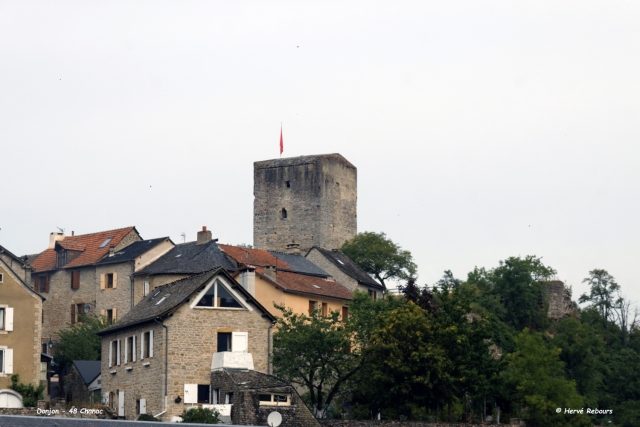
The Château de Chanac is an ancient feudal castle located in the commune of Chanac in Lozère (France). Long held by the bishops of Mende, it was burned during the French Revolution, and since then only the keep, a tower, and remnants of the ramparts remain.
Description+
The castle is on a promontory on the banks of the Lot. It consists of the keep, a clock tower, and remnants of the ramparts. The keep is made of stone, has a square base, and has one room on each floor. It is also surrounded by a moat that connects it to the clock tower. The latter, as well as the ramparts, were made of brick.
History+
It seems that the Crown of Aragon (the Counts of Barcelona, who became Kings of Aragon in 1164, inherited the County of Gévaudan and the County of Provence in 1112) had a castle built on this promontory not far from the fortress of Grèzes, allowing control of access to the Causse de Sauveterre, while having a wide view of the Lot valley. This construction dates back to 1194, during the reign of Berengar IV. In 1220, Guillaume IV de Peyre, Bishop of Mende, is said to have taken advantage of the Albigensian Crusade to take possession of Chanac. He then had the still visible keep built. The bishops then used it as a summer residence for several centuries. During the Hundred Years' War, it was one of the few castles in Gévaudan that was never taken by the English or by the routiers. This was not the case during the Wars of Religion, with Catholics and Huguenots alternately mastering the fortress. Mathieu Merle held possession of it from 1580 to 1581. It can also be seen that the bishops, through Jean de Salas, had the clock tower built at this time. This is one of the oldest known examples in Gévaudan.
During the League, it was the same, Philibert d'Apchier, Baron d'Apcher, held it in 1591 before it returned to the royalists. On August 24, 1696, a large fire ravaged the castle and the dwellings of Chanac.
Source: Wikipedia · Licence: CC BY-SA 4.0 · Image: Hervé Rebours
This description draws on the facts documented in the linked Wikipedia article; Wikipedia content is licensed under CC BY-SA 4.0. Wording and editing: Mobile History.
Location: 44.4673, 3.3437