The remains of the Castle can be visited
CastleChâteau-Gontier
Château de Château-Gontier
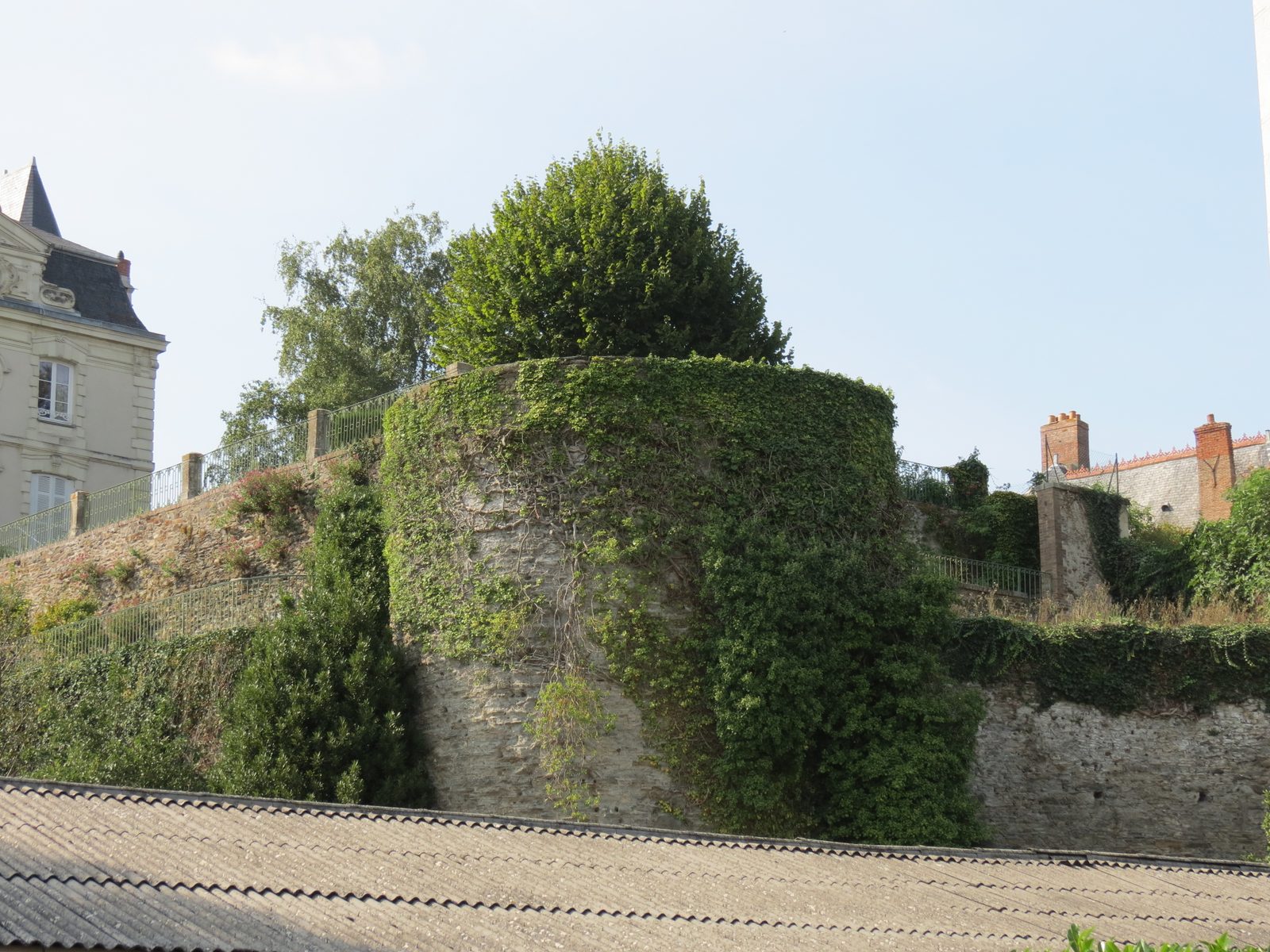
The Château de Château-Gontier is a former castle in Château-Gontier, Mayenne (53). Remains of the fortifications are preserved in the Rue du Théâtre. The remains of the 13th-century castle were added to the list of Historic Monuments by decree of April 5, 1930.
History+
Origin+
The Count of Anjou, Foulque Nerra, gave the estate of Bazouges to the Benedictines of the Abbey of Saint-Aubin d'Angers. The donation of the estate and the church is said to have taken place between 988 and 999. Foulques Nerra granted the abbey all useful feudal rights, census, and vendas. The Benedictines built the Priory of Saint-Jean-Baptiste. Foulque Nerra, who wanted to strengthen his borders with Brittany, decided to have a castle built. Probably to counter the claims of the Bretons, Foulque Nerra had Château-Gontier built at the very tip of the Breton conquest. The founding of the castle and the town itself is at the head of the Cartulaire de Saint-Aubin, which recounts the construction of the castle by Foulque Nerra in the same year as the birth of Geoffroy Martel (1007) in the territory of Bazouges, which the Count had taken from the monks of Saint-Aubin several years earlier in exchange for Hondainville; the guarding of this castle was entrusted to one of the Count's officers, villicus, named Gontier, a vassal of Foulques III Nerra. The charter of 1037 identifies as distinct works:
the construction of the castle by Foulques Nerra, 1007; the construction of the tower, begun by him and completed by Renaud I de Château-Gontier, the first lord of Château-Gontier; the cession of a plot of land, corresponding to a quarter of their court of Bazouges, by the monks of the Abbey of Saint-Aubin d'Angers. First a small fort was built, then a large keep, which was completed by Renaud I de Château-Gontier, the son of Yves.
Town Walls+
Renaud I de Château-Gontier received from the abbot a quarter of his court of Bazouges to include it in the town wall, and promised him to hold it to him and his successors in fidelity and homage, in fidelitatem hommagii. This land, which corresponded to the perimeter of the town, Renaud had enclosed, without leaving his successors the task of extending the enclosure.
Conan II of Brittany+
Conan II of Brittany tried in 1066 to exploit the temporary weakening of the Counts of Anjou and to strengthen his border with Anjou. Towards the end of 1066, the Breton prince, after occupying Pouancé, which belonged to Sylvestre de la Guerche, and taking Segré, advanced to Château-Gontier, which he besieged. The town fell, according to Guillaume de Jumièges. But Conan died before the town on December 11, 1066, allegedly poisoned by a traitor on behalf of William the Bastard, who was suspected of having ordered this murder. The campaign in which Conan died seems to have aimed at restoring the authority of the Bretons in this area, from which the Norman invasions had driven them, by reconquering Pouancé, Segré, and Château-Gontier. The cause of the war was probably the desire to restore the borders of Brittany, which extended from Erispoë to the Mayenne and which the Breton prince had fortified with powerful fortifications, consisting of two ditches and two earthworks, supported at intervals by boulevards and extending from the Mayenne above Bazouges to the Seiche opposite Les Availles [Where?]. There are still serious traces of these works on a line marked by places called "les Miaules", and it is clearly recognizable that the defense was directed against an enemy from the north. It is also known that the Bretons still maintained their influence in this region, which included the Craonnais, in the 10th century.
Middle Ages+
The castle, which occupied the northeastern end of the town, suffered greatly from the English occupation in 1368-1369; in 1414, mention is made of the Chastel anxien à présent démoly.
17th Century+
Several historical works mention that Cardinal Richelieu, on his way back from La Rochelle to Paris in 1628, ordered the destruction of the castle ruins when he passed through Château-Gontier. For Abbé Angot, Richelieu's orders for the destruction of the castle of Château-Gontier must be revised after the study by Emmanuel Marie Félix Chiron du Brossay. Somewhat later, the remains and ruins of the main residence of the lords are mentioned. Underground passages, remains of the old fortress, were discovered during the demolition work. Another house was built in 1731 on the site of the old castle; it still exists.
Take Mobile History with you
You are reading this text for free. Premium adds what matters on the road: descriptions read aloud, sites found through your camera, whole regions taken offline.
- Every description, including the ~17,700 Premium sites
- Audio guide: have descriptions read to you on location
- AR finder: see sites through your camera, with distance and bearing
- Unlimited saved sites
14 days free, then from €2.99 a month. Cancel anytime.
Source: Wikipedia · Licence: CC BY-SA 4.0 · Image: Romain Bréget · Wikimedia Commons · CC BY-SA 3.0
This description is a machine translation of an excerpt from the linked Wikipedia article. The source text was written by its authors, the translation is by Mobile History; like the original it is licensed under CC BY-SA 4.0.
Location: 47.8258, -0.7039