The remains of the Castle can be visited
CastleHambers
Château de Chelé
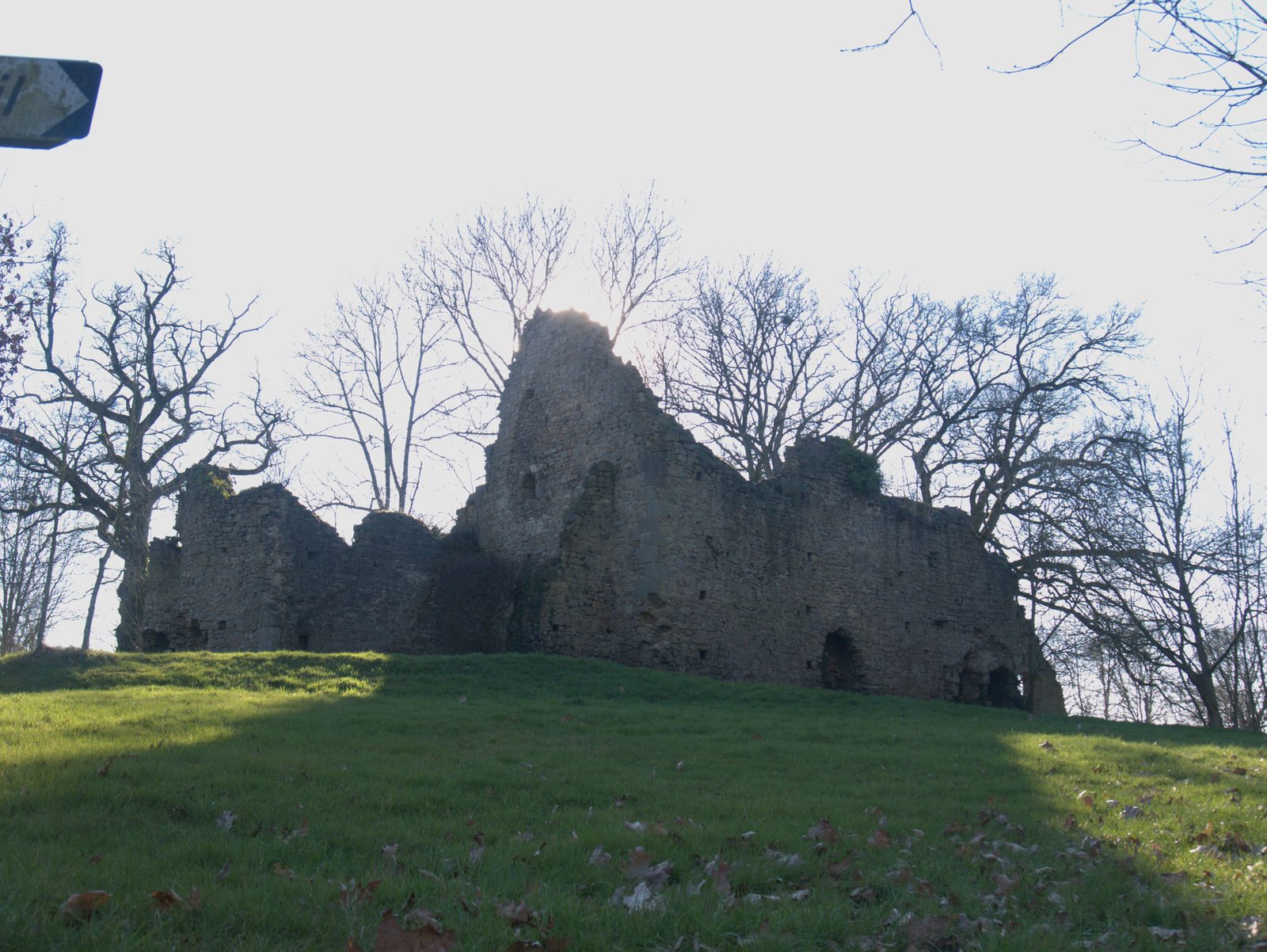
The castle of Chelé was located in Hambers in the Mayenne department. Remains of a significant medieval estate are preserved from this castle:
a Romanesque keep; a manorial residence from the mid-13th century. It is a significant site, possibly preserving the original motte. The Chelé stream, which originates in Hambers, powered a grain mill in the village itself and flows into the Bias stream, also in Hambers; length 2,300 m.
Toponymy+
The old references cited by Alphonse-Victor Angot are:
Loco quæ (sic) dicitur Calviaco, 616 (Testament of Bertrand du Mans); Villam nuncupatam Calgiacum, 989 (Cartulary of Évron); Les dismes de Cheilé, ca. 1200 (Cartulary of Champagne); G. de Cheleio, 1214 (Charter of the Abbey of Fontaine-Daniel); G. de Chelleyo, 1272; G. de Chiélé, 1287 (Chartrier du Rocher de Mézangers); J., dame de Chiellé, 1304; G. de Chellé, 1346 (Chartrier de la Roche-Pichemer); Chelay (Map of Jaillot). Calviacus, Calgiacus have nothing to do with Chelé.
Hamlet+
In Chelé, the oldest traces of human settlement in western France were found: a very dense network of Gallic roads is noted in the region. Important lithic material was discovered on the Chelé site. A monolith is identified as a Gallic stele in the castle courtyard. The Roman road from Le Mans to Jublains runs 1 kilometer south of the village. Chelé is referred to as one of the estates bequeathed to his cathedral church in Bertrand of Le Mans, Bishop of Le Mans', will of 616 and attributed in the 10th century by the Count of Blois to the restored Abbey of Évron. However, the land fell back into secular hands before the 13th century. The remains of an old windmill, a water mill, and ruins of a castle in Chelé are still preserved.
Church+
It was probably the knights named Chelé who built the small church in the 12th century, dedicated to Saint Mark, to which tradition originally attributes parish rights. Only the chancel with a square end remains of the building. The Romanesque arch that separated it from the nave is 4 meters high and 2.50 meters wide; two small primitive windows are preserved; that of the end is pointed, divided by a central mullion; another, in the same style but simple, illuminates the altar to the south; a small double basin is set into the wall on the Gospel side. From a stained-glass window that adorned the east window, a 12 cm figure with a halo, holding a book with two clasps, was still preserved at the end of the 19th century, and has since disappeared. The date 1686 can be read on the paneling, the date 1736 on the door. The most interesting object is a 50 cm high, seated Virgin made of tuff, holding the Infant Jesus, a naive work from the 13th century. The local church was partially destroyed. The nave, which was converted into the Saint-Marc chapel, is preserved. From the Middle Ages until the 1970s, a mass was read there on April 25. A chaplaincy of Our Lady was founded in this chapel at an unknown time, endowed with tithes, about which there was a settlement between the incumbent and the parish priest of Hambers in 1659. Among the chaplains:
Félix Sallion, Bachelor of Canon Law from the University of Angers, also endowed with a benefice of Saint-Jacques in the church of Malicorne, 1560. Léonor-Jacques de la Borde, resigned, 1675. Since then, the incumbents are those of the chapel of the Rock of Mézangers.
Castle+
Chelé, known as manorial land since at least the 12th century, obviously already had a castle at that time, of which no traces remain. The one in the pointed arch style, whose ruins still exist, was built in the 15th century, probably by Marguerite Machefer, around the time she rebuilt the chapel of Montaigu on the estate. The castle was then surrounded by moats, and it seemed possible to flood the surroundings over a large area, which provided an excellent means of defense. It opened through a gatehouse, the oldest house in the Mayenne department (12th century, according to Abbé Angot). This castle was probably built after an older building, of which no traces remain: the castle of Viel. The castle was already a ruin in the 16th century; in 1615, an imposing oak had grown in the main hall. One can still see finely worked stones in the castle chapel, as well as traces of paintings in the main hall. It is the castle chapel and not that of Saint-Marc, which is recorded in the Pouillé du Mans in the 15th century: In parrochia de Hambers, in manerio de Chelé, est quædam capella fundata in honorem B. M. V.. The castle had its still existing pond, a water mill at the overflow (ruins) and a windmill whose walls defy the centuries (view of the Coëvrons). In 1672, things were already in their current state. Manor house, consisting of an old, dilapidated castle, so it is written, of which only the walls remain, once surrounded by moats and ditches, with a building that formerly served as a gate. The estate included the forest of La Boulaie, 30 acres, the heath of Le Pont and the pond of 40 acres, the heath of Mongouin of 200 acres, that of Chelé of 100 acres, with two ponds; the heaths of Montaigu with the chapel, etc. The castellany of Chelé was a vassal of the barony of Sillé. The acknowledgment made on January 23, 1458, lists: the manor house, courtyard and enclosure with the moats, ditches, gate and drawbridge; the ban oven of the market town of Chellé; the hills and valleys of the place Montaigu; the hare and rabbit warrens; jurisdiction, roads and high, middle and low lordship, contract seal. In 1459, its high jurisdiction was disputed, and the lord was summoned before the assizes of Le Mans for having pulled a dead man from his pond without calling justice. But the rights of the castellan of Chelé have since been constantly recognized. René d'Alençon, Duke of Alençon, acknowledges by a deed issued on September 26, 1478, in La Flèche, that the inhabitants and residents of the land of Chelé have the right of use for pasture, firewood and litter in the forest, wood, heaths and consensuses of Langé, by paying 100 bushels of oats to the revenues of Sainte-Suzanne. The land included in 1771, at the sale of the Rocher de Mézangers: the dilapidated castle, presentation to the chapel, mill, pond, lordship of Hambers, La Romagnère, La Dilantière, La Valette, Villoiseau, the coppices, mill and estate of Lingé and Foucault, the fields of Viel, du Portail, du Pâtis, de Jauzé. The castle was listed as a historical monument in 2010.
Lords+
From the Chelé family are known:
Guillaume de Chelé, who exchanged the sixth part of the tithes of Chelé, which Raoul, Abbot of Champagne, had received from Guillaume de Montgiroul, according to his own statement, for some tithes of Hambers, around 1200; Geoffroy de Chelé, who seized the men and wagons of the monks of Évron in the forest of Langé, 1210; he owned in Montourtier a land that had been given to the Abbey of Fontaine-Daniel by Sylvestre de Roupéroux, 1214; Guillaume de Chelé, knight, who acquired various rents after 1281; he made an agreement with the parish priest of Bais concerning a rent that had been given to him on the estate of Plessis, 1272. Finally, Guillaume de Chelé, squire, 1300, who gave part of the mill of Teil as rent, 1326. Jeanne de Clermont, wife of one of the aforementioned, is Lady of Chelé in 1305. Jeanne, Lady of Chelé, buys a rent from Henri d'Orthe, 1304; Guillaume de Chelé, knight, whose sister Mareste de Chelé had married Guillaume de Couesmes, sells 10 pounds of rent on the provostship of Villaines to Hector Machefer, son-in-law of Guillaume de Couesmes, 1346 (Chartrier de la Roche-Pichemer). Hamard du Fournet, knight, Lord of Chelé, is a witness with Jean Anthonin and Henri de Vinen, nobles, to the granting of the right of use in the forest of Langé by Guillaume d'Anthenaise, lord, Baron of Mézangers, to Denis Parator, parish priest, 1331. Since then:
Guillaume de Couesmes receives from Jean de Couesmes, his brother, on the occasion of his marriage to Jeanne d'Averton, the entire land of Chellé, 1392. Jean de Landivy, husband of Marguerite de la Macheferrière, heiress of Jean de Couesmes and Roberde d'Usages, 1402; then the lords of Chemeré until Madelon de Sourches, who sold Chelé in December 1545 for 8,500 livres to René de Bouillé. The lords of Rocher were since then also those of Chelé. Éléonor de Bouillé, knight, Prior of Torcé and Gesnes, constantly bore the title Lord of Chelé.
Take Mobile History with you
You are reading this text for free. Premium adds what matters on the road: descriptions read aloud, sites found through your camera, whole regions taken offline.
- Every description, including the ~17,700 Premium sites
- Audio guide: have descriptions read to you on location
- AR finder: see sites through your camera, with distance and bearing
- Unlimited saved sites
14 days free, then from €2.99 a month. Cancel anytime.
Source: Wikipedia · Licence: CC BY-SA 4.0 · Image: Simon de l'Ouest · Wikimedia Commons · CC BY-SA 4.0
This description is a machine translation of an excerpt from the linked Wikipedia article. The source text was written by its authors, the translation is by Mobile History; like the original it is licensed under CC BY-SA 4.0.
Location: 48.2319, -0.4289