To be privately owned
CastleCherveux
Château de Cherveux
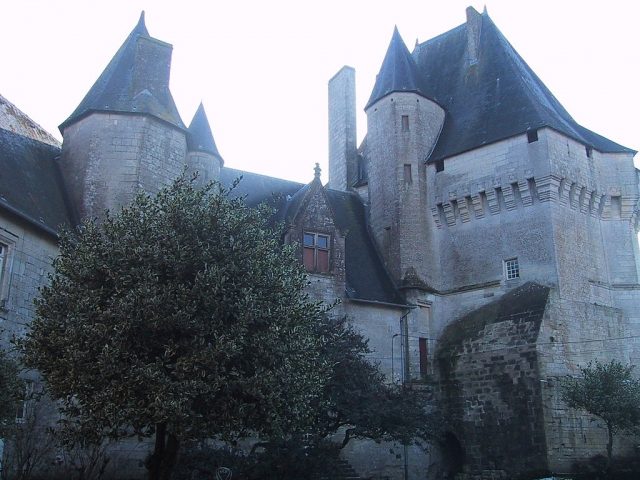
The Château de Cherveux is a castle complex in the municipality of Cherveux in the French department of Deux-Sèvres. Classified as a historical monument, it features well-preserved late medieval architecture and surrounding moats.
History+
Originally a motte-and-bailey castle, Cherveux developed into a fortress under the rule of the Lusignan. In 1242, King Louis IX confiscated the castle from Hugues X de Lusignan, but returned it to his descendants after his submission. The castle changed hands several times, including the Mello, Craon, and Chalons families. Under English occupation in 1363 and after Du Guesclin's victory in 1369, it returned to Amaury de Craon. In 1457, Amaury d'Étissac acquired the castle, which eventually passed to the Chenin family. Through the marriage of Louise Chenin to Robert Conningham in 1440, a Scottish captain of the royal bodyguard, the castle was rebuilt in its current form around 1470. During the Wars of Religion, Cherveux became a Protestant stronghold, but suffered attacks in 1569, 1574, and 1586. After the death of Louis de Saint-Gelais, his son Charles converted to Catholicism and banned Protestant worship. The castle later passed to the Plessis-Chatillon and Narbonne-Pelet families. During the French Revolution, the last Counts of Narbonne-Pelet were guillotined, the castle confiscated, and the archives burned. Access to the moats by local residents prevented its destruction. In 1794, it was sold to Pierre Allonneau, whose descendants owned it until 1931.
Location+
The Château de Cherveux is located in the commune of Cherveux in the Deux-Sèvres department in the Poitou-Charentes region, France. It stands at an elevation of approximately 106 meters above sea level.
On site+
Today, the Château de Cherveux is privately owned and has been classified as a historical monument since 1929. The complex is surrounded by water-filled moats, accessible via a fixed bridge with three arches. A keep with redans and sculpted machicolations, as well as decorated dormer windows, characterizes its appearance. The architecture combines strict geometry with elements. Inside, there is an irregular pentagonal courtyard. Part of the former soldiers' quarters has been converted into guest rooms.
Take Mobile History with you
You are reading this text for free. Premium adds what matters on the road: descriptions read aloud, sites found through your camera, whole regions taken offline.
- Every description, including the ~17,700 Premium sites
- Audio guide: have descriptions read to you on location
- AR finder: see sites through your camera, with distance and bearing
- Unlimited saved sites
14 days free, then from €2.99 a month. Cancel anytime.
Source: Wikipedia · Licence: CC BY-SA 4.0 · Image: http://commons.wikimedia.org/wiki/File:Cherveux_cour_interieure.jpg?uselang=fr
This description draws on the facts documented in the linked Wikipedia article; Wikipedia content is licensed under CC BY-SA 4.0. Wording and editing: Mobile History.
Location: 46.4166, -0.3553