The Castle can be visited
CastleCraon
Château de Craon
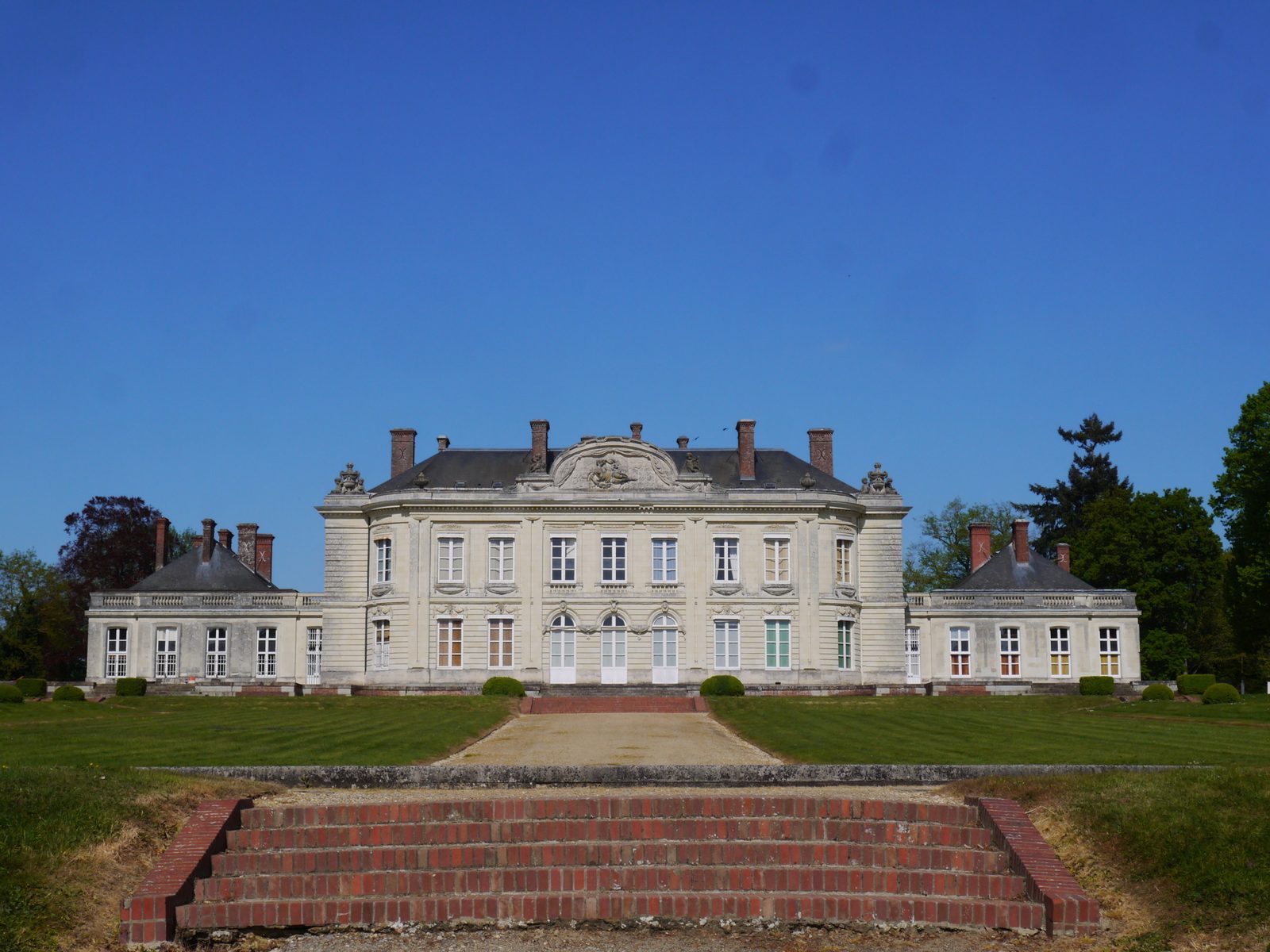
Craon Castle is located in the commune of Craon, in the Mayenne department.
History+
The castle was built from 1773 to 1779 according to the plans of the king's architect and contractor Pierre Pommeyrol (1744-1801), originally from Saint-Julia in Haute-Garonne, by masons from Limousin and Anjou for the Marquis d'Armaillé. Pierre-Ambroise de La Forest d'Armaillé, born in 1734, came from a family of Angevin administrative nobility, married Marie Gabrielle de Mornay-Monchevreul from an old noble family in 1753, and inherited from a rich cousin in 1763. Pierre Ambroise de La Forest became Marquis d'Armaillé, Baron of Craon, Gonort, Puy-du-Fou and other places. He became one of the most important landowners in Anjou and divided his time between hunting in Craon and Parisian social life, attending, among others, the salon of Countess du Barry and owning a box at the Comédie-Française. In January 1790, the Marquis d'Armaillé, feeling threatened, left his castle to the revolutionary troops who were quartered there. He fled to his Parisian hotel. In October 1793, General Charles Marie de Beaumont d'Autichamp and the Catholic and Royal Army of Vendée drove out the republican soldiers of General Chambertin, who returned in January 1794. Fighting took place in the park, followed by summary executions by General Vachot the following summer: the trees were cut down, the stud farm animals scattered, the furniture stolen.[Source required] The lord of the castle was imprisoned in 1794 and narrowly escaped the guillotine. He died in Grigny in 1806, without having regained ownership of the estate. This was only returned to his daughter Marie-Camille (1759-1827), Countess of Cossé-Brissac, on August 28, 1816. Her son Arthur inherited it in 1827. The descendant sold it in November 1828 for 146,000 francs to Guillaume de Champagné (1766-1831), whose family remained owners until Hélène de Langle, successively Marquise de Champagné and then d'Andigné. In March 1943, she achieved the classification of the 42 hectares of the estate and bequeathed it upon her death in 1954 to her nephew, Count Louis de Guébriant (1916-2005), the grandfather of the current owner. The castle was classified as a historical monument in 1971 and listed in 1990. It is open for visits and offers guest rooms and holiday apartments, as well as the rental of reception rooms for weddings and seminars.
Architecture+
Built of tufa, a white stone from Saumur, the castle features a facade with a curved gable and bays decorated with Louis XVI garlands. The courtyard side displays a neoclassical style. A century later, Marquis Alain de Champagné (1874-1918), who inherited it in 1890, commissioned three renowned specialists for its modernization: the Parisian Alfred Coulomb (1838-1929) – who rebuilt the central part of Les Ormes Castle (Vienne) for Count Pierre Gaston Marie Marc de Voyer d'Argenson from 1903 to 1908 – his colleague and partner, André-Louis Chauvet from Nantes, and the sculptor and bronze artist Jules-Edouard Visseaux (1854-1934).
Interior+
On the ground floor are the reception rooms, some of which were redesigned between 1897 and 1900: the large vestibule and its Louis XVI style grand staircase, designed by Jules Visseaux, with a wrought-iron railing made in Paris (1898), whose decorations and capitals of the columns supporting the staircase are the work of two Italian stucco artists who worked there from August 1897 to March 1899. The castle has four 18th-century salons with Louis XVI furniture and beautiful paneling from the late 18th century, as well as a Louis XVI style dining room, but from the late 19th century.
Gardens+
Restored in the 1990s, the gardens consist of a French garden around the castle and a large English park of almost 47 hectares, traversed by the Oudon and lined with century-old trees. The gardens also feature garden houses, a vegetable garden with its 19th-century greenhouses and an orangery, a consecrated chapel, former stables, a laundry room, a 19th-century ice house where snow was collected in winter to store food in summer. A second chapel, the Saint-Eutrope chapel, is visible from the green avenue at the end of the park along the river. It cannot be visited.
Take Mobile History with you
You are reading this text for free. Premium adds what matters on the road: descriptions read aloud, sites found through your camera, whole regions taken offline.
- Every description, including the ~17,700 Premium sites
- Audio guide: have descriptions read to you on location
- AR finder: see sites through your camera, with distance and bearing
- Unlimited saved sites
14 days free, then from €2.99 a month. Cancel anytime.
Source: Wikipedia · Licence: CC BY-SA 4.0 · Image: Simon de l'Ouest · Wikimedia Commons · CC BY-SA 4.0
This description is a machine translation of an excerpt from the linked Wikipedia article. The source text was written by its authors, the translation is by Mobile History; like the original it is licensed under CC BY-SA 4.0.
Location: 47.8527, -0.9504